Monday, 16 December 2013

Monitors: oh look, skills

A slightly tweaked attribute table follows.

Attribute Summary Uses
Agility Perform dextrous feats and avoid physical danger Avoid falling rocks, dodge attacks, jump over chasm, roll under closing bulkhead, sprint through crowd, squeeze through vent, intercept frisbee, ride hoverboard, drive a boat through rapids
Ballistics Shooting, throwing, calculation, analysis Shoot an enemy, throw a stone, determine angle of fire, prep artillery, find cover
Bureaucracy Accounting, bureaucratic procedures, filing, loopholes, organisations, office politics, paperwork, law Spot corruption, exploit procedures, identify appropriate contacts, play officers against each other, apply for grants, forge permits, guess where documentation is kept, interpret jargon, conduct legal case, draw up contracts
Combat Hand-to-hand fighting, with or without weapons Punch, wrestle, kick, headbutt, bite, restrain, stab, bludgeon, disarm
Endurance Perform feats of toughness and tenacity Force-march long distances, swim stormy lakes, remove objects from fire, keep hold of thrashing porcupine, resist disease
Fettle Evaluate, fix, patch or sabotage structures or physical machinery Reroute plumbing, fix weapon, repair fence, fettle engines, cannibalise machinery, patch hulls, reinforce viewports, pick locks, plan demolition, use explosives
Knowledge Knowledge of current events and historical past, archaeology, anthropology Identify obsolete technology, recognise historical figures, identify heraldry, recall political scandal, evaluate ancient sites, identify artefacts, remember cultural taboo, memorise
Medicine Injury, illness, accident, epidemiology, disease, poisons, parasites, drugs Treat poison, treat disease, give vaccinations, stop bleeding, splint a limb, administer painkillers, diagnose insanity, identify medication
Occult Myths, artefacts, magical practices, tomes, sorcerers, spirits Recognise names, perform rituals, identify artefacts, identify a practitioner's traditions, guess intentions
Parley Befriend, bully, startle, bargain, overawe, disdain, bluster, fob off, charm, distress, bluff, empathise, psychoanalyse, impersonate Excuse trespass, impress a crowd, make friends in a pub, bluff past a guard, get a signature, obtain an invitation, avoid a fine, borrow a car, strike bargain, intimidate a thug, detect deceit
Perception See, hear, smell, taste, feel Find spots of blood, recognise repainted car, spot feet under bulging curtain, trace gas leak, detect alien, anticipate chloroform, notice drugged coffee, appreciate wine, detect an intruder, locate a songbird, pick out password, sense vibration, orient yourself
Science Biology, chemistry, physics, geology, astronomy, maths... Develop vaccine, identify creature, plot orbit, identify star system, predict volcanic eruption, find secret mine, synthesise chemical, crack code
Stealth Avoidance, discretion and surveillance Lurk in bushes, evade CCTV, disappear into a crowd, walk silently past guard, remove wheels from car full of mobsters without being heard, carry a weapon undetected, hide a vehicle, apply camo makeup, place a bug, make a hidden cache, stash incriminating evidence away from the cleaners, follow a car
Strength Climb, swim, lift, push, drag, wrestle, throw, run Climb a tree, shin along a beam, pull someone back to safety, bend bars, lift gates, escape from sharks
Tech Assembly, software, data, security, theory, personalities, equipment Build server, write program, follow data flows, track hacking attempt, hack system, manipulate photo, use robotic surgery bay, synch with battlecruiser, identify blogger, pilot mech, hotwire vehicle, disable droid
Will Concentration, independence, tenacity and strength of purpose Ignore hunger, stare down aggressors, remain still for long periods, ignore distractions, resist hypnosis, withstand fear

I've reskinned Guns as Ballistics to incorporate the inevitable throwing of things, with any technical issues handled under either Fettle or Tech. This skill can also be used for things like forensic ballistics or finding safe routes under fire.

The three "resistance" attributes of Agility, Endurance and Will have been slightly tweaked to emphasise active uses, rather than passive ones. I don't want these to shut down player options too much, which is a mild concern; "you can't keep concentrating unless you pass Will" is a potential drawback. The basic idea though is that they let you push past normal limits, so it becomes a case of "you would normally X, but you can try to use Y to ignore that". Obviously resisting spells and other effects is one use, but things like slipping through someone's legs, forcing your way through horse nettles or staying absolutely still disguised as a statue to observe a cult meeting are active uses.

I'm strongly considering cutting out Medicine, especially given the short-term injury model I'm using. These activities, where necessary, could be handled under a mixture of Science (diagnose and treat), Perception (notice symptoms), Fettle (first aid) and Knowledge (general information). As it stands I'm not sure there's much immediate use for Medicine, but it's sort of hovering on the brink. Specific medical training could be a Background trait allowing a bonus on medical-related checks.

The Will, Agility and Endurance attributes will be used for resisting the effects of certain spells, basically because I haven't come up with anything better. In some cases another attribute will be used; for example, Perception may counter illusions. Another feature that may potentially end up being used is the creature's remaining Wounds.

Friday, 13 December 2013

Monitors: quick fix for weapon Strength

Following issues with weapon balance, a possible solution just came to me (and given the time lapse I felt like a new blog post was justified).

Basically, rolling 1 save per Strength made Strength extremely powerful - though this could be controlled by only offering Strength above 1 on weapons that you're not likely to tote around by habit. On the other hand, rolling one save felt to me like it made damage very swingy, especially with high Strength and good saves; you'd be likely to either ping off ineffectually or suddenly do massive damage, considering that wounds are pretty low in this game. Ironically, I could end up with a system where hard damage is binary and soft damage is variable!

However, it come to me sudden-like that you could cap the number of dice rolled at the target's Wounds. Perhaps their initial Wounds? This should:

  • Cap the usefulness of Strength against weak targets, compared to other weapon features.
  • Allow powerful weapons to do variable damage against stronger targets, which is mechanically more interesting.
  • Make it less likely that powerful weapons will ping entirely off tough armoured targets, allowing them to soak some of the damage but still be injured. This feels narratively appropriate and mechanically appropriate, since lugging heavy weapons around is a pain and should be rewarded.
  • Make it "cheaper" (balance-wise) and therefore easier to incorporate weapons of variable Strength, potentially allowing a more interesting selection of gear.

Thursday, 12 December 2013

of Adventure!

Rapid-fire idea again. During a fairly ridiculous evening, the idea of an Enid Blyton-like game somehow came up.

As I recall, it was something like:

  • Pixar do loads of interesting films about male protagonists doing all kinds of fun things, but their film about a girl is substantially about Being a Girl.
  • Things are very rarely about Being a Boy.
  • I wondered what a Being a Boy equivalent of Hellcats and Hockeysticks would be like, and would be genuinely interested to see a take on fictional Being a Boy. I don't believe (borne out by female friends) that Hellcats is an accurate depiction of girls' schools (nor was it intended to be one), but what would the male equivalent pick out from the school experience? I'd like to see what was highlighted as core aspects of boyschoolhood.
  • Suggestion that the boys' equivalent would be grounded on things like Just William, though we don't think this would work as there's no real party structure for William most of the time, just a few NPC allies. Enid Blyton?
  • The Famous Five come up, but we notice they are all related. Someone suggests the Secret Seven, who aren't all related, but there are more of them than in a typical gaming group. Five Find-Outers? The .... of Adventure books come up. We can't remember if they were related or not, but they had a parrot.
  • Idea of game based on this sort of thing. I get carried away, as usual. After some naysaying, I suggest that we don't need to stick entirely to Blyton canon, and can probably ignore the classism, chalk-whiteness and fossilised attitudes of the actual books and just try to play with the fun bits.

of Adventure!

A group collaboratively build their mascot. If they really want, they could build more than one, but don't get carried away. Dogs are the most common mascot, but parrots, monkeys and so on are also good. Your mascot should ideally not be such things as A Girl, A Working-Class Person or A Homeless Man With A Strange Bond With Nature.

The mechanics should probably just be a simple system of dicepools and adjectives. You gain bonus dice for acting according to your stated character as long as it's at least vaguely related to what you're trying to do. Note that your adjectives don't need to make you better at the goal of the action in order to gain the bonus. For example, if you are ripping off Anne from the Famous Five, perhaps you are captured by smugglers (it's not likely, because as Anne you never get to do anything interesting, but just suppose). Anne might decide to meekly do some chores around the den while looking for a chance to escape. Because she is Domestic and Meek, the smugglers are easily convinced by this and she gains a bonus to her rolls for finding an escape route.

Having slept on it, I remember that my family actually played Enid Blyton pastiches for many years as in-car or holiday entertainment. You start with the Famous Five doing something, and take it in turns to "continue the story using" X, Y and Z. At some point one of these would inevitably be a pair of pants.* This is probably the most rules-light RPG I have ever played, and we started when I was old enough to know any Famous Five stories. Which just goes to show that RPGs are indeed good wholesome family entertainment that anyone can enjoy. Or something.

For any American readers, pants are an item of underwear, and should not be confused with kecks.

Skeleton Ruleset

Character generation

You create a Young Person to play. Adults do exist in the Blytonverse, but are not appropriate player characters.

Good Points

Everyone has five points to allocate. Use these to emphasise character aspects that should come into play. You can of course have as much other description as you want, but this won't provide mechanical bonuses. They are generally admirable traits, skills or interests.

Good aspects might include:

  • stubborn ("pig-headed", if you want to stick with the theme)
  • interested in science
  • fond of dogs
  • well-behaved
  • inquisitive
  • athletic
  • plucky
  • good at sailing
  • a natural leader
  • a good actor

Some things are accurate Blytonisms, but probably not good for play: there's not that many ways to use aspects like Fat or Ingenuous. Personality traits perhaps shouldn't be aspects unless they're likely to be mechanically useful, and are better portrayed with roleplaying. I allowed Stubborn because persistence is mechanically useful and Plucky because showing pluck is both Blytonesque and easy to apply as a bonus; however "irritable or "sensible" aren't easy to use.

You get a bonus die whenever you make a convincing argument that one of your aspects is relevant. You can use any number of aspects simultaneously.

Bad Points

Everyone must pick a weakness. It's entirely possible for your weakness to also be an aspect; Stubborn can be both a benefit and a drawback.

Antagonists gain a bonus die whenever your weakness is relevant. For example, if you are Timid, they gain a bonus die to intimidate you into revealing information.

If you can find a way to use your weakness as a strength, go right ahead.

Mascot

The group collaboratively builds a mascot (some kind of pet), or more than one if they want, although having more than two is likely to get pretty out-of-hand. Each player can contribute one point to the mascot to define one thing about them. Unlike human characters, all significant abilities of the mascot require a point; they don't get freebies just because you decide that your mascot is a parrot-squid crossbreed and should be able to reproduce human voices, manipulate complex objects and slip bonelessly through small spaces.

For example, Timmy the dog is Brave, can Swim and Barks Fiercely. Kiki the parrot can Fly, Imitate Speech, is Small, Clever and can Manipulate Objects.

The story

I'm inclined to say this one should be a GM-less thing where everyone picks a generic Blytonesque adventure they want to play in (Smugglers in a Circus, Mysterious Island with Scientists) and then suggest twists as they come along.

Play proceeds in arbitrarily-defined Chapters in which a Thing Happens. One player is the Baddies and controls the antagonists during that Chapter, as well as having final say on introducing any twists or plot elements. While being the Baddies, their character should probably fade into the background. A Chapter doesn't necessarily feature all the characters; it might feature only one. Decide between yourselves when a Chapter ends; they should be relatively short. Everyone else should feel free to chip in with ideas unless they become annoying, in which case they should let up a bit.

Adventure!

Roll a d6 to try and achieve things that are significant or interesting. You get a bonus die whenever you make a convincing argument that one of your aspects is relevant. You can use any number of aspects simultaneously. You can also gain a bonus die if the situation makes your attempt easier. Make sure you make it clear what you're trying to achieve first, because it's not a very fine-grained system and it's annoying for everyone if you think you're doing one thing and the Baddies player thinks you're doing another.

There are three difficulty thresholds: 3, 6 and 9. These are chosen semi-carefully (I thought for several seconds) so that they allow for varying difficulty and dice pools. A 3 is straightforward for anyone and trivial with any advantages; a 6 is difficult without an advantage but straightforward with; a 9 is impossible without an advantage, fairly difficult with one, and fairly straightforward with three. Obviously it's possible to have more than three dice, but in general I'd expect one aspect plus one situational bonus to be the most common achievable pool.

If you roll the number or better, you get more or less what you wanted, or at least something appropriate depending on the natural consequences of your action and what's interesting. Rolling well might let you succeed even more successfully if it seems appropriate.

If you don't reach the difficulty number, you don't get what you wanted. Depending on what you're doing, you might just fail ignominiously, or something interesting might happen as a consequence. Rolling particularly badly might result in a particularly hilarious or disastrous consequence if it seems appropriate.

Genre rules

A few rules are necessary because of genre expectations.

  • Nobody gets killed onstage, and very few offstage
  • A child fighting an adult either flees or is captured. However, children may be able to create a situation in which they can overcome an adult. A group of four or more children can capture one adult. Adults can capture one child per free hand.
  • Bullets never hit anyone, which doesn't mean guns can be ignored. Simply interpret the rolls according to genre; for example, Bobby attempts to flee from the crooks but stops short when a warning shot spangs off the wall nearby.
  • There is no damage mechanic. Injuries are rare. Determine the effects of injuries as seems appropriate; the most likely are twisted ankles. Injuries are quietly forgotten about when that seems like a good idea.

There you go, 10-minute RPG written.

Bringing Back The Funk(ing Investigators), part two

Following on from last time, where I set out the problem of PCs having run away from a scenario, let's look at some ways your group might resume play. There will be bullet points, oh yes.

Re-involvement

I’m only going to talk about tactics for the last two (and a half) options I mentioned last time, so situations where either:

  • the PCs just don’t know how to proceed or have managed to wander away from their goal, but the players would like to get back on track; or
  • the characters are discouraged because it’s too dangerous, too unpleasant or too much for their frail human minds to handle.

Uninterested players or characters are a very different issue and not something I can deal with here.

There are a few different broad types of tactics that I can think of, each with their own advantages and disadvantages, which I’ll group in three types:

  • bringing the PCs back to the plot
  • bringing the plot back to the PCs
  • letting things lie

The main distinction I'm drawing is how strongly youse enforce the connection between those specific individuals and the events, places, items or people that form the Plot. Each approach has advantages and disadvantages and I'm not saying any of them is right or wrong; it depends a lot on context, on what your group want to do, on whether you used any of those ideas recently, and so on.

Bringing the PCS back to the plot

U-turn

One option is very simple: you and the players agree that the PCs will change their minds (or even retcon previous events) and continue the investigation. This is straightforward, quick and easy, and those are advantages not to be underestimated.

That being said, the U-turn may feel arbitrary or directly contradict the personalities you’ve established for the characters, and that might undermine your enjoyment of the game. Sometimes it might work fine; maybe the PCs have a chance to calm down, rationalise a bit and work themselves up into a more go-getting frame of mind, or indeed accept their fate and confront the enemy out of sheer contrariness. At other times it’s just going to grate or encourage (unwanted) metagaming. Different PCs (and players) will allow different amounts of leeway for this sort of thing.

This sort of thing is highly genre-dependent. In a Dick Barton-style adventure game, it's odd for the PCs to break and flee at all; only tactical withdrawals are allowed. In something grittier but still heroic, PCs might well be scared off, but only to regroup and return more determined than ever. So the expectations of the game will strongly affect how players feel their characters should behave. The system can also be a factor, but in general a given system can be used to run a variety of genres and moods.

In some games, you might also legitimately have colleagues, superiors or allies straight-up tell the PCs to get back to their mission, either because it's their job damnit!, or because the Prophecy is too important to neglect, the Electric Cowboy too dangerous to be on the loose, or "it's not like you" to give up so easily.

Wait a minute!

A bit more subtly, you can (as a group or as GM) think up in-character reasons for them to take up the original plot again. These might be reasons they’d temporarily forgotten: a lead previously overlooked that suddenly prods someone’s subconscious, remembering that one of the cult knows exactly where you live, or suddenly realising that a plan to release an alien god from its slumber under the mountain will destroy the mines that provide your entire family’s income and leave you a penniless wretch, because nobody will fork out the insurance money. Maybe they read a tome they picked up and realise just how terrible the cult's plans actually are: is being killed by demons as you raid the temple worse than being killed by demons in your own kitchen a week later when the portals to Hell open?

A variation on this approach can be used to restart stalled scenarios, by having a character spot some piece of information they'd overlooked or make a sudden leap of logic. This is perhaps particularly sensible if the players have a good idea how to proceed but their characters are stuck. I don't really want to get too heavily into that stuff here, as it's opening a new can of worms really, like scenario design and GMing techniques. However, if you have wound up with the characters baffled, sudden recollection of an important clue is an absolute classic of fiction: the scrap of paper on the noticeboard, the face glimpsed on the stairwell, the long-forgotten Elvish lessons, any of them is fair game to suddenly well up from the PC's subconscious and get things moving again. Perhaps, wandering frustrated through the palace, they unconsciously count their steps and realise this room is suspiciously short compared to the next... a secret door? A small amount of GM narration can be an acceptable way to shift the logjam.

New motivations

Alternatively, you might think up new reasons to introduce, which cause them to change their minds. This has the advantage of providing in-character motivation, so it avoids the arbitrary feel of just saying the characters change their minds. It's not necessarily difficult to add in some light character development that alters the balance of motivations; personal matters could change their perspective on a situation without necessarily relating directly to the plot.

  • The classic "NPCs remark on how brave and noble you are, cue enormous guilt as you prepare to flee"
  • A shortage of new contracts means this case is the only way you have to keep the loan sharks off your back
  • You learn that the troll shaman defiled the altar of your god; you must seek revenge!
  • An NPC you care about is liable to be harmed by the case, without being directly drawn into it. Maybe they're keen to invest heavily in Innsmouth waterfront properties, or marry their daughter off to the Duke (he seems a decent sort, good prospects).
  • The benefit you expect to get from succeeding turns out to be a heck of a lot bigger than you originally though. Maybe a new bounty is posted, or you learn of a valuable item owned by an antagonist. There could also be major social or personal benefits to be gained - this is partly down to the system and player preferences.
  • A counter-threat appears which forces you to take on the challenge. This has been used in loads of fiction, from the poison implants in Neuromancer to crime bosses holding your family hostage until you deal with some job for them. It doesn't need to be a direct personal threat though, only something that makes the danger posed by the original situation seem worth facing.

However, it might be easier (or more believable in-character) for the PC to feel guilty but keep away, than to go back to face probable horrible death. Also, these could feel rather heavy-handed, even when they're deployed by general consent.

For an indirect option, you might find reasons for the PCs to be exposed to the mystery again, without forcing the investigation itself on them. The doctor has to go to Cultville on an urgent medical case; university high-ups (or worse, funding bodies) want to see the professor’s research progress on that artefact; coming out of the station, you’re convinced you recognise the sorcerer getting into a cab, and hear him give an address. This gives the PCs (and the players) the option to make an in-character decision to get involved again, without being too heavy-handed about it. It could work well as a chance to return to the case after a break playing other scenarios, but if the players don’t really feel like biting, or if it really wouldn’t suit the characters, they can pass up the opportunity and do something else. This may be a sensible approach if you're not sure whether the players actually do want to get involved again, as it can be worked in relatively naturally and give them room to say no. Although you could just ask them!

A-wandering

If the group has simply wandered away by following up red herrings, getting distracted or making a series of decisions that somehow left them dealing with completely different issues, then it's possible to have an in-character discussion about that. There are definitely precedents in fiction for the protagonists giving themselves a good talking-to when they realise they've forgotten the their original purpose (although it often involves realising that an enemy has misled them).

Some of the options I just mentioned above also usable here, since they provide an in-character way for the PCs to regain interest in the original issue.

Bringing the plot back to the PCs

A different approach is to bring the plot to the PCs. Again, this can work whether it’s leads or character motivation that are lacking. The idea here is that youse don't have mess with PC motivation or retcon their decisions, because whatever they decided to do, the plot crops up again and gives them another chance to bite.

The most straightforward option is a blatant chunk of plot.

  • One of the PCs is kidnapped and taken back to Cultville.
  • The alien artefact begins to glow and hum in a deeply disturbing way.
  • The neighbour you're damn sure is a vampire sends one of the group an invitation to a party.
  • People with marks just like the cultists start following the PCs on the streets.
  • Another hook comes up, which turns out to connect back to the abandoned plot.

Again, this sort of thing is simple and obvious, so neither players nor PCs can miss it. On the other hand, it’s heavy-handed and players might find it cheesy or too much for their suspension of disbelief. This is a relatively strong option in more actiony games, since it's easy to accept that if you don't clear out the bandit lair, they grow bolder and begin raiding villages like the one you're staying in. The last option may work well in games with fairly active protagonists (who expect to deal with multiple problems in their careers) and where larger-scale problems are likely (such as conspiracies, enemy alliances, evil influences and so on). In one-shot games with fairly ordinary protagonists, having them encounter two different plots may seem a stretch, at least until the connection is revealed.

For the moderate option, bring the plot back into contact with the PCs, but not in a way that forces them to embrace it.

  • Someone turns up at the university offering to buy the artefact, claiming ownership of it, or on a sabbatical to study it.
  • You were masked when you burst into the temple, so you’re pretty sure your charming new neighbour doesn’t recognise you, but you’ve seen that face over an altar and heard that voice screaming praises to Tsathoggua...
  • A wandering seer stops the party in the street and reveals a vision about the undead stirring in the ruined city; a vision that gives them some clues on how to succeed this time.
  • Information comes onto the market about the EvilCorp project, if you're willing to pay for it.
  • NPCs begin their own preparations to deal with a problem, leaving obvious opportunities for the PCs to support them.

These give the PCs and players an obvious jumping-off point for their investigations to resume, but give them an awful lot of freedom in how to handle the situation.

There are also some light-touch options, though some are genre-dependent.

  • Cryptic dreams (or visions?) are a staple of occult fiction. The sci-fi equivalent might be mysterious signals or data points indicating that something's important, or even the files relating to a situation sitting around on your screen and reminding you that you never resoved it.
  • More or less any setting supports odd news items or bits of gossip that, with what the PCs know, points to more sinister things going on than others realise.
  • Strange people, creatures or goings-on are reported somewhere just off the beaten track.
  • Strangers making cryptic remarks, apparently recognising you, blatantly leaving items for you to pick up, and so on.

These are all things that might lead them to take action, but also leave them plenty of room to stay the heck out of things.

There is a problem with all three of these options that doesn’t apply to the others. Actually, it’s two problems on opposite sides of the same coin, which allows me to summarise it glibly:

  1. You risk making the characters too peripheral
  2. You risk making the characters too central

If the plot relentlessly pursues the characters, their actions and decisions are less important. This is not quite the same as railroading, because you’re not forcing them to fit the plot, but bending the plot around to fit them: a second playthrough might not produce remotely the same story. However, consciously or otherwise, it seems liable to make players feel less involved. In my original forum post, I compared this to playing a computer game with a walkthrough to hand; it’s probably more like playing a classic point-and-click with a hint system turned on. Of course you can work things out on your own, but (if you’re like me) you tend to gravitate towards relying on the hints as soon as things get difficult, rather than taxing your brain too much.

Getting out of the metaphor and back to the topic at hand... If the GM always brings the plot back to the characters, even when they wander off track or get too freaked out to keep investigating, then you don’t need to be as mentally involved in the story because you can’t lose it. Meanwhile, your character’s personality and decisions get subordinated to the plot, which may undermine your involvement again. I feel this is slightly different to the usual tacit agreement that Plot in general happens around PCs, because that's more a case of opportunities occurring around them and players deciding what use to make of them.

On the flipside, if the plot relentlessly pursues the characters, they may become too important. If the PCs are not intrinsic to the plot, and their enemies have no special ability to track them down or no special interest in doing so, it can seem forced.** You can end up with a situation where everything revolves around the PCs, rather than events simply happening and PCs interacting with them, and that can undermine the verisimilitude of the scenario. This can again lead to disengagement with the scenario, because the PCs become so important that whatever they do, the plot will follow them around. Deliberately or not, that tends to invite faffing and doing things that are not really appropriate because you know the plot will accommodate you. Here, the plot gets enslaved to the characters.

** If you are just playing relatively ordinary people (be they adventurers or not) but just happen to stumble across machinations of the Sapphire Cult no matter where you go, it's going to start seeming weird unless the entire setting is based around the Sapphire Cult. What are you, the Famous Five?

Obviously, there are plenty of situations where plot should follow the characters: PCs who have overtly interfered with antagonist activities and are known to be a threat, or who have something that someone wants. In some of situations, it’s appropriate for the terror to be something inescapable, either because that is the whole point, or even because the PCs are intrinsic to the plot. For example, anything involving curses, bloodlines or possession; PCs who’ve read the Revelations of Glaaki, manipulated the Shining Trapezahedron, spoken the name three times, or attracted the attention of the Hounds of Tindalos. If they have acquired certain artefacts or knowledge, they become targets. And of course, you could be playing a game where the PCs are explicitly really important for some reason and everything is all about them. But that's unusual.

Letting things lie

The last pair of options is hands-off. The PCs have given up on the story, either because they just ran out of leads, because they’re injured or in prison or otherwise unable to continue, or because one way or another they’re too scared to carry on.

End of Book One

Firstly, you can accept that as a legitimate end to that particular chapter. Leave the PCs alone to nurse their injured bodies and minds, and (maybe after a break) follow up with a sequel, dealing with the fallout from the situation as it stands, using different PCs. It might be days later, or even overlap the previous scenario if you're all feeling creative. On the other hand, it might be decades or even centuries later. It might take place on a different continent. The previous party might appear as NPCs, or leave cryptic diaries, or artefacts in a Swiss bank vault; they might even be subjects of rumour and myth for the new party to filter for truth.

This has the advantage of supporting and validating the players’ actions, decisions and choices, without insisting that they follow a predetermined plotline. It should encourage roleplaying and be beneficial to the group as a whole (in a nebulous way). You also get to indulge your creativity in seeing how the situation as it stands would progress over time - this could be a lot of fun if you're riffing on a published scenario, but may be a pain if you lovingly wrote it yourself. The players get to see the scenario from a new angle, with the benefit of whatever experience they’ve picked up so far. The adversaries' early success may help inspire both players and PCs to foil them this time.

They can also use their existing knowledge to build PCs that are more appropriate to the scenario, which can be a particular help if it featured problems that the PCs were unsuited to in stats or in fluff. There's no reason a priest can't partake in a crime-heavy scenario, but if you want that character to stay on the level, a swap is a good idea. Ideally a GM will have forseen major mechanical issues, but they aren't always obvious. Depending on the game in question, they might also re-equip to deal with specific threats, or even recruit some hirelings with skills that will help them overcome particular problems. Particularly if an enemy isn't really aware of who they are, the party may be able to set plans in motion to deal with them more indirectly. In a range of games potentially including Call of Cthulhu, they might actually be able to hire assassins to take out an enemy. More subtly, there could be financial or legal machinations that would hamper the antagonists and leave them vulnerable; getting the temple condemned and closed for Health and Safety reasons could set them back for months.

A disadvantage here is that some of the work you’ve done preparing the scenario and creating interesting events may be wasted, if you can’t use it in the sequel. You might run out of new and interesting sinister happenings, or original ways for the antagonist to cause trouble - though to be honest, rehashing the same tactics is fairly likely, especially if they worked before. You might even have to give up on the plot itself, and develop a new one that can evolve from the situation as it stands. Nobody likes to give up on a good story, and that might apply as much to the players as to the GM. They may find they're less sold on the new incarnation of the plot than on the original one.

The Ones That Got Away

Finally, you could stop the scenario right there. The end. Your Investigators have come, they have meddled in things of which man was not meant to know, and they have recoiled in horror. Or, depending on the reason for dropping the investigation, they have found a mystery, been disturbed and baffled by a series of horrific and inexplicable events, and never found the truth behind them. Either of those can actually be a good, satisfying ending. They could also be frustrating for everyone involved, because the Keeper's work on the plot is wasted (unless you can reuse it) and the players don't get to see what would have happened or the pleasure of solving the mystery. For world-spanning conspiracies or doomsday scenarios, it may also be unsatisfying that nobody else tries to intervene.

In other genres, the party might realise that they are not powerful enough to defeat the Iron Queen, and scatter to spread tales of her terrible might, leaving the burning town behind them. The scouting ship may settle for escaping the weird planet rather than resolving any of its weirdness, having seen the cost of trying. In a social game this may be more problematic, depending on the nature of the original plot, because you're likely to keep dealing with the same characters; however, it's still possible for the antagonists to stage a coup, destroy an ally of the party or otherwise wreak irreperable havoc, without ending the whole campaign.


Next and last, I'll briefly (he lies) look at why resuming the scenario might not be the best option.

Tuesday, 10 December 2013

Bringing Back The Funk(ing Investigators), part one

This set of posts is based on some I made on YSDC a couple of years back. I'm doing some clean-up on them after a server move and though this set might be worth dusting off, revisiting and giving a bit more attention for a more general gaming audience. Basically it's about how to respond to the PCs not just wandering from the plot, but actively running away from because sh*t got real, man. It will still tend to be heavily mystery-centric and fairly Cthulhoid because that's how it started out.

The original posts were based on this forum thread and I'll re-post key content to protect against the next server migration.

Sorry it's long; click to skip to the end of the quote

The Investigators left. Now what?

Posted 25 July 2011 - 04:39 PM

Or; Why become a cultist? And what to do when you've won?

Or; Those aren't really my questions. Well, sort of...

(Oh man, this became looo-oong...)

Here's the deal:

I ran a scenario for my group. The ending was not carved in stone, there where at least four different outcomes I could think of. The players came up with a fifth. They ran!

Later, I told them I could do a sequel if they went back. I needed to know why they went back, so I could plan around that. No one could come up with any reason to go back...

I still want to do a sequel, but I'm stuck. So I'll shamelessly throw my stuff up here, and see if someone is kind enough to come up with ideas for me.

Background (which the players found very little of, so some of it can be changed)

1840s: The young Jemimah Ordway was unable to give her husband children. In here desperation, she was tricked into worshipping The Black Ram of the Forest (i.e. Shubby). This got her pregnant, with a three for one deal. As an added bonus, the surrounding countryside grew more fertile.

When Jemimah realized that her triplets where tied to the thing she worshipped at the black altar, she tried to turn her back on The Black Ram.

Dark Young where unleashed on the countryside, Jemimah was blamed, and burnt as a witch. The local priest, who knew stuff guys shouldn't know, used the blood of Jemimah's three daughters to bind the Dark Young in a ritual.

Unfortunately, he messed up the ritual. The Dark Young where contained beneath the ground, draining the countryside of its life. And even worse, Jemimahs descendants where forced to make yearly blood donation at the burial mounds to keep them there.

The Scenario

1930s: A few generations later, enter a coven of wannabe witches, who are basing their “studies” on the witch who got Jemimah into this. Also, enter the Investigators, who didn't at all suspect the coven, but instead assumed that they where also Investigators and/or cannon fodder.

Together they searched the decaying village of Dewsbury and its withered surroundings, before they found the three burial mounds. And started digging. The released Dark Young was so weakened that they where able to (barely) defeat it. But the Investigators decides to bail, while the coven pretended to do so.

And there we are. The Investigators are gone. The villagers are even more devastated and scared than before. Meanwhile, the coven knows where two Dark Young are buried. And once they search a bit more, they will find the blackened altar of the Black Ram of the Forest.

The few ideas I have (that are in no way carved in stone):

The coven will find out that throwing yourself on the altar at nigh will result in a sanity blasting and (regardless of gender...) quite impregnating visit from The Black Ram.

Combine this with the release of the Dark Young, and the countryside will become “healthy” and quickly start growing again (even though its late autumn). This might require the sacrifice of some villagers...

Anyway, what does a coven of witches do in this situation? Just sit tight and pretend everything is golden? Expand? Go nuts?

And how do I get the Investigators, who are hiding in Arkham, to come back to have a look at this?

All I've come up with is having a (now pregnant) male member of the coven defect and come to the players. He'd obviously die while giving birth to... something... during the visit.

But having people mysteriously visit the Investigators is getting a bit old. 2 out of 3 adventures with this group have started that way, with the third having some ties to their hang out...

Hmm... my few ideas expanded somewhat as I was typing. Might be something useful there, at least...

But please, don't let that comment stop you if you've come up with something!!!

I'll end this with throwing in a quick description of the coven members that were present:

Bethany Stather: Broke into the Investigators place, her death got them into this mess.

Father Nathan Barnes: A sociopathic priest who terrorized his flock with blackmail. Now recruits coven members from said flock. One of the covens top dogs.

Edward Kippen: Small time thief, brought in by Barnes' black mail. More errand boy than believer. Possibly pregnant nowadays...

Dale Bradford: Asylum orderly, happened to be present when the coven started. Thinks of himself as a leader because of that, while everyone else treats him as muscle.

Claire Belham: A society girl whose main function in the coven is recruiting. As a city girl, she didn't fit in very well on this very rural mission.

Those where the one present, though others should have been called in by now.

Anyway, any ideas are very, very welcome!

In short, OlderNick posted about a game where the Investigators fled the scenario altogether after discovering the secret of the village. He was interested in ways to do a sequel investigation, and the assumption seemed to be that this would mean getting the same Investigators back into the mystery. In this case, it didn't sound like just a Keeper trying to corral players who've lost interest, but a team effort to get back to the game without just handwaving things.

I posted a couple of things at the time, and eventually decided it was interesting enough to merit a longer exploration of the topic, using OlderNick's situation as an example.

And how do I get the Investigators, who are hiding in Arkham, to come back to have a look at this?

So how do you get Investigators to come back to the site of horror, and is it actually your best option?

Let me just self-indulgently quote myself for a minute, because I think I phrased this pretty well the first time:

Your Investigators went to investigate a mystery, got freaked out by horrible supernatural events, and ran for their lives...
The terror has emerged, they’ve survived and dealt with the immediate threat, and scuttled off to hide...
They are scared, most likely mentally scarred (and perhaps physically scarred) and hopefully impressed with their own puniness and smallness against the horrors that lurk beyond our ken. Let them cower behind locked doors; let them tell stories when the gin they crave to drive away the horror loosens their tongues; let them shiver inexplicably when they walk past a mound and shun forests and whisper words of warning to sceptical friends.

In this specific situation, I felt it would be a more... powerful? interesting? fun? idea to leave the Investigators be and close off this scenario here. In the film version, this could be the final escape shot, the surprise twist cultist-in-the-back-seat ending, or the protagonists in a bar fifty years later clutching bottles of gin. This isn't necessarily an end to the story altogether (that's where sequels come from), but a firm end to this particular chapter. However, there are lots of factors that could influence how you decide to proceed from this point.

Why did they leave?

I think the first thing to establish is why the PCs have left the plot (which might mean physically leaving the area, as in this case, or just abandoning their investigation) and how that relates to the players. Similar concerns may apply to some non-investigative plot threads, such as fetch quests.

  • The worst case would be that the players just aren’t interested in the plot, so they don’t feel any particular inclination to pursue it. At that point, you need to think about making serious changes, or just moving on to a new scenario. It could be an intrinsic problem with the plot not matching the group’s interests or expectations (too clichéd? not clichéd enough? too technical? too subtle? too stomach-churning?), or it could be the way you’re presenting the scenario and another approach might work wonders.
  • A related but healthier situation is that the players are interested, but their characters don’t have much motivation to keep going. It could be they’ve just got the wrong kind of characters to be interested in the mystery in question: rich aristocrats won’t find payment much incentive for grimy and dangerous investigations, and homeless muggers have other concerns than elaborate plots by mystic scholars to influence the political system. Alternatively, it could be that the clues or events so far aren’t what’s needed to draw them in, but they’ll be motivated once you find the right hook.
  • The third possibility that strikes me is that the players, or the characters, don’t know what to do. If they run out of clues and leads, then wandering home or going back to the day job might be the obvious thing to do. Or they might have lost track and started following red herrings. At that point you should still be able to get things moving again.
  • OlderNick’s example is a different thing again. The characters themselves have lost motivation to keep investigating, not because they’re bored or out of clues, but because they found out too much and are terrified. They have very strong motivation to drop the investigation like a hot potato and avoid the whole business. In this case the problem is horrendous non-Euclidean truths, but in another genre it might be realising the Mob are involved (and you're an average Joe), uncovering evidence that the President is part of a secret werewolf conspiracy and then finding bugs in your fountain pen, or working out that the Duke is planning a coup and you really don't want to be forced to pick sides.
  • In another genre, you might find similar issues cropping up if the PCs feel overwhelmed by the opposition in a particular enemy stronghold, get stymied by a devious dungeon full of secret architecture, or are all playing retired planetary governers who really have no reason to do grunt work for a corporation.

In general, so long as the players and GM are invested in a particular plot strand, it’s worth trying to keep things going. However, there are various kinds of changes you may want to make to oil the wheels.

That doesn’t necessarily mean keeping the same PCs. In fact, in some situations it’s much better to roll up new ones. If an character isn’t a good fit for the scenario and loses interest, the game will probably go much better if you replace them; I don't think "incompatible motivation" is that different from "incompatible concept" or "incompatible morality", if it makes it difficult to play the game you want to play, then change something. Changing the whole party is a bit drastic, but Call of Cthulhu is the kind of game where that's not such a big step - even if you play campaigns, you could well let your usual party start a scenario, then step aside when it turns out not to suit them, and let someone else take over. In another genre, this may feel like more of a problem. Broadly speaking, the more work required to create a character, the more reluctant I suspect you'd be to do that.

If the characters are just terrified, then it really depends what kind of game, genre and scenario you’re running, and how much your group is invested in character concepts versus handwavey metagamey considerations, which is what I'll discuss next.

Saturday, 7 December 2013

Gang Aft Agley

I had planned to spend some time this weekend thrashing out the vexed issue of spells and tech, hoping to come up with some concrete proposals for a dozen or so of each to give that cyber-sorcerer feel. As luck would have it, I have mostly spent Saturday not on long (and Monitors-productive) bus journeys to visit friends and family, but slumped on a settee surrounded by tissues and Lemsip, doing nothing more taxing than listening to podcasts with my eyes shut or shuffling across the road to buy milk. My brain isn't really functional enough for any complicated thinking on account of the alien goop that appears to have filled my skull cavity and whose faint, lullabetic humming leaves me nodding drowsily and composing blogposts that sound like I'm on something illegal. With my eyes shut. At least all those years of typing practice are paying off, eh?

Perhaps I'll be feeling better tomorrow. Or perhaps whatever otherwordly entity is currently coccooning in my feeble frame will develop a strong desire to write a silly reptile-based RPG before putting its world-domination plans into motion. Only time will tell.

Friday, 6 December 2013

Monitors: Lineage traits

Okay, I’ve recovered a little bit of confidence and tried to stat out my lineages a bit more firmly. I suspect these will turn out to be wildly imbalanced, but it’s a bit hard to say right now. Hopefully I can come up with enough things to make most of them reasonably balanced, without having to cut out too many cool traits from others or producing massive lists. One thing I haven’t touched on is varying thermal capacity, but it’s always an option.

Each lineage confers a set of Traits. A few are simple modifiers, mostly an extra Wound; I’m not yet sure about these and may end up swapping them out. A lot provide a situational modifier whenever that trait would be important; in some cases this is very often, and I’ll need to think about whether things like Strong should provide near-permanent bonuses to Combat, for example. The third type provide special abilities such as toxic skin, extensible tongues or night vision.

Anuran:

  • Ballistic tongue (Close range, can pick up small objects, can inflict Pinning on enemies)
  • Skin toxin (Blind 1d4)
  • Skin breathing (water)
  • Swimming +2 or Climbing +2
  • Jumping +2
  • See Motion +2

Basilisk:

  • Fast +5
  • Water running (can run across liquid or fragile surfaces; must reach solid ground by end of turn or resolve as normal; cannot jump)
  • Swimming +5

    (unless I can think of some more traits for these, they’re in trouble)

Caudatan:

  • Skin toxin (Blind 1d4)
  • Skin breathing (water)
  • Regeneration 1*
  • Shed Tail (1 week/1 month recovery)
  • Swimming +5

Chameleon:

  • Chameleonic skin +2/+5 (varies by amount exposed)
  • Ballistic tongue (Close range, can pick up small objects, can inflict Pinning on enemies)
  • Climbing +5
  • Ultraviolet vision
  • Keen Eyesight +5

Chelonian:

  • Shell (functions as Body Armour 8)
  • Sturdy +2
  • Stay still +5
  • Swimming +2

Crocodilian:

  • +1 Wound
  • Scales (Armour 2)
  • Secondary Eyelids (Visor 2)
  • Strong +2

Geckonid:

  • Shed Tail (1 week/1 month recovery)
  • Night vision
  • Climbing +5
  • Fast +5

Heloderm:

  • +1 Wound
  • Tough +5
  • Bite toxin (Slow 1d6)

Varanid:

  • +1 Wound
  • Ignores Carrier’s Constraint
  • Strong +2
  • Keen scent +5

* Regeneration will speed up recovery from lingering injuries, not yet discussed. It doesn’t affect short-term injury.

Armour

I hadn’t thought about this until we got to chelonians, but I think Armour needs to be divided into categories. I don’t want to rule categorically that they don’t stack, because a certain amount of stacking makes sense. I think I’m just going to say that you can’t exceed Armour 10 by stacking. If you’re already wearing reinforced bulletproof plating, having thick skin isn’t really going to do much. This will also discourage people from piling on several armour types in defiance of common sense. In the case of chelonians, they effectively come with built-in carapace armour; they can't benefit from other forms of body armour, but can gain a bit of extra protection by adding on protective clothing, and they don't have to worry about the weight or bulk because it's natural to them. I'd also allow them to use other armour types for special protections, if I decide to introduce any more granular rules like resistance to particular weapons, since in theory you could make or rig up armour that fits over the shell.

You can also, logically, only wear one armour in each category. In some special circumstances a GM might rule that (for example) wearing nine sets of clothing at once results in a higher Armour value, though it would come with a swathe of associated problems like total inability to move. Even fields are subject to this rule; from a technical point of view, projecting multiple energy fields around yourself causes interference, in the same way that running several firewalls does, and generally just results in none of them working properly.

  • Natural armour – scales, tough hide and so on.
  • Fabric (like clothing)
  • Body armour (chestplates, chainmail, lacquered leather and all that).
  • Powered (servo-assisted suit)
  • Field

Thursday, 5 December 2013

Monitors: crisis of confidence

So having at least briefly touched on just about everything that seems vital, I thought I might try firming up some of the material to try and get things to a remotely testable stage instead of just pontificating about it all on the internet.

Unfortunately, I'm now having a big angst over pretty much the entire underlying mechanics of the game. It's sparked specifically by an attempt to flesh out the lineages I discussed previously with some actual rules.

Fundamentally, Attribute-based success and the damage system I have right now do not seem to support the distinctions and characters I want to give the different lineages. They fall into an awkward middle ground: sparse enough that adding in new specific rules seems over-crunchy, but specific enough that there's no obvious leeway for minimalist rules.

The problems

The simplest possible example is probably strength. There are several lineages that could reasonably be marked out for their brawn: crocodilians, varanids and heloderms all come to mind. However, in the system I've outlined (which I think has many good points, otherwise I wouldn't have picked it) there is absolutely no provision for variable strength between creatures. There is no Strength or Physical or Body attribute. Damage is intrinsic to weapon types and the Wounding system offers no room for strength variation. The skills are broad enough that adding a modifier to any based on a creature being strong would cause all kinds of logical inconsistencies. Of course, I can add in a trait: the Strong creature gains a +5 bonus whenever being Strong would provide an advantage.

Next, armour. Chelonians are the main point here, but other creatures ought to have natural armour (including some non-reptiles, like armadillos). Okay, we can give them an innate armour value, let's say 8 (tortoiseshell is damn tough, and frankly there aren't a whole lot of other advantages they're going to get). But it's both beardy and illogical to let them wear ordinary body armour on top of that as well, so we need a provision. Okay, armour comes in types. Chelonians count as wearing carapace armour at all times, which will in itself prevent that. What about less-armour critters like crocodilians? Well, we could give them armour 2 or 4, but that's hardly ever going to be useful, to be honest. Or we could let it stack with the armour they're wearing? Now we have two different rules for how armour can work, making things complicated and inconsistent. Maybe we should scrap that one.

Chameleons, of course, have good vision because of the separate eye movement. Frogs are really good at spotting movement, but otherwise not so hot. Neither one is really covered by Perception, so we'd ideally want a separate rule for that if we want it to feel specific rather than just like a generic bonus.

More interestingly, chameleons are of course chameleonic. That really wants to be in here. Although it should only apply when they have a reasonable amount of skin on display if we're aiming for any realism at all. And it's technically mostly associated with emotion, you could do interesting things with that if you want to spend a couple of pages writing rules for it.

Geckos and basilisks are fast. There's really no rule for speed in here, except a vague movement speed one. Again, I could add a vague "whenever applicable bonus", but it feels unsatisfying. Their climbing would need another one, because climbing is part of... Agility, I think?

...and so on and so forth. Venomous skin here, jumping there, regeneration yonder. And this is without getting into the weirdness of other genera.

It feels like things are pulling in different directions here. Some are crying out for detailed, crunchy rules; others seem to really favour a very loose ruling-based system. Strength, speed and endurance come up regularly as lineage traits but can only really be represented by either detailed and specific rules, or by a vague handwavy rule. Other interesting and characterful traits, like skin-breathing and tail-shedding and ultraviolet vision, need some kind of specification to make them at all usable. I don't want to turn all of this into bland "+4 to X" rules à la recent editions of D&D, because then you lose the whole thing about actually feeling like reptiles. On the other hand, grafting on highly specific rules to a fairly skeletal core mechanic seems problematic.

I also can't help feeling that this is just one instance that I've noticed. There were rumbles of disquiet earlier when I was thinking about magic, and realised the system as it stands doesn't especially allow for resisting spells or even having variable effects. Similarly, once we get to detailing tech, I suspect I'll find that it's difficult to characterise things like bionics with no physical stats to modify. In some ways, the system I've got would actually be far better for a game where you're all playing very similar characters and don't have to worry about statistically-significant variations in anatomy.

So I'm pretty stalled on what to do here; reluctant to tear the guts out of the whole thing and start again, but not really sure how to proceed with what I've got either. And I've got a rotten cold right now that isn't helping at all.

More to follow, undoubtedly.

Wednesday, 4 December 2013

Deathwatch: The Price of Hubris, part 13

Contains spoilers for, funnily enough, The Price of Hubris from The Emperor Protects.

As always, be aware that the podcast is not really family-friendly, and features a fair amount of background noise, if that sort of thing bothers you.

The Episode

This episode is just a catch-up of our comments and feedback on the scenario and Deathwatch in general. Since it consists entirely of commentary, there really isn't anything for me to add; everything I have to say has either been said here, or fleshed out in the various blog posts I've linked to repeatedly throughout this series.

I hope you've enjoyed listening to this, and when I have time I'll see what I can recover of our second adventure, which had some recording issues. Next up for the podcast, though, is probably Numenera.

Link to Episode 13.

Tuesday, 3 December 2013

Deathwatch: The Price of Hubris, part 12

Contains spoilers for, funnily enough, The Price of Hubris from The Emperor Protects.

As always, be aware that the podcast is not really family-friendly, and features a fair amount of background noise, if that sort of thing bothers you.

The Episode

This is the last episode of actual play in this block, though there will be a further episode featuring post-game discussion of the scenario and of Deathwatch in general.

The setup for this final encounter gave us a chance to get all Fisty and establish a defensible base. I tend to quite enjoy planning and preparing for things, so I had fun here - it's a shame it wasn't a bit longer really so we could have had a chance to test ourselves against multiple waves of enemies. However, we were obviously coming up to the final stretch, and we got a confrontation with the broodlord that was reasonably climactic, letting us push through a couple of dangerous rounds to finish it off. We made quite a lot of use of the Tactics skills in this section, which both offers some prompts at times, but also helps out with visualising the environment in a way that Space Marines would (full of tactical potential) and players don't really have the skillset for. This way, the GM can highlight that such-and-such a thing would offer cover or a safe route to something, or is easily demolishable, which players aren't necessarily able to guess. It's not like we were using maps or minis here.

Arthur has discussed elsewhere some of the difficulties of running major Tyranid beasties and other such powerful individuals, with many special rules and abilities. Unless you read up on them a lot in advance, it can be hard to do without constantly checking rulebooks, which causes the kind of slowdown you really don't want in a climactic battle. To quote Arthur paraphrasing me:

There’s no earthly reason why NPCs and monsters in an RPG should be built along similar terms to PCs; Shimmin pointed out after the game that providing truncated stats for the monsters in the module plus pointers on tactics they might use in combat is far more useful to a GM than providing the sort of stat blocks they currently provide. Sure, maybe I’d have been able to make better use of them if I thoroughly studied the monster listings before the game, but isn’t the point of pre-genned adventures to minimise my prep time?

This episode, for those of you who care, was where my musings on soft attacks started, leading to the existence of Monitors, an awful lot more musing on games and theory than I used to do, and (in some ways) the fact that I've got more than about four posts on this blog at all. So hey.

Doing all this podcast-editing, followed by relistening to quite a bit of it in order to add these blog notes, has really made me want to play some more Deathwatch... There's something so cheerfully uncomplicated about it.

Link to Episode 12.

Aftergreen

Throughout the ages, there were those who stumbled across dark and terrible secrets. They whispered of things Man Was Not Meant To Know, and muttered of dreadful consequences: global madness, a new Dark Age, the doom of humanity. So the old men locked away their old books and kept their secrets, while Things slunk in the darkness and slumbered in the seas. But you know, they said much the same things about votes for women and free jazz.

They didn’t understand humanity. We didn't come from tree shrews to global civilisation through weakness. We grew. We learned. We changed. We spread out across a world full of hungry giants and we made it our own. And we got very good at giant-slaying.

When the old world shook, we forged ourselves a new kind of sane for a new reality. We learned. We changed. And when the jolly green giant woke, the welcoming committee wasn't what he expected.

But we have to admit, they were right about free jazz.

Make Your Own Stars Right

All the old stories say that Mankind is doomed. The Sleeper in R'lyeh will wake, and mankind will descend into an endless chaos of jubilant killing. Doom will come from the stars. Terrible things that slumber beneath the earth will rise, and appalling entities burst from the ice, and the fragile veneer of civilisation that humanity has built will be shattered forever. Frail human minds will break beneath the awful relevations of the things to come; and so these truths must be hidden away forever by those unfortunates who learn them, so that at least the rest may go on in blissful ignorance.

It's for your own good, you know.

But amongst ten billion human minds, minds honed over millenia to learn and change and thrive in an ever-changing world, primed with myths and stories and the wild fantasies of outcast scientists, there's plenty of people who can believe just about anything, and plenty of others who just aren’t all that interested.

With digitisation encroaching ever-deeper into priceless archives, it was only a matter of time before carelessness, apathy, methodicalness, relentless professionalism or a tragic inability to read proto-Arabic left a swathe of Mythos texts firmly in the public domain. Though most people didn’t notice, linguists, mythologists, occult hobbyists, conspiracy theorists and would-be cultists were enthralled. Increasing disquiet rumbled across the globe. Strange happenings were reported. Psychiatrists began an urgent recruitment drive. All manner of official and unofficial bodies began to take a serious interest in these disparate, yet somehow connected events.

On a bright spring Wednesday morning, a consortium led by Miskatonic University and Princess Nora bint Abdul Rahman University proudly announced that a number of priceless manuscripts by that under-appreciated author, Abd al-Hazred, had entered the public domain. Within an hour, the server was down and smoking, but by that time it was everywhere. Information wants to be free.

Within a week, shifty-eyed folks who'd locked up memories for decades were spilling them for the cameras, and antiquarian bookshops were either making a killing or crumbling into ash. Within a fortnight, most of the world was in lockdown and six million people were dead. Not all of them were human.

Within a month, the first of many pacts was sealed in the catacombs of Paris.

Within a year, the second was made in Zagazig, over silver bowls of cream.

Within a decade, the third was signed in a cavern beneath the Antarctic ice.

And when the stars came right and the waters of the Pacific split with the rising of R'lyeh, and Great Cthulhu forced his loathesome bulk from the coffin-bed of aeons and gazed out over the world that was once his and should have been again, he barely had time to scream before the Eternal Lie came to an abrupt and unexpected end.

The Aftergreen setting

So, if you haven't worked it out yet, Aftergreen is a system-free Lovecraftian setting where the secrets of the Mythos went viral, humanity turned out to be (on the whole) more resilient than the fainting heroes of Lovecraft's writing all feared, and after devouring every Mythos text in sight and making deals with a host of other races, we annihilated Cthulhu and made our way out amongst the stars.

Truths that earlier scholars had thought to be terrifying, blasphemous and apocalyptic turned out surprisingly tame to a humanity that had been misusing the word "quantum" for decades and devised both acid house and paraphilosophical horror. The discovery that we were descended from discarded shoggoth-matter brought to earth aeons ago by vegetoid aliens required only minor alterations to textbooks, on the whole. Extraterrestrial visits spanning millenia weren't much of a surprise in some quarters, and frankly a relief in others. The real revelation wasn't that the Universe was an ancient, terrible, uncaring and even malevolent place in which humanity was a mere insignificant speck whom most of its denizens would not even bother to destroy; it was where to find them.

Admittedly, it wasn't all peaches and cream. Between the sudden outbreaks of madness, most of the Internet collapsing under its own weight, and a spate of hasty uprisings by ill-prepared cultists who didn't really see what else they could do, an awful lot of people died before we got a grip on ourselves. Governments collapsed. Countries dissolved. Panicking world leaders left smoking radioactive holes in Colorado, Qinghai and the Libyan Desert, and only some very impressive countermeasures limited the damage that far. More than a hundred cities worldwide are still under perpetual quarantine. Nobody ever found out where Madagascar went - along with every lemur in existence, living or dead. But a lot more of us, and our civilisation, was left standing than we might have expected. And we had what humans always thrive on: common enemies.

Fast-forward a few decades, and humanity is strung out across the stars. Admittedly, we've changed along the way. We're a bit less sentimental, a bit less given to daydreaming, a bit more coldly paranoid. We stopped telling a lot of old stories when we found out where they came from, but we found plenty of new things to talk about. We're more inclined than ever to cooperate - quickly, quietly, and carefully - with uniformed agents that report sightings of monstrosities beyond space and time. But basically still the same old Homo sapiens.

Well, we redesigned our own genome a few times. Let’s say, 94% the same, give or take.

Features of the setting

This is essentially a sci-fi setting with Lovecraftian entities, but not particularly designed for Lovecraftian themes.

Humans live and work and explore alongside some of the more approachable Mythos races: the ghouls, the elder things, and of course, cats. Alien science has advanced our abilities at phenomenal speed, and alien knowledge expanded our knowledge of our own history a thousandfold. We toil in our cities and spaceships, laboratories and mines much as we always did. Some of us explore alien worlds for the first time, others decipher ancient tomes discovered mouldering in libraries. But there's purpose behind it all, slow and near-invisible. There are things out there that are no longer beyond our imagination, only beyond our ken; things that could destroy us all in a heartbeat. And slowly, surely, carefully, beginning with the weakest of them, we mean to work our way up that chain, learning as we go, until there's nothing left to threaten us. Only then can humanity be safe. Along the way, we will encounter more races than we had ever believed. Some are weak and irrelevant; some are strong, and worthy to join us; some are dangerous and must be destroyed. And some don't know a good deal when they hear one.

For most of us, life just goes on, as we explore our way across the universe. The Great Plan doesn't generally affect day-to-day matters. It's a long-term goal that humanity as a whole is working towards, and shapes policy and law more than everyday behaviour.

Humans are a little different from the old days. We’re fitter, more resilient, and generally healthier after all the genetic tinkering. We understand a little more of the underlying reality, and our minds are a little more in tune with it. Magic isn’t exactly commonplace – we might shrug off interdimensional monstrosities, but our brains still aren’t really evolved to think the right way – but it has its occasions, and its specialists. A few are relics of the old days, but plenty more are recent acolytes kept firmly under the official thumb, with weekly visits to therapists.

Now that nobody’s getting sectioned for reporting alien weirdness, people keep an eye out for interlopers, shapeshifters, extradimensional horrors and cannibalistic sorcerers. Crack teams of special agents, regened and equipped with whatever we’ve managed to understand so far, investigate the mysterious and battle the horrific. There are always cults to undermine, summonings to interrupt, and stray star vampires to round up. Certain caverns need constant guarding lest terrible things pour out that we haven’t yet worked out how to destroy. Besides that, there’s plenty of less confrontational work to do: the stars aren’t going to explore themselves. Cities still need maintaining, most of us still need food, there are plans to make and resources to distribute. Machines of unimaginable complexity need constructing. Children need educating. People who go mad need reprocessing. And there’s always room for more cat handlers.

Be specific

Okay, specific features of the setting...

  • Humans have truces and mutual benefit treaties with Earth cats, ghouls and elder things – reading from most trusted to least. Whether the trust is well-assigned remains an open question, but habits are hard to break. I'll probably want to leave relations with other Mythos races open to adaptation, though I can't imagine the deep ones are very happy with us.
  • Pretty much everyone can talk to cats and ghouls, at least enough to ask for directions or report a Reality Breach.
  • Many aspects of the Mythos are familiar (though not necessarily known well or accurately).
  • Sanctioned sorcerers, official occultists and chartered champions are sent to deal with outbreaks of weirdness. They are the newest emergency service, under phone number 666 (we didn’t lose our taste for officially-sanctioned awkward humour).
  • Superstition and the occult are widespread; we know some of these things are roughly true, and act accordingly.
  • Technology is highly advanced, but not universally understood. We’re learning as a species far faster than we can really follow individually.
  • There is widespread contact with alien races, sometimes peaceful, sometimes not.
  • It’s not exactly post-apocalyptic, because we never had an apocalypse. However, there have been some pretty major alterations in terms of radiation deserts, cities destroyed, cities under quarantine, ruins, and the destruction of suspicious landmarks. There are fewer people on Earth, not least because quite a few of them moved to the stars. There are a fair number of mad people around.
  • Sinister presences, lurking monsters, evil sorcerers, dangerous cults and would-be dictators still present a threat.
  • Exploration of the Dreamlands is an ongoing project.

I haven’t defined any of those things particularly tightly at the moment, partly because I’d quite like to leave flexibility, especially in terms of things like precise government structure or which cities got destroyed. However, that’s not the most useful way to design a setting... so I’ll probably come up with some details in the future.

This idea just came to me one day out walking. I don't remember the exact thought process, but I think I was listening to some Call of Cthulhu podcast or other, with people mentioning how of course humanity is doomed, and belligerently said to myself: "well, says who?".

From there it was only a matter of moments before the idea of hardened Mythos-hunters in a slightly harsh world of the differently-sane came to mind. Not a pointlessly cruel world, but a place of tough people making tough decisions, yet also full of weird tech and frequently in space. A place where, Ghostbusters-like, when terrifying otherworldly monstrosities appeared, so did people with unreasonably large and shiny plasma annihilators. Where you might, quite reasonably, trap Tulzscha in a massive Faraday cage and use it as an inexhaustable supply of renewable energy.

First Impressions: skills, part one

Dan recently reminded me that a while ago I was thinking about skills, and about what they can tell you quite a bit about a game. I brought this up in passing when discussing skills in Monitors:

I tend to subscribe to the view that the skills list helps to define a game. It highlights the sort of things you're expected to do, and the way in which things are combined or isolated shapes expectations. If there are fifty different combat skills for performing different manoeuvres, then expect detailed combat, many weapons, and (probably) choices about optimisation or use of weapons unskilled. On the other hand, if there's a Fight skill and twelve different magic skills, the game will be somewhat different.

In particular, I think a well-considered skills list (on a broad definition of "skills") can be a useful way to establish expectations for the game. They can help indicate the kinds of activities that are important to the game, and the crunchiness of the system. Expanding our scope slightly, they can also help to convey information about the relative competence of PCs, the degree of specialisation of characters, how much PCs fall into distinct niches, and how generous the system is about assigning ability. While I'm not saying any of these are independently crucial, taking these clues as a whole can give you a fair amount of information about the genre and tone of the game, the mechanics and the content you can expect.

Let's have a look at a few game examples and see whether I'm talking complete nonsense, or just exaggerating.

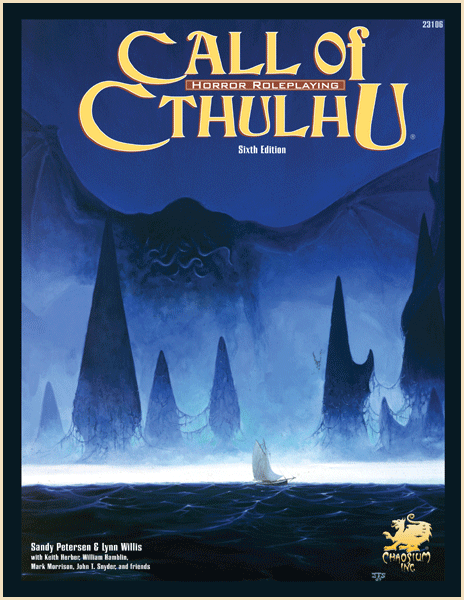
Call of Cthulhu

Call of Cthulhu has one of the longest skill lists you tend to see. This is because, fundamentally, everything you do in Cthulhu is done with skills. Stats really only become relevant when you're calculating damage. You can guess from this that skills are reasonably important (because there's no reason to define so many if they aren't), and the wide selection also suggests that a wide range of characters are possible. Skills are an important way to define and differentiate characters, and perhaps the most important. In my experience, only POW tends to influence a character's nature to the same extent as their skills.

It's immediately noticeable that the skills are (relatively) modern and everyday ones. The very first skill is Accounting. Law makes an appearance, and so does Photography, neither of which seem relevant to exploring a dungeon. The major sciences all feature, as do a number of skills based on social interaction. These give the idea that this isn't a game of high adventure, but one where quite ordinary activities are relevant and useful. Although a player might not consciously consider it, they should register in the back of their mind that they’re not being offered skills in wilderness survival, spaceship operation, jetpack use or necromancy.

Knowledge skills are the most numerous group, covering most academic and scientific fields of the 1920s, though the humanities arguably get short shrift. We can correctly deduce that understanding and interpreting information is likely to be a significant part of the game. We can also deduce that the game is expecting the kind of characters who might have skills in history, foreign languages, physics, law or the occult - in other words, relatively educated, respectable characters. Of course, it's also possible to make characters based on more physical skills, but the skillset does tend to discourage barbarians and assassins. Perhaps less obviously, it’s also not that easy to make characters who are lower-middle or working class, because there’s not that many suitable skills, though with some generous interpretation it’s entirely possible.

The way the skills are distributed also offers some insight. While scholarly abilities are clearly considered relevant enough to make up a dozen different skills, we can be reasonably sure that Physics isn't considered a core part of the game, because there's a Physics skill. We can guess that stealth mechanics are probably more relevant, because there are five distinct skills based on concealment or detection. While the substantial list of weapon skills suggests combat may be a significant part of the game, a little bit of thought also suggests that we're not going to encounter detailed tactical combat because of the Skill Paradox. We have a set of very general combat skills that basically boil down to two things: Dodge and Use Weapon XZY. This is precisely the sort of skill you use for things you don't think are important enough to model in detail. A combat-heavy game that consisted of repeatedly rolling the same two skills (and you're not likely to have more than two) would be extremely dull - and with the BRP percentile skill system, you're going to be rolling on the same numbers. On the other hand, there's no sign of a big set of skills for doing particular kinds of things in combat, which might indicate a crunchy tactical game. So the fact that there's a list of skills for all kinds of weapons can be taken to mean that the rules want to be adaptable for a variety of characters and settings - and perhaps to be quite "realistic" about them. In contrast, there are at least four skills for dealing with social situations (Credit Rating, Fast Talk, Persuade and Psychology), and a dozen or so relating to specific areas of knowledge or research. What we don't have, as the Paradox predicts, is a skill for Investigate, because investigation - the key feature of the game - consists of using all the other skills and all kinds of non-skill activities in suitable ways. While the skills list isn't enough by itself to tell us that this is a game of investigation, I think it reinforces that nicely.

The other major thing that you can guess (correctly) from the skill list is that Cthulhu characters are generally mediocre. Initial skills are largely in the 1% to 5% range, with a few everyday ones closer to 20%. Of course, you assign additional skill points to the things you're actually interested in, but starting with a very low chance of doing anything - and this being true of anything you don't specialise in - informs the players that you aren't going to be dashing heroes who thrive in every situation, but actually will fail quite often even at things that you might be relatively good at.

Finally, in this system specialisation is very much as you make it. The fairly unconstrained allocation of points means you can choose to be expert at a few things, or okay at quite a lot. Because there are a lot of skills, characters are likely to develop different skill sets. However, they won't necessarily fall into distinct niches, because the game can't rely on even a single person having any specific skill above base, and because some skills are obviously more likely to come up than others and are likely to be taken by multiple characters.

Hellcats & Hockeysticks

Skills are less important to H&H than some other games. That's partly because you're okay at most things unskilled - as good as a trained Call of Cthulhu character, in fact - and partly because the style of the game can vary quite a bit. If you go heavily into the more Mean Girls or even The Craft end of things, the social mechanics and general unruled roleplaying are likely to be more important than skills. You also get a hefty dose of character definition from your clique, which unlike the more traditional "class", explicitly says things about the kind of person you are; it also gives you a special signature ability. I’m adding this explanation here, but it isn’t completely apparent to a new player.

The most obvious thing about the Hellcats skills list is that it's silly. The skills are almost all common subjects in British schools, used for mischief by the girls. This immediately gives the impression of a jokey, irreverent game that isn't taking itself seriously. It also, of course, reinforces the point that this really is supposed to be a game about schoolgirls - you'd really struggle to hack it for barbarian adventurers or police drama.

The descriptions make it clear that while the skills are technically based on school subjects, their primary purpose is getting up to no good. Thus, we have Needlework used for lockpicking, Team Sports used for GBH, and Chemistry used for making gin and explosives. If the players are familiar with the St. Trinian’s works* then they will already have a decent idea of what’s expected**.

* And if not, I’m not sure why they’re playing this game.

** Although, as we have discovered, this is actually somewhat misleading.

This game does include skills for occult shennanigans and mad science, which marks them as possible options. Again, with a bit of thought, we can guess (correctly) that they aren't really core gameplay, because having a skill to roll for each one doesn't exactly establish a foundation for fascinating play - and indeed, these are optional extra rules bolted on to the main game. However, the existence of so many skills for doing disreputable, secretive and illegal things – just about every skill highlights these uses – reinforces the nature of the game as one of mischief.* It's notable that sneaking is different from lockpicking, which is different from lying, which is different from cheating at cards, whereas the sneaking skill also covers all forms of athletic activity.

* You could take this as a cue to run a serious and nasty game (and I'm sure it'd be possible) of being plain old juvenile delinquents, but the tone of the entire rulebook strongly pushes you the opposite way.

There are some skills that cover basic survival and construction skills, which would allow you to run desert island scenarios, and in fact I think you’d manage that fairly well, but that’s easily within the scope of this kind of game. Unlike Call of Cthulhu, there really isn't much in the way of skills for research, or any other nitty-gritty stuff (in fact, from the descriptions in the rulebook, there's no reason to think having points in a skill makes you any good at the subject it's named after). Lacking anything in the way of research skills, you're not likely to be piecing together complex mysteries. There's even less detail in terms of combat skills, giving the sense that this is a game with a fairly loose combat system - there's not even a Dodge, let alone specific weapon skills.*

* That being said, the absence of weapon skills doesn't necessarily indicate that combat isn't important, as we'll see later - it could have meant quite the reverse.

These omissions are quite interesting, because there are a lot of skills here: 26 in all. That's only slightly fewer than 3rd edition D&D, though half the number in Call of Cthulhu, and it's mostly down to the sheer range of activities they cover for a relatively rules-light game. The range of the skills, coupled with the broad scope of most of them, could indicate a couple of things: either it's a wide-ranging game needing a broad ruleset to cover all manner of chaos, or it's designed to cover a range of different genres with a subset of skills used each time. In this case, it's a bit of both but more of the latter.

The final thing to note about these rules is that the skills scale from 1-5, which translates into extra D6s for your dicepool. You can tell fairly easily from these two bits of info that you've got a reasonable chance to do most things (generally 4+), and a very good chance if you put even one point into them. Because each clique encourages players to pick particular skills, you're likely to end up with characters falling into distinct niches, but because they always get to roll at least one die with decent odds, they can't specialise into uselessness outside that niche. It also encourages you to just have a go at things, which fits the free-flowing type of game Cubicle 7 seem to be aiming for.

Unfortunately, though it conveys the general tone of the game and the loose nature of the mechanics, I don't think the skills list in Hellcats and Hockeysticks is that great. As that article points out, in practice it's often difficult to match up skill names and their mechanical use. There are wild variations in how broad and useful some skills are, and the existence of a skill doesn’t necessarily indicate that you’ll engage in that sort of activity. The length of the list, and the breadth of activities it covers, also rather muddies the waters in terms of what the game is about: if you read through and spot rules that specifically cover falconry (Animal Husbandry), stock markets (Maths), torture (Leadership), legal skills (History), bomb timers (Electronics) and melee combat (Team Sports), I think you can be forgiven for some confusion over what the focus of the game is. In fairness, this is partly because the game itself is trying to cover all possible genres where girls at school behave badly, which is arguably either an advantage or a burden for it. It’s also, I suspect, aiming to suggest what skill you’d use to do X, rather than what you use Skill X to do. Finally, you absolutely need to read the descriptions of each skill in order to have any idea of what it does, which means the skill list in and of itself is of limited use.

The game is also quite keen to play up its social dynamics rules, which aren't represented in skills at all – or rather, are completely separate from skills, though you might use skills to resolve situations. I can't really comment on this, as they saw no use whatsoever in our play, and I've yet to find a review where they did feature. So I don't know whether the lack of clues in the skill list is leaving you oblivious to one of the core mechanics, or giving a realistic impression of the likely importance of those rules in play. As we’d expect, the absence of rules for resolving social dynamics in your group indicates that either a) this is irrelevant to the game itself, or b) this is so important that it can’t be handled by anything as simple as a couple of skills. In the case of this game, I’d say it’s either/or, depending on what genre you want to run.


More to come in future posts, but this one's already longish and trying to pin this stuff down in words is pretty hard work.

Sunday, 1 December 2013

Monitors: NPC types

So, leaving weapons and complicated spreadsheets aside for a minute.

I'm basically thinking that NPCs/monsters (I'll call both NPCs in this post for simplicity) will come in five mechanical types. These are civilians, grunts, veterans, antagonists and hordes.

Civilians

Because Monitors isn't a combat game as such, there's a reasonable chance they'll end up confronting civilians. There's petty criminals, scientists, bystanders driven insane by alien influences, hivemind drones, factory bots, and all that sort of thing. There's also a lot of potential for civilians to be involved on the Monitors' side, perhaps if their spacecraft is attacked by pirates, or if they're rescuing captives. Civilians will have a single Wound, and any successful attack that penetrates their defences will take them out of action for the rest of the combat. They will have minimal combat skills, and will typically have only one or two professional skills worth mentioning, though these may be very high. Typically they will avoid combat.

This might seem to be undervaluing non-combat NPCs, but if you think about it, the non-lethal combat system of Monitors should make this completely appropriate. There's no need to layer on unconvincing survivability to NPCs just to let them function (a bugbear of mine relating D&D 3e NPC classes) because they're not going to get killed off, so you only need to worry about them getting captured or leaving them behind. The main exception will be if you're trying to protect them while they do something important, like carry out repairs.

Grunts

Grunts represent any NPCs with some level of combat experience. These are things like hired thugs, security guards (and bots), ordinary soldiers, pirates and so on. Their precise value will depend on their combat skills, which aren't fixed, but will tend to be between 4-8 in most cases. Grunts have a single Wound, which means they can be taken out with one good attack; this is vital for sentries and the like. They appear in only small numbers, because once you have more than a handful, you should be using a Horde for mechanical balance.

Unlike civilians, Grunts are affected normally by soft weapons, inflicting a Blind or Slow die rather than taking them out of action.

Veterans

Veterans are competent, well-trained soldiers. They aren't necessarily more skilled in combat than Grunts, but are more durable. In general, a group of Veterans should be a challenge for a similar number of Monitors. Veterans will have a similar number of Wounds to Monitors (I'm currently thinking both will have three to five). Veterans represent things like bodyguards, elite strike teams, assassins, and anyone else who gets their own theme tune.

Antagonists

Antagonists represent major threats of some kind. They are likely to have good equipment, good skills (not necessarily in combat) and plot armour represented by multiple Wounds. It doesn't really matter whether they're a mad scientist, a pirate queen, a huge monster or a malfunctioning warbot, they still want to absorb a few hits to be a satisfying opponent - though those without combat skills won't be able to fight back directly. Some antagonists will be a significant threat in combat in and of themselves, while others are threatening because they command lots of minions, control dangerous machinery and so on.

Hordes

Hordes, as discussed previously, represent large groups of enemies that are generally relatively weak. They are hard to fight effectively without weapons designed for that purpose. I'm currently thinking of replacing the earlier rules with a Wound-based system, where Hordes will have a significant number of Wounds (5+) and this will modify both their and the Monitors' effectiveness.