Showing posts with label Hellcats. Show all posts

Tuesday, 3 December 2013

First Impressions: skills, part one

Dan recently reminded me that a while ago I was thinking about skills, and about what they can tell you quite a bit about a game. I brought this up in passing when discussing skills in Monitors:

I tend to subscribe to the view that the skills list helps to define a game. It highlights the sort of things you're expected to do, and the way in which things are combined or isolated shapes expectations. If there are fifty different combat skills for performing different manoeuvres, then expect detailed combat, many weapons, and (probably) choices about optimisation or use of weapons unskilled. On the other hand, if there's a Fight skill and twelve different magic skills, the game will be somewhat different.

In particular, I think a well-considered skills list (on a broad definition of "skills") can be a useful way to establish expectations for the game. They can help indicate the kinds of activities that are important to the game, and the crunchiness of the system. Expanding our scope slightly, they can also help to convey information about the relative competence of PCs, the degree of specialisation of characters, how much PCs fall into distinct niches, and how generous the system is about assigning ability. While I'm not saying any of these are independently crucial, taking these clues as a whole can give you a fair amount of information about the genre and tone of the game, the mechanics and the content you can expect.

Let's have a look at a few game examples and see whether I'm talking complete nonsense, or just exaggerating.

Call of Cthulhu
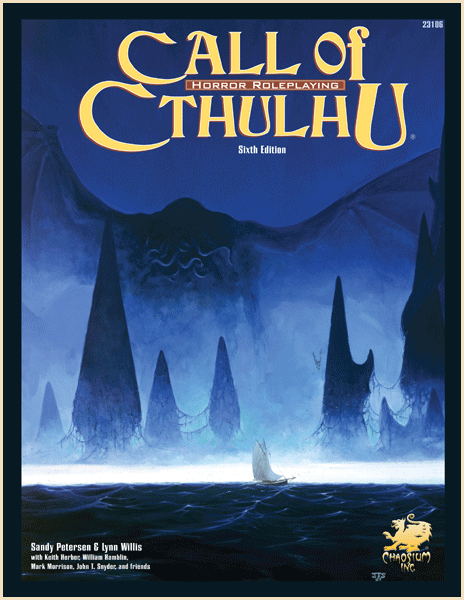
Call of Cthulhu has one of the longest skill lists you tend to see. This is because, fundamentally, everything you do in Cthulhu is done with skills. Stats really only become relevant when you're calculating damage. You can guess from this that skills are reasonably important (because there's no reason to define so many if they aren't), and the wide selection also suggests that a wide range of characters are possible. Skills are an important way to define and differentiate characters, and perhaps the most important. In my experience, only POW tends to influence a character's nature to the same extent as their skills.

It's immediately noticeable that the skills are (relatively) modern and everyday ones. The very first skill is Accounting. Law makes an appearance, and so does Photography, neither of which seem relevant to exploring a dungeon. The major sciences all feature, as do a number of skills based on social interaction. These give the idea that this isn't a game of high adventure, but one where quite ordinary activities are relevant and useful. Although a player might not consciously consider it, they should register in the back of their mind that they’re not being offered skills in wilderness survival, spaceship operation, jetpack use or necromancy.

Knowledge skills are the most numerous group, covering most academic and scientific fields of the 1920s, though the humanities arguably get short shrift. We can correctly deduce that understanding and interpreting information is likely to be a significant part of the game. We can also deduce that the game is expecting the kind of characters who might have skills in history, foreign languages, physics, law or the occult - in other words, relatively educated, respectable characters. Of course, it's also possible to make characters based on more physical skills, but the skillset does tend to discourage barbarians and assassins. Perhaps less obviously, it’s also not that easy to make characters who are lower-middle or working class, because there’s not that many suitable skills, though with some generous interpretation it’s entirely possible.

The way the skills are distributed also offers some insight. While scholarly abilities are clearly considered relevant enough to make up a dozen different skills, we can be reasonably sure that Physics isn't considered a core part of the game, because there's a Physics skill. We can guess that stealth mechanics are probably more relevant, because there are five distinct skills based on concealment or detection. While the substantial list of weapon skills suggests combat may be a significant part of the game, a little bit of thought also suggests that we're not going to encounter detailed tactical combat because of the Skill Paradox. We have a set of very general combat skills that basically boil down to two things: Dodge and Use Weapon XZY. This is precisely the sort of skill you use for things you don't think are important enough to model in detail. A combat-heavy game that consisted of repeatedly rolling the same two skills (and you're not likely to have more than two) would be extremely dull - and with the BRP percentile skill system, you're going to be rolling on the same numbers. On the other hand, there's no sign of a big set of skills for doing particular kinds of things in combat, which might indicate a crunchy tactical game. So the fact that there's a list of skills for all kinds of weapons can be taken to mean that the rules want to be adaptable for a variety of characters and settings - and perhaps to be quite "realistic" about them. In contrast, there are at least four skills for dealing with social situations (Credit Rating, Fast Talk, Persuade and Psychology), and a dozen or so relating to specific areas of knowledge or research. What we don't have, as the Paradox predicts, is a skill for Investigate, because investigation - the key feature of the game - consists of using all the other skills and all kinds of non-skill activities in suitable ways. While the skills list isn't enough by itself to tell us that this is a game of investigation, I think it reinforces that nicely.

The other major thing that you can guess (correctly) from the skill list is that Cthulhu characters are generally mediocre. Initial skills are largely in the 1% to 5% range, with a few everyday ones closer to 20%. Of course, you assign additional skill points to the things you're actually interested in, but starting with a very low chance of doing anything - and this being true of anything you don't specialise in - informs the players that you aren't going to be dashing heroes who thrive in every situation, but actually will fail quite often even at things that you might be relatively good at.

Finally, in this system specialisation is very much as you make it. The fairly unconstrained allocation of points means you can choose to be expert at a few things, or okay at quite a lot. Because there are a lot of skills, characters are likely to develop different skill sets. However, they won't necessarily fall into distinct niches, because the game can't rely on even a single person having any specific skill above base, and because some skills are obviously more likely to come up than others and are likely to be taken by multiple characters.

Hellcats & Hockeysticks

Skills are less important to H&H than some other games. That's partly because you're okay at most things unskilled - as good as a trained Call of Cthulhu character, in fact - and partly because the style of the game can vary quite a bit. If you go heavily into the more Mean Girls or even The Craft end of things, the social mechanics and general unruled roleplaying are likely to be more important than skills. You also get a hefty dose of character definition from your clique, which unlike the more traditional "class", explicitly says things about the kind of person you are; it also gives you a special signature ability. I’m adding this explanation here, but it isn’t completely apparent to a new player.

The most obvious thing about the Hellcats skills list is that it's silly. The skills are almost all common subjects in British schools, used for mischief by the girls. This immediately gives the impression of a jokey, irreverent game that isn't taking itself seriously. It also, of course, reinforces the point that this really is supposed to be a game about schoolgirls - you'd really struggle to hack it for barbarian adventurers or police drama.

The descriptions make it clear that while the skills are technically based on school subjects, their primary purpose is getting up to no good. Thus, we have Needlework used for lockpicking, Team Sports used for GBH, and Chemistry used for making gin and explosives. If the players are familiar with the St. Trinian’s works* then they will already have a decent idea of what’s expected**.

* And if not, I’m not sure why they’re playing this game.

** Although, as we have discovered, this is actually somewhat misleading.

This game does include skills for occult shennanigans and mad science, which marks them as possible options. Again, with a bit of thought, we can guess (correctly) that they aren't really core gameplay, because having a skill to roll for each one doesn't exactly establish a foundation for fascinating play - and indeed, these are optional extra rules bolted on to the main game. However, the existence of so many skills for doing disreputable, secretive and illegal things – just about every skill highlights these uses – reinforces the nature of the game as one of mischief.* It's notable that sneaking is different from lockpicking, which is different from lying, which is different from cheating at cards, whereas the sneaking skill also covers all forms of athletic activity.

* You could take this as a cue to run a serious and nasty game (and I'm sure it'd be possible) of being plain old juvenile delinquents, but the tone of the entire rulebook strongly pushes you the opposite way.

There are some skills that cover basic survival and construction skills, which would allow you to run desert island scenarios, and in fact I think you’d manage that fairly well, but that’s easily within the scope of this kind of game. Unlike Call of Cthulhu, there really isn't much in the way of skills for research, or any other nitty-gritty stuff (in fact, from the descriptions in the rulebook, there's no reason to think having points in a skill makes you any good at the subject it's named after). Lacking anything in the way of research skills, you're not likely to be piecing together complex mysteries. There's even less detail in terms of combat skills, giving the sense that this is a game with a fairly loose combat system - there's not even a Dodge, let alone specific weapon skills.*

* That being said, the absence of weapon skills doesn't necessarily indicate that combat isn't important, as we'll see later - it could have meant quite the reverse.

These omissions are quite interesting, because there are a lot of skills here: 26 in all. That's only slightly fewer than 3rd edition D&D, though half the number in Call of Cthulhu, and it's mostly down to the sheer range of activities they cover for a relatively rules-light game. The range of the skills, coupled with the broad scope of most of them, could indicate a couple of things: either it's a wide-ranging game needing a broad ruleset to cover all manner of chaos, or it's designed to cover a range of different genres with a subset of skills used each time. In this case, it's a bit of both but more of the latter.

The final thing to note about these rules is that the skills scale from 1-5, which translates into extra D6s for your dicepool. You can tell fairly easily from these two bits of info that you've got a reasonable chance to do most things (generally 4+), and a very good chance if you put even one point into them. Because each clique encourages players to pick particular skills, you're likely to end up with characters falling into distinct niches, but because they always get to roll at least one die with decent odds, they can't specialise into uselessness outside that niche. It also encourages you to just have a go at things, which fits the free-flowing type of game Cubicle 7 seem to be aiming for.

Unfortunately, though it conveys the general tone of the game and the loose nature of the mechanics, I don't think the skills list in Hellcats and Hockeysticks is that great. As that article points out, in practice it's often difficult to match up skill names and their mechanical use. There are wild variations in how broad and useful some skills are, and the existence of a skill doesn’t necessarily indicate that you’ll engage in that sort of activity. The length of the list, and the breadth of activities it covers, also rather muddies the waters in terms of what the game is about: if you read through and spot rules that specifically cover falconry (Animal Husbandry), stock markets (Maths), torture (Leadership), legal skills (History), bomb timers (Electronics) and melee combat (Team Sports), I think you can be forgiven for some confusion over what the focus of the game is. In fairness, this is partly because the game itself is trying to cover all possible genres where girls at school behave badly, which is arguably either an advantage or a burden for it. It’s also, I suspect, aiming to suggest what skill you’d use to do X, rather than what you use Skill X to do. Finally, you absolutely need to read the descriptions of each skill in order to have any idea of what it does, which means the skill list in and of itself is of limited use.

The game is also quite keen to play up its social dynamics rules, which aren't represented in skills at all – or rather, are completely separate from skills, though you might use skills to resolve situations. I can't really comment on this, as they saw no use whatsoever in our play, and I've yet to find a review where they did feature. So I don't know whether the lack of clues in the skill list is leaving you oblivious to one of the core mechanics, or giving a realistic impression of the likely importance of those rules in play. As we’d expect, the absence of rules for resolving social dynamics in your group indicates that either a) this is irrelevant to the game itself, or b) this is so important that it can’t be handled by anything as simple as a couple of skills. In the case of this game, I’d say it’s either/or, depending on what genre you want to run.


More to come in future posts, but this one's already longish and trying to pin this stuff down in words is pretty hard work.

Monday, 9 September 2013

Some very belated Hellcats thoughts

You know what nobody's expecting a post about? Hellcats and Hockeysticks.

Dan has already discussed some of the technical aspects of the game, and you will of course remember my article about running it. But for some reason I ended up giving it a bit more thought recently.

Concerns

Cliques

The idea of 'cliques' plays a reasonably significant part in the game, as they're a kind of class-equivalent for the girls. Dan had a few misgivings about the use of class here, but it didn't especially bother me as such. However, I did and do think it's an inappropriate tool for what they're trying to do, which is give each girl a special flavour while also representing some (perceived?) subgroups within teenage girl society.

The problem here is that cliques, by their very nature, are a groups. You cannot be a clique of one. Moreover, cliques are generally perceived to be exclusionist and insular, except where they go around being mean to non-members. This means it doesn't really make sense to create a party consisting of four people with widely-varying tastes who are specifically marked for their habit of hanging around with other people just like them.

I'm honestly not sure what the designers thought they were modelling, or whether they simply wanted to represent a range of likely girl-types and didn't really think about party composition. The only situation I can really think of where you tend to get these rag-tag bunches of wildly different individuals are where it's forced on you. It can happen in school, admittedly, because you pick the same subject or get assigned to the same detention pool or whatever.

In fiction, though, which is where H&H is trying draw its inspiration, the usual situation where this happens is when something goes wrong. The school gets invaded by aliens, or the whole class are stuck in the mountains when the bus breaks down. An unlikely bunch of people with the right skills are forced to step up to the wicket, confront and abandon their prejudices, learn to work together for the good of all, and learn some very special lessons about difference, respect and friendship that will undoubtedly leave them all getting along well in the closing credits. Importantly, what happens here is that people's usual social preferences are broken down somehow, either because their friends are absent or injured, or their friends turn out not to be up to the challenge, and they're forced to associate with a different group of people.

Unfortunately, that doesn't sound anything like the game presented to you here. H&H is specifically about a group of friends who regularly hang around together, getting up to mischief and squabbling for status and giving other people grief. The group mechanics rely entirely on that idea. It's far more so than things like St. Trinian's tend to be, but fits in with the other source material like Enid Blyton and Mean Girls. You aren't reluctantly working together to achieve a short-term goal.

As well as the logical confusion, I'm mildly concerned that cliques encourage you to end up with characters whose abilities are very divergent. This tends to make working together difficult, because one party member is very athletic and has no social skills, one is incredibly eloquent and clumsy as hell, and one walks like a shadow and can't climb over a low stile. While this range can be useful in some situations (and often works in things like D&D), you're reasonably likely to end up with the whole group having to make the same checks together, and at least one person always likely to fail.

Suggestions

So I'm not especially planning on running any more H&H, but if I were, here's some things I'd consider changing around a bit.

Cliques

Obviously. The most straightforward change I can think of that retains a bit of the original flavour is to fork this out into two separate concepts, cliques and niches. Unfortunately, both would need rebuilding.

Cliques would take on their obvious place as a party-level mechanic. Think of it (if it helps, which it probably won't) as a sort of vague equivalent to things like party alignment or guild affiliation. All members of the group are part of the same clique, which indicates the general kind of attitude, demeanour, style and taste they share that lets them work together socially. The choice of a clique would not only determine your broad skillset, but also to some extent indicate the kind of game you hope to play.

While the details would want some tweaking, some original cliques should be recyclable here. I reckon Goth/Emo, Hockey Girl, Nerd and Prefect are all usable, while you could also construct Socialite and something like Hipster, and perhaps a vaguely Hippy/Artistic sort of thing. In a normal school you'd have a social group of ne'er-do-wells, but of course, that's everyone. The group's clique would determine which skills they can take to level 5, and some kind of special ability they share. This has the advantage of meaning the group are likely to be good at a broadly similar set of things, and therefore well-suited to doing things together, as you tend to want from a party. It won't mechanically enforce it, but each clique suggests certain kinds of skillsets to the reader, and so you're inclined to pick what seems appropriate.

Oh, and just in passing, let me banish "Japanese Exchange Student" to the outer darkness where it belongs.

Niches are personal. The simplest way I can think of to explain this is the Spice Girls. They are all Spice Girls. But one of them is Sporty, one Scary, one Baby, one Posh, and of course, one Ginger. Your niche indicates some of the things that mark you out as an individual within your group of friends, even while you share a lot in common.

From the original clique list, I would probably adapt Sweetheart, Coquette and Fixer into niches, maybe Scientist, and look for another couple to add. It would broadly depend whether you want niches to represent generic individual traits, or specifically to mean the role that characters falls into in their group of friends. Either way, niches would grant individual special abilities, and perhaps one extra skill, which allow characters to shine in their element, without restricting them from working together.

Skill blagging

The skills used in the game are almost entirely, but irritatingly not quite, based around rough version of school subjects. In theory this is quite fun, but in practice the way actions are allocated the skills leaves you with some quite unintuitive links. For example, Track and Field is about stealth as well as athletics, while Economics turns you into a haggling machine but doesn't cover actual finance or indeed any kind of theory (Maths covers that). There's also the odd fish of Observation, not a well-known school subject. Music has precisely one use, playing music. Several skills are mostly relevant if you're using the bolt-on rules.

My proposal here would be to drop the descriptions more or less entirely, and let the players make the case for whatever skill they want to use. After all, the game specifically emphasises that it's looking to depart from the usual formal player-GM relationship, and have players wheedle or otherwise influence the Headmistress to get their way! It seems to me that having skill use based on blagging it would be both fun and highly in keeping with the school theme - talking the talk was a fairly significant school skill from what I remember.

I might also consider (but not necessarily go through with) slightly revising the skills. One possibility would be to have "Academic" and "Vocational" skills, for example. This might help deal with some of the wobblier things like sneakery, which are expected in RPGs (and very useful in a ne'er-do-wells game) but don't fall naturally into any of the subjects (no, not even Track and Field).

Relationships

The game sets you up with a single best friend, plus a group of people you hang around with but don't particularly like, apparently. That's not strictly what they say, but that's sort of the impression you get when a game asks you to list what you dislike about them.

As we discussed on our podcast, one of the mechanical reasons this is a problem is that before the game starts you have no idea what any of the other characters are like, and so no way to pick really suitable dislikes. It doesn't necessarily matter, as dislikes aren't necessarily logical, but it's awkward.

If we want to avoid completely ditching an idea from the books, I might instead suggest something that, to my surprise, is influenced by Fiasco. Rather than the likes and dislikes, characters might define how they see their relationship with each of the other characters - this could be freeform or chosen from a list of suggestions. Other possibilities (all requiring a certain amount of character-introduction beforehand):

  • Why do you hang around with each of the others?
  • Who in the group do you feel closest to?
  • Who in the group do you look up to? Down on?

Alternative friendships

To be honest, though, for a game I'd run, since this is supposedly your group of friends and (as far as I am aware) girls too prefer to associate with people they basically like, I would consider doing this differently.

First, pick a 'best friend' from a group, and possibly a 'least best friend' just to set up some relationships - might be someone you don't quite get, or tend to quarrel with, look down on a bit (like a younger kid), or find mildly exasperating. Again, best to have a bit of idea what everyone's like before you do it (maybe play for a while first?), but this sort of relationship can be quite vague, so your best friend might be anywhere from an actual intimate buddy to someone you respect or secretly idolise (or indeed fancy) and want to please.

Then, very briefly create someone(s) you don't like within the school, which might be a teacher, non-teaching staff or (preferably) another pupil. Although it could also be, say, someone's boyfriend. This would offer some of the same possibilities for rounding out your own character, without seeming to define someone else's character or emphasising the negative side of your group's relationships. It would also offer some plot and RP potential that isn't tied into any written scenario, allowing these characters to be pulled in, but not forcing them on the game.

Saturday, 30 March 2013

Actual Play: Hellcats and Hockeysticks

Sometime last summer, a gang of us got together for a game of Hellcats and Hockeysticks. I'd picked this up at the suggestion of someone on the YSDC forums, partly to help with planning for a now-abandoned Call of Cthulhu scenario, and largely because I really like the St. Trinian's films. Dan has already blogged about this quite a long time ago, so I'll try not to retread the same ground, but focus more on my experience of running the game.

In any case, I ended up recording the game. It was a fairly impromptu idea, so we didn't do any of that stuff like introducing ourselves or sound testing, and it was recorded just on a portable recorder plonked in the middle of the living room where we were lounging on various comfy chairs, windows open because of the heat. As a result, some people (Kat) ended up very quiet, and there's quite a lot of background noise from traffic, let alone our own rustlings and clattering.

I've slowly and irregularly been editing away at them (learning how to audio edit in the process) and finally got them in some kind of shape to post publicly. So, I present what might conceivably be the start of an irregular series: the Librarians and Leviathans Podcast. It's probably the only Actual Play of Hellcats and Hockeysticks out there. Enjoy!

EDIT: I've managed to combine the files into a single item, now available for download on Archive.org.

Homework

I do feel bad about not being better prepared for the game. I fully intended to do some more prep, but personal stuff got in the way and I had to run it more or less cold, on the basis of a couple of readings weeks earlier. I’m normally an over-preparer and ended up trying to handle things on the fly, with a scenario that I still think is tricky in retrospect. As a result, I was a bit stressed and nervous about it, though I don’t think too much of that comes through in the recording. I did delete a lot of the long pauses and “Um...”s, though.

In particular, I was absolutely not on top of the Willpower mechanic, which is the main way PCs are expected to impose their will on the world. Partly as a result, the first scene was a bit shambolic because I was struggling to work out when and if the PCs were actually controlling the conversation and achieving their aims. However, this was compounded by some problems with the scenario itself. Having a firm idea of exactly how Willpower is supposed to work in practice, and how to model various situations using Willpower, would have made the whole thing much slicker and probably improved everyone's opinion of the game. If anyone's planning to give this a shot, I would strongly recommend setting yourself up some sample situations (or nicking them from films, or whatever) and doing a dry run to see how you'd actually apply the Willpower rules.

Practical Exam

Because I didn't have an especially firm grip on things, I didn't adapt especially well to off-script activity (the scenario is fairly scripted for its length). The first scene expects the girls to isolate and interrogate one or two first-year diggers, whereas they chose instead to confront the whole lot. This was a perfectly reasonable decision: they're dangerous bolshie girls, terrors of the local populace, and having decided the boys were intruding on their drinking space beach, they wanted to chase them off. I suspect also the image of a gang of boys digging doesn't immediately inspire the idea of isolating one; perhaps Peregrine pictured it as individual first-years digging some distance apart, with older boys roaming around giving orders, but I don't think that's quite how it came across to us. If you picture it as a group close together, the idea of wandering up and marching one away to question seems quite odd. Anyway, because of that we ended up with basically a standoff between the gangs, and I struggled to get enough information to them without it just being a GM fiat infodump. The conflicting goals of the boys, and the girls' own uncertainty of exactly what they wanted, added to the issue.

Short on information, the PCs did some freestyle roleplaying (which was one of the most enjoyable parts of the game) before biting the hook again and heading off to get more information. Since they hadn't learned that much, they didn't go back to their own school, where they'd have learned about a missing girl whose room contained clippings about stolen gold. Instead, they went to recapture one of their new acquaintances (poor old Fred), and dragged him away to interrogate. Of course, this would still have been a perfectly reasonable decision if they had picked up the hints about Annabel, but it's a shame they ended up unable to make that call. Although on the plus side, I got quite fond of Fred by the end.

This is possibly the biggest oversight on my part, because I had a good opportunity to smooth things over and failed. As was pointed out in the discussion, I should have had Fred start talking before they left the school and spill the beans about Annabel, so they could extend their incursion and rescue her immediately. Instead, they snuck out of the school, interrogated Fred, then had to sneak back into the school again to find Annabel! It's no catastrophe, but it could certainly have been slicker.

I feel like the incursions went okay, but the fight in the Common Room felt a bit wooden to me. The combat rules do work, but it's not really what you're supposed to be doing with the game, I think. Thankfully, the fire alarms they'd set off provided a nice reason to take the scenario's suggestion and cut down on the number of boys inside, so they didn't need to come up with another plan to distract them.

I'm not sure how obvious this was, but by the end everyone was more familiar with the rules, and I was also a lot less nervous, so I think things went more easily in the final scene. There was a bit of uncertainty over what they were 'supposed' to do, which I think is significant - even by that point, people were still struggling to decide what genre they were playing in, and so they ended up taking the Mallory Towers ending rather than the St. Trinian's one (in Mean Girls, presumably the whole gold business would only have been relevant as a tool to attain some social ambitions).

Syllabus

The scenario felt odd to me somehow.

I don’t think it introduces the core mechanics very well, because while it lays out characters and events (and the characters are decent), there’s no specific guidance on how particular mechanics might be used in particular scenes. This was a particular issues for the atypical rules like friendship and Willpower – I’m quite happy running skills and combats, but when a game is asking players to not jump to a fight, nor to chat and negotiate in character, but instead to browbeat and humiliate the opposition, it’s going against established instincts. They weren’t sure how to narratively achieve their in-character goals within the expectations of the game, and I wasn’t sure how to guide them. Even the finale of our playthrough was resolved physically, rather than through the Willpower rules for crushing an opponent. Similarly, the scenario had absolutely no occasion to use the much-vaunted friendship rules – as someone commented in the recording, that would just have got in the way of the adventure story plot. The two didn’t really feel compatible.

As I mentioned, I also found the directions for the scenario genuinely confusing. In the very first scene, the boys “are keen to get away” (from the girls) but also “curious to find out how much the girls know” about the gold and the missing girl, without giving away more information in the process. For the life of me, I could not work out how to blend “escape” and “perform subtle interrogation” coherently. I couldn’t even work out how they could question the girls without telling them what they were up to, especially given the boys are a) clearly being quite suspicious; b) a very obvious plot hook for the PCs to investigate; c) NPCs, whose job is to answer questions, not ask them; and d) afraid of the girls and so not in a strong negotiating position. This is probably one of those times when the writer has a strong mental picture of the situation and how things might go down, but struggled to communicate it.

There's some pretty solid detail and several tactics offered for the rescue mission, though because they'd already been in the school once I treated it fairly broadly. Similarly, the final scene in the churchyard has quite a few suggestions. I wish the initial scene had been as detailed, because setting the hook firmly and providing basic information is key to a decent scenario. The rescue mission is basically always intended to come down to a fight - arguably a useful opportunity to teach the combat rules, if you're planning to play more games - but there are several ways to handle the ending.

In overall fairness, I think it's really very hard to write scenarios, especially hard to write scenarios that complete strangers are going to play without you around to help, even harder to do so with a very limited page count, and perhaps hardest of all to write introductory scenarios that are also intended to teach players the core of a game with some unusual mechanics, while still being fun and interesting. So the fact that this one struggles to meet all those requirements is no great surprise.

References

We didn’t quite manage to discuss the experience mechanic, but I found it quite interesting. I like the idea of “specific learning outcomes” from the game’s events. In a nutshell, the Headmistress asks each player what they learned. You can say “dunno, miss” and just get a generic skill point to spend. The more interesting expectation, though, is to name something quite specific, in which case you get to write down a unique bonus that applies in particular situations: lying to police officers, say. I can see it might end up unwieldy in very long campaigns, but honestly, I don’t see anyone playing a very long H&H campaign; it’s a one-shot sort of game.

As I mentioned in the podcast, I also found the rulebook quite oddly laid out, and struggled to find important information. In fairness, I was using the PDF rather than the physical book, and the real thing is (as usual) rather easier to navigate, but it’s still hard to pin down things like the complete Willpower rules, or the Skills rules. Cross-references or just repetition would have helped.

Fundamentally I think the source materials they’ve chosen are too disparate and conflicting to build a cohesive game on. St. Trinian’s is fast-paced slapstick chaotic farce, full of action and quite complex plotting, with minimal character development, and often features adult NPCs as the main drivers behind events (the Headmistress uses loyal girls, government inspectors use undercover agents, criminals use their relations in the school...). The Craft, on the other hand, is more or less entirely about personalities (even the supernatural stuff is secondary to character, and events are mostly important as they relate to the characters) and adults are largely irrelevant.

St. Trinian’s, to come back to the references, notably doesn’t feature friend-politicking. There are several power blocs within the school, each with their own goals, from the Headmistress to the younger girls to the Sixth Form, as well as outside agents like Harry, criminals or parents. The groups play off against each other, but not within their group (people sometimes act against their peer group, but not their friends). I don’t think there’s ever any change in relationships during a story, because that’s just not what the films are about.

I think to some extent “badly behaved schoolgirls” isn’t a... strong enough? concrete enough? ...central idea. Mallory Towers and St. Trinian’s and Mean Girls are very different genres (as is The Worst Witch or Harry Potter or The Craft), and so what you end up with is a game that doesn’t have one solid strand running all the way through it, but several related sets of mechanics, none of which you need for all of these genres. I suppose the Willpower-humiliation mechanics is the main focus of the game, but I felt like there wasn’t enough guidance in how to actually apply this in real play.

It’s a grab-bag of ideas from various school-themed sources, and in practice you can just ignore whatever elements don’t suit your game style, deliberately or not. In our case, most of the friendship mechanics never got a look-in, though best friend and rivals did come through in roleplay. We also ignored Mad Science and Magic. We ended up making very little use of the Willpower rules, but that’s partly because I couldn’t work out how to and tended to handwave it.

It would have helped if they’d given the scenario more space to breathe, and in each section offered some suggestions for how the girls might defeat their opponents’ Willpower. In fact, just provide some sample vignettes to test out before the game, so everyone can see how it works beforehand in isolation. I think the difficulty isn't the mechanic itself, but getting used to interpreting in-character situations through a lens of “what do I want to achieve, and how do I undermine this person until I get it?” and then coming up with in-character actions that will have the right mechanical effect. It's quite different if you're used to taking more direct action through just using skills on people or hitting them with swords. It also ties in to the power dynamics of the game, which are a bit unusual: you're officially fairly powerless and subject to school and adult authority, but everyone's supposedly scared of you, but you need to manipulate them rather than just doing whatever you like.

Final Report

I think on balance, I wouldn’t choose to run this system often. If I had a particular idea in mind, I’d probably pick a system that I thought supported that kind of play – hijinks, or social dynamics, or jolly school adventures – and add a school skin, rather than a generic Schoolgirl Game that’s trying to serve several, well, mistresses. The main time I’d use this system might be to run a one-shot improv game where I didn’t really know where it might go, or possibly to introduce people to roleplaying who might find the St. Trinian’s idea appealing. That being said, the game as it turned out didn’t feel especially St. Trinian’s-y, and I think that’s partly because tightly-plotted farce (and all farce is tightly plotted, however chaotic it may seem) is one of the least suitable genres for roleplaying, driven as it is by players. That’s not a specific criticism of this game, which does aim to support that type of play – I’m just not sure how successful it’s possible to be.

I think it would actually work out better if you abandon any attempt at scenarios and just ran it on the fly, allowing the girls to direct the plot. The mechanics are simple enough that you could work up NPCs very quickly, and it's the sort of game where clichés and stereotypes would probably work fairly well to construct cheerful chaos around. This is a fairly radical departure from the films, where a lot of the action comes from the adults, but NPCs directing things doesn't tend to do well in RPGs. It would also reduce the issue of getting anarchic self-willed schoolgirls to bite plot hooks.

All that being said, I don’t think it’s terrible, and I’m quite conscious that we didn’t really explore some of the game’s main talking points at all. Neither Willpower nor Friendship really got a look in, and while I do think a lot of that is down to the introductory scenario, it still leaves me unqualified to give any kind of final verdict on the game.