Friday, 7 August 2015

Wild Talents in yellow

So it looks like we might end up running Definitely Not X-Men for Wild Talents, and based on my previous posts Dan suggested that trying to stat up characters you already have in mind is the way to get into the system. He's been playing with making X-Men characters. That seems eminently sensible. Wild Talents is pretty much made for running some humans with a bunch of special powers.

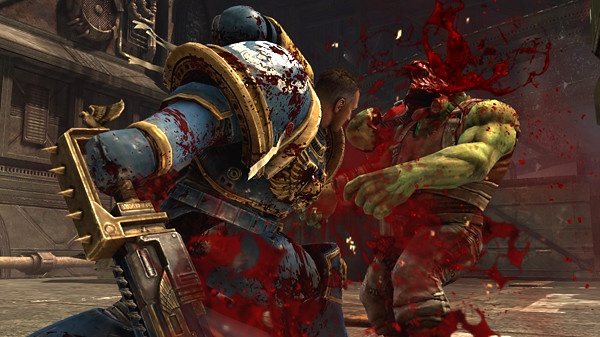
Naturally I consider this laughably childish in its simplicity, so instead I am going to play at making the Adeptus Astartes for Wild Talents. What could possibly go wrong?

Saturday, 1 August 2015

More fun with Demon: the Descent

You might want to read my Impressions of Demon: the Descent first, particularly the bits about powers, and also this one.

I was quietly doing random character generation, as I am wont to do, and I noticed this. These two powers sit side by side in the rulebook. You'd think someone might have noticed the discrepancy.

Name of power Raw Materials Shatter
Description Nature abhors a vacuum. With this Embed, the demon can break an object to “summon” an object of similar Size. The object that she breaks is destroyed, never to be repaired or made functional again. The object she summons isn’t created out of nothing, but is brought to her location by a seemingly coincidental series of events. Everything breaks. It’s just a matter of applying force in the right location. A demon who understands this principle can apply the force of entropy to an object and shatter it with a swift kick.
Dicepool Manipulation + Crafts Wits + Crafts
Limitation No size limit specified. Durability is immaterial. Success doesn't risk Cover. Object can be no larger than the demon. Used on an object with Durability 3+, she risks blowing Cover.
Mechanical Intention Obtain an object by destroying another object of similar size. Destroy an object.
Narrative Intention I'm not sure. As mentioned in the power, breaking down doors and smashing weapons.
Drawbacks A failed roll risks Cover. The new object takes some time to arrive. Failure causes injury. A success risks Cover if the object is Durable.

Friday, 31 July 2015

Why can't me and Wild Talents just get along?

I would start using a "Rambling" tag on these posts, but it would go on pretty much all of them.

So as mentioned previously, we recently attempted a campaigngen brainstorming session for Wild Talents, and I didn't get on with the game.

That rather confused me, because I don't understand why. I feel like this is the sort of game I should like. I like tinkering with mechanics, so shouldn't I like a game where you build your own powers and everything? What's putting me off? I wanted to try and work this out.

Okay, for a start, I think we got off on the wrong foot for a couple of reason that aren't to do with the game per se, but the attitude I read into it. The Introduction and What Is Roleplaying seem a tiny bit preachy to me - somewhat reminiscent of White Wolf, to be honest - and despite the attempts at catering to all tastes, I get the sense that really they want you to play a gritty game where you're people with superpowers, and think actual superheroes are a bit naff.

Tuesday, 28 July 2015

Worlds Unbuilt

Recently I threw out an idea for running a D&D game over VOIP, since I'm finding it difficult to travel to see the usual friends. Someone else suggested running some Wild Talents, and that got some traction (including that all of us are playing a certain amount of D&D anyway), so tonight we attempted to put together the basis of a game, also on VOIP (Ventrilo, specifically).

It really didn't work.

Basically I just wanted to waffle a bit about why that might be.

So Wild Talents is more or less a GURPS for superheroes. It's more or less completely customisable - even the superpowers are build component by component using a point-buy system with benefits and flaws that modify cost, although there are a few samples in the book. It has no default setting. Although they talk about different takes and tones in the game, like full "four-colour" spandex-wearing romps, the base assumption is still clearly a fairly gritty one where supers might get their head shot off and collateral damage exists. I'm actually inclined to place it near The Authority in terms of superhero takes, although there's a wide variety of possible power levels, including the ability to snuff out the sun. It's actually not that difficult.

One of the problems was absolutely that I wasn't particularly enthused to begin with. I don't have a problem with superheroes, mind. The fact that I'd proposed a different game was undoubtedly part of it, and I'm not going to dismiss that. To a large extent though, my apathy was down to Wild Talents, and the fact that my head began to hurt quite a short way into reading it.

Demon: the Bodging

I'm in a really White Wolfy mood right now.* I could really play some White Wolfy game. Admittedly I might get frustrated with it within a few hours when it turns out not actually to be what's advertised, but I hold out hope.

That was... a couple of months ago, when I started writing this. Same old, same old...

Anyway, my exhaustive (ahem) researches for Visitant involved rereading Demon: the Fallen and being reminded how promising it first sounded. Isn't there some way to get a faux-Judeo-Christian game about demons that are actually vaguely tied into real-life Judeo-Christian demon tropes (including, obviously, all the pop culture stuff that it's spawned) out of this?

Monday, 27 July 2015

Demon: the Descent is bad at character generation

So I'm in a bad mood today, and also playing with Demon: the Descent, and as a natural outcome of these activities I just want to take a few minutes to lay out in detail how the character generation instructions for Demon: the Descent are approaching a platonic ideal of wrongness. I have touched on this matter before.

Character generation rules always have problems, it's true. There's very rarely a way to make a character in one single pass - revisiting and revision are almost always needed, except in games with very light character mechanisation. But White Wolf seem to be singularly bad at chargen, and in their rules for both Demon games I feel they have reached a real nadir. This seems to stem, ultimately, from their abject refusal to acknowledge how their own game works, but some parts seem impossible to explain except by sheer incompetence.

Let us begin.

Character Creation, as outlined by White Wolf, has nine steps:

  1. Character Concept
  2. Select Attributes
  3. Select Skills
  4. Select Skill Specialties
  5. Apply Demon Template
  6. Select Merits
  7. Determine Advantages
  8. Age and Experience
  9. The Fall

And here's a quick precis of the game, just in case. In Demon: the Descent you play a sort of Agent Smith. The God-Machine (SkyNet) is real and secretly rules the universe, or most of it, in a reality that's a conspiracy theorist's wet nightmare. You were an agent of the God-Machine, or "angel", a kind of biomechanical-metaphysical entity doing certain tasks. You used artifical human identities as necessary, creating, donning and doffing them whenever required. Then something went wrong in your programming, and you went rogue, a state called "demon". Now you're on the loose with your own motivations, and at least some of your old reality-warping power, in whatever human identity you were last assigned.

Thursday, 23 July 2015

Using status mechanics to keep characters involved

Another day, another riff on Shannon. Shannon's post is quite specific, being about status in LARPS, and specifically a possible implementation for one of her own games. Inevitably, mine will be a general post about character status with no specific application in any of the games I'm not running.

Let me also point out that I think Shannon's solution seems absolutely fine.

One particular strength is that because it's reliant on rules and spends (rather than randomisation) it gives players a lot of control, and avoids rules causing silly results. If it's not practical to delegate the work, you can't delegate it (and hence, you have some incentive to find reasons why it's not practical...); you can only spend so much effort digging dirt on lower-status individuals, otherwise everyone will start thinking you're weird. And it's pretty simple!

It also limits players to a certain number of questions, for example, which means they can't just get around the restrictions by repeatedly asking questions about a high-status person until they get a good roll.

The reason I'm going to play with randomizer-based mechanical solutions is because I want to know whether, and how, it could work.

Wednesday, 22 July 2015

Visitant: Technological Gift trees

I'm still calling these "trees" all over the place, but let's be clear: they're very obviously pools. There is no hierarchy.

I actually really like the Demon: the Descent way of handling special abilities, and would have liked to use that. My original idea for Visitant was that there wouldn't be specific species at all. Instead, I'd discuss broad alien archetypes, and players could then combine certain low-level powers to make a species of their choice. More potent abilities would be keyed off these, just like D:tD.

For one reason and another (not insignificantly, a strong representation from a friend that Extremely Specific Splats were more White-Wolfy than vague mumbling, which seems true enough) I went the other way, and it has some advantages. Like, I don't have to worry about people combining completely arbitrary sets of abilities and producing some RAW-derived monstrosity. Only a small subset of abilities can be combined, which is frankly bad enough.

Today I present the last two Gift pools: the tech powers. Luminescence and Nanokinesis are both power sets I dreamed up out of nowhere. I started writing powers long before I'd nailed down exactly what the aliens would be. I originally intended these to be attached to a specific alien, but there were two things. One, I had no particular ideas for said alien. Two, I was very conscious that my aliens get a very restricted choice of powers compared to most White Wolf games, and allowing them free choice from some technology-based pools seemed both genre-appropriate and a useful getaround.

I may still write some more of these if I get inspired.

Tuesday, 21 July 2015

Trappery, part ten: goblin caves example

I just discovered this post lurking in my site, unpublished. It's a very long time since I wrote Trappery, and any train of thought I had going is long since dissolved. So this is a pretty short post, but it looks coherent so I thought I'd stick it out there rather than deleting all that work.

The Goblin Caves

In contrast to the last example, this one is far from reality. A band of utterly stereotypical goblins has holed up in a cave network. They are cunning, malevolent, nasty, brutish, and short. The goblin chiefs, led by Ugluk, want to protect their slightly-less-decrepit belongings from the light-fingered masses, as well as from any thieves that might come sneaking into their territory.

Into Ploughshares

So I've been thinking about Into Ploughshares again. This is partly because it just sort of got inside my head and niggles at me. Another reason is that I'm doing a lot of fiddling with games at the moment, and have managed to play a good few since I got back from abroad. The writing and reviewing parts, in particular, emphasised to me just how much time RPGs devote to fighting, or investigating grizzly deaths, and I started to feel rather down about it. I also had some interesting conversations with Dan about other types of genre and gameplay, which helped revive my interest.

What about characters?

The (silly) conceit of Into Ploughshares is an attempt to more-or-less directly map a combat-free pastoral narrative onto stereotypical traditional dungeon crawl mechanics. And that means character classes with distinct roles. I actually think this might work fairly well.

The idea that's come to mind is that, just as seasons (and their challenges) will map onto dungeons (and their rooms), individual challenges will map onto combats. Some will be unavoidable - winter descends on you inevitably, just as the minotaur hunts you down in its labyrinth. Others are optional challenges that can bring some benefit - destroying the undead guards in the vault will get you loot, forging a road through the forest will open up trade routes and speed communications.

Obviously, "fighting" a challenge means a damage system is needed, and the idea that comes to mind is Work Points.

Any given Challenge has, amongst other things, a pool of Work Points. This is a crude representation of how much effort will be needed to overcome the Challenge. Digging a privy requires relatively little effort and has few Work Points. Building an irrigation system for enough farmland to feed a village requires a lot more effort.

The first class we need, then, is naturally the fighter-analogue. Um... possibly. In our case, we have the Labourer. A Labourer is a pretty simple class with minimal special abilities. Where they shine is in plodding away at hard work. A Labourer has a high average Work output and is pretty reliable. They take on the lion's share of labour, freeing up other party members to handle fiddly stuff. In contrast, the other classes have more specialised roles that depend on application to be effective.

What about PCs, though? Most challenges aren't exactly damaging them, but PC Work Points would make no sense at all.

Dungeon crawls feature enemies that injure you, but often you're the one making decisions about pacing. I feel like season challenges need to work a bit different. Essentially, the challenge of pastoralism lies in whether you can overcome a challenge with the resources you have in the time available. This means a lot of challenges will tend to be on a schedule, with PCs only having a certain amount of time to deal with them.

In this case, I'm inclined to say that the obvious option is Fatigue. A PC's "attacks" indicate how much they manage to accomplish, but a challenge's "attacks" indicate how much the character's reserves are depleted by their efforts. This isn't the only option, though. A storm might damage infrastructure, so the challenge is to cope with it as quickly as possible to minimise the harm it does (PC "attacks" here will indicate taking precautions, minimising damage, repairing and so on).

The classic rogue/thief mechanics create a character who's good at sneaking around to find out the lay of the land and predict challenges. They can also deal with unexpected hazards (disarm traps), acquire unexpected benefits (theft) and position themselves to dish out heavy Hit Point damage, providing they can make the right setup rolls. How would we parallel that?

Clearly, we're looking at a Scholar.

The Scholar relies on some kind of theoretical roll to metaphorically 'navigate' the season, interpreting and predicting challenges and opportunities. They can find and deal with unexpected hazards (test of ingenuity or knowledge), acquire unexpected benefits (inspiration), and position themselves to deal heavy Work damage by application of theory to do a lot with a little.

Saturday, 18 July 2015

Visitant: Ytaleh Gift trees

Almost finally, we come to the Gift pools for the ytaleh, little bundles of nervous tissue that they are. These critters get a rather woobly set of abilities, with the telepathic Mentalist pool granting ability to sense and manipulate other minds. Neuromancy is a harder one to pin down; as an electrochemical field-based pool, it combines tapping into the minds of host bodies, disrupting the functions of inconvenient humans, and sensing or manipulating electromagnetism. The ytaleh therefore tend towards a fairly low-action approach, sensing things and invisibly manipulating them to their own advantage. They're good when they have time to exploit their memory-stealing capabilities, but do have some combat capability too, and those are some of the subtlest attacks in the game.

If anyone's wondering, yes, the ytaleh are the Joe 90s of Beneath Dark Skies.

Wednesday, 15 July 2015

Visitant: Mistaken Identity

Observant readers may notice that, for someone trying to approximate a White Wolf game in a sci-fi setting, I have some major omissions.

Looking closely, almost everything published for Visitant so far is rules, of all things, while the rest is setting material. Where, oh where, is the terrible game fiction?

As mentioned, the six chapters of Prologue: We walk amongst them are only available to premium subscribers. I wouldn't breach their trust by betraying that. But that doesn't mean you get off scot-free you have to go without entirely.

Here, for your delectation and nausea, is the first ever piece of Visitant gamefic.

Visitant: Shekt Gift trees

You either know the score by now, or you have no idea what is going on. If the latter, I heartily encourage you to go back a few posts. In fact, maybe go all the way back to something more entertaining, like the Imperial Fists podcasts or the ones where I make sarcastic comments about poisonous doorknobs. Those were the days.

It may not come across, but I tried to give each Gift pool set of names that were thematically equivalent, so that you don't get a big aesthetic clash; I didn't want really purple names sitting next to "Levitate" or whatever. So the Guise names are a little fancy, Protoplasm is fairly matter-of-fact. Mosa Gifts have pretty short, punchy names that try to describe them as briefly as possible (Taste the Wind is an exception, admittedly).

Today, Shekt gifts! The insect swarm folks get two pools, one based on making buzzing noises, and the other on... well, being made of thousands of insects. Seems fair. For Shekt, I went with alliterative song-based names for the Cadence pool, and fancy-pants florid names for the swarmy ones. No particular reason, I just started with I Am Legion and went from there.

I would also like to note that I'm aware "One With Everything" sounds like a pizza. This is not accidental.

Tuesday, 14 July 2015

A beastly problem: animal companions in 5e D&D

So* recently I've been playing about with making a Beastmaster Ranger.

No, come back! I promise not to let this post descend into excoriating it for being sub-par or anything like that. Although it... kind of is. That may crop up. But it is not the primary thrust of this post.

* I am aware that an awful lot of my sentences start off with "so". Here my blog accurately recreates the experience of talking to me. See also: constantly going off on tangents, rarely reaching actual conclusions, talking far too much. On the plus side, here I tend to at least finish my sentences, instead of just tailing off, so...

See what I did there?

NOTE: since I wrote this, I've discovered that some issues are addressed by the PHB errata. I'm leaving this as written, partly because I'm too lazy to change it, partly because it frankly horrifies me that things like "is this animal less sentient than an actual literal zombie?" were not picked up before publication.

Sunday, 12 July 2015

Visitant: Mosa Gift trees

As per the previous post, here are some powers, this time for the self-evolving Mosas.

The Mosa Gifts are somewhat odd, in that a lot of them don't require rolls, but simply provide various kinds of boosts. Quite a few don't even require require Focus. I'm not sure whether this will prove unbalancing, in that Mosa end up able to reserve their Focus for a small number of powers, or whether it's irrelevant because the utility of the powers is the main thing.


Saturday, 11 July 2015

Visitant: Ansad Gift trees

The four playable splats for Visitant have now been introduced, so laying out their powers seems the next logical step.

I've taken a broadly traditional WoDdy approach, so these are more like Vampire powers than Demon: the Descent.

There are some differences between the way "powers" (Gifts, in Visitant) work here and in some White Wolf games. The main thing to note is that in the vast majority of cases, it is absolutely 100% impossible for a member of one splat to obtain a Gift belonging to another splat. This is not just a mechanical block, it's a narrative one. Visitants' abilities are primarily derived from their biology, not from magical or supernatural talent, so it's not like this is something you can learn. Are you a gestalt mind composed of several million insectoid drones, or aren't you?

Thursday, 2 July 2015

Fun-Sizing the Great Old Ones: Yog-Sothoth

I have posted part three of my Fun-Sizing the Great Old Ones series on Yog-Sothoth.com. This time: how can we use Yog-Sothoth, the Key and the Gate, effectively in a game, other than getting shipwrecked on R'lyeh?

Since I was apparently asleep during this one, and completely forgot to discuss linking Yog-Sothoth with Judeochristianity, I probably need to come back to this!

Fun-Sizing the Great Old Ones: Cthulhu

I have posted part two of my Fun-Sizing the Great Old Ones series on Yog-Sothoth.com. This time: how can we use Cthulhu himself effectively in a game, other than getting shipwrecked on R'lyeh?

You can find further notes on Cthulhu use in my previous post.

Tuesday, 30 June 2015

Visitant: Ytaleh, those within

Ytaleh

Ytaleh are a coiling mist of nervous tissue, beautiful and strange. Evolved to drift in the gelatinous depths of their world’s oceans, they are almost helpless on dry land. As they evolved, their species developed the ability to infiltrate another creature’s body, binding to its nervous system and guiding their actions. Now able to explore the world, build and experiment, the parasites developed an advanced society with galactic reach.

Modern ytaleh are no longer parasites but symbiotes, co-evolved with certain other species, neither able to survive without the other. Their host species develop only rudimentary brains and nervous systems, relying on the ytaleh to be their minds, while they are the hands. Scaled ytaleh-igophi dance in the oceans, great fins beating through the waters as they explore the depths. The ytaleh-horoth scamper through forests, and the ytaleh-affah lumber on the plains. Even the skies echo to the song of swooping ytaleh-barra. Each pairing-caste brings its own strengths and insights to the greater ytaleh civilisation.

Monday, 29 June 2015

Fun with unusual spells

So, I've moaned a bit about certain aspects of 5e, including sorcery. As I've been playing casters recently, and planning others, I've spent a lot of time thinking about spells. I just want to throw out some ideas I've had for spells.

Wacky hijinks

The Elemental Evil handbook offers a lovely fun selection of new spells. Some of them have unexpected potential.

I'm pretty sure mold earth was intended to be a digging tool, but what it gave us is an infallible pit trap. You can instantly move a 5' cube of earth away, and although the spell specifically says the movement doesn't cause damage, it says nothing about being unable to dig around creatures or any defences whatsoever. Dig a 5' cube away under a target and drop them into a hole with no saves or attack rolls. Sure, it's only 5', but that should inconvenience them quite a lot. At the very least this should force a Concentration roll for casters. For extra bonus lulz, have two people take this. The first one digs out a 5' cube under an enemy; the second one shovels that 5' of earth right back on top of them. Let's see you take a standard action now, boyo. See also: quicken spell. Depending how your DM interprets all this, it's quite possibly one of the most powerful things a sorcerer can do.

What do your elf eyes see?

I just stumbled across a new blog, Nerd-O-Mancer of Dork, and it seems intriguing so I'm looking through the archives. It's a broadly old-school gaming blog, is probably the simplest shorthand to describe it. One post I found is about some issues with the way darkvision (and its variants) work. Here's the key quote:

Darkvision takes away the suspense of being in a dark creepy location far underground and moreover destroy the suspense for the human players who have to struggle with torches and lanterns.

I do think there's a lot of truth in that. One thing I've noticed is that there's a strong tendency for people to pick non-human characters, particularly amongst my friends with less gaming experience.* A part of demihumans can be mostly unaffected by darkness, which seems like a non-trivial loss. It removes a useful tool for creating atmosphere, adding mysteries, shaping combat encounters, and just plain differentiating one slice of the adventure from another. If there's no apparent difference between being in a dark cavern and an open plain, that seems sad to me.

That's probably because these players aren't that familiar with the rules, and in many cases not that interested in them; they want to make a cool character and have fun adventures, and I absolutely endorse this. Most of the other races are significantly cooler (in various ways) than humans, because we're already all humans, and humans don't get any groovy abilities because, um, we don't have them.** Where humans tend to be particularly good is usually in making particular character concepts, because they're flexible and tend to get extra skills, feats, multiclassing potential or what have you. My experience so far is that newer players are less likely to approach things that way.

** Actually, humans have loads of cool abilities, but we don't notice them much, and then we assume that any vaguely humanoid creature would have all the same abilities we do, plus other ones, because they're just flat-out better. Colour Vision? Resist Lactic Acid? High density of sweat glands to disperse heat? And that's without getting into any cognitive stuff that other races might well be worse at.

Because I like playing with mechanics, I suggested taking Dawnrazor's idea further and devising some rules for how those various *visions actually work. With science, like. Here, I expand on those ideas a bit more than I wanted to as a first comment on someone else's blog.

Decide amongst yourself which kind of *vision a creature actually has. I'd tend to recommend that subterranean dwarves have infravision, for example, while elves might have ultravision for all that starlit dancing.

A guide to demihuman vision

Vision

Vision: it's the best! Normal vision in dim-to-bright light is the best model for most of your needs, guaranteed. Sensing shape, colour, movement, fine detail, texture and more, we recommend it for all but the stealthiest of situations.

Low-Light Vision

It’s like vision, only you need less light.

Darkvision

Darkvision is definitionally working without light. You’re seeing some other way. And it’s not a magical ability. It's apparently not sonar, because that's blindsight usually. I’m going to suggest treating this as ‘shape vision’, and assuming it works on some very specific wavelength that's essentially omnipresent. That’s mostly for contrast with the other types below.

Darkvision lets you see shapes and movement, and that’s it. No colour at all for you, and very little detail. You can find the walls of the dungeon and the furniture, but you can’t read this parchment, or even tell whether there's writing on it. It's good for moving around safely, and lets you defend yourself, though you can’t always tell who’s the bandit and who’s your ally without all that facial detail and colour information.

Infravision

So I'm ruling that it’s actual infrared you’re seeing here, so what this fundamentally gets you is heat. When there’s no normal light to overwhelm it, you can make out sources of heat and cold, but very little else.

This lets you see many creatures quite easily, though not most undead or constructs. You can make out surroundings to a limited extent because different substances react differently to heat – a wooden table and a stone wall will look a little different. Very hot objects seem so bright that it’s difficult to see anything else nearby. A major benefit is you have a chance to see creatures that are lightly hidden, say behind a cloth or leaves. Heat sources leave traces - you may be able to track the heatprints left (very recently) by a creature, and if a room was warm recently it'll still seem light to you.

Ultravision

Suggested by commenter Umbriel on Nerd-O-Mancer of Dork.

This requires a source of ultraviolet light, typically faint starlight or moonlight. The character can see most objects dimly in shades of grey, while many plants and animals (especially insects) have rich ultraviolet patterning. Some mineral substances, including many poisons, are visible to ultraviolet. Some creatures, particularly magical or unnatural entities, may glow with ultraviolet light, making them visible and acting as a dim light source. Undersea or subterranean creatures may have evolved similar capabilities to allow vision, attract mates or find prey.


This was all primarily intended just to make things richer and a bit more interesting. It should also mean that demihumans don't leave humans completely in the dust when it comes to exploring in the dark, which is a large part of most games. Under the standard rules, there are quite strong arguments for never using light sources: if you can see perfectly well with minimal or no light, carrying a lantern primarily serves to attract attention and make you visible to enemies. In many ways a human can just be a hindrance to a party of adventurers who could otherwise run around in the dark.

I’d also tend to rule that it generally takes a few seconds at least for eyes to switch between *visions, in the same way we have to adjust to dark rooms and bright sunny days. So when the lantern goes out, the elf and dwarf aren’t just completely unaffected – they get to spend a round blinking and cursing too.

Using these or similar rules would tend to open up some new kinds of puzzles or confusion for players trying to work out how to interpret colourless shapes or heat signals.

Don't forget, this would apply to enemies too. Players and characters could take advantage of the properties of each monster's vision to distract, confuse or thwart them. New options is generally good.

Of course, it does add complexity, and that's not necessarily what you want. A major advantage of simple darkvision or infravision is that they just let you see in the dark and move on with your life.

Sunday, 28 June 2015

Out of the frying pan

With the howl of a wounded daemon, the drop pod plummeted towards the Imperial lines, slowing barely in time to turn a fatal impact into a merely agonizing one.

The doors hissed open.

Vast power-armoured figures strode out, their equipment glittering in the weird green light of Drachtos. All around them, Imperial troopers worked and scurried. Here ammo containers were carried from dropship to Chimera; there a platoon were busily reinforcing the new trenches. Thousands upon thousands of warriors, the backbone of the Emperor's armies, toiling to serve His will. Every one of them tough, loyal, and above all - hungry.

"There." One of the figures pointed towards a low concrete building. "The facility is complete, it appears."

They strode purposefully towards their target, and troopers hurried out of their way even as they stared upon the white-armoured demigods. Rameses led the way inside, flicking open the massive doors with one hand. The occupants looked up, and sprang to attention.

"My lord Astartes! Welcome to our humble facility. I hope it meets with your approval. I must apologise, it was built in haste..."

"You are?"

"Adept Arcturis, my lord. I and Lieutenant Brador" - he indicated a guardswoman to his left - "are responsible for this facility."

Rameses nodded approvingly, his mighty brow creasing. "We will see."

He turned and led the way into the main chambers. Chromesteel glistened everywhere, vast metal benches stretching between whitewashed walls. Arclights beamed down so that no corner of the chamber was in shadow. Pipes wove their way around the room like gigantic iron pythons, skull-topped taps and valves jutting from them. Crates and storage units were everywhere.

The commander grinned, running armoured fingers through his rust-coloured hair. All was as promised. He walked to his appointed place in the centre of the room, a gleaming pedestal with many shelves. Two eagle-tipped banner poles hung above him. Mounting the stairs, Rameses slowly drew a gigantic blade from his belt. Brador tried not to gawp; Arcturis had no such self-control. Rameses ignored them.

"Brother-Entremetier Olivier, to your station. Brother-Rotisseur Cradox, kindle the promethium. Brother-Patissier Kipling, at the ready. Commis-Scouts, bring forth the ingredients. I will lead us in the sacrifice to ensure the Emperor's favour."

"Ave, Brother-Cuisinier!" they shouted, as one. Armoured fists pounded on armoured chests like the resounding of great bells.

"Very good. Begin!" Brother-Cuisinier Rameses turned the gleaming cleaver in his hand, and looked around at the staring humans. "And one of you serfs bring me the thrice-accursed ham."

Thus was the coming of the Iron Chefs to Drachtos.

In the grim darkness of the far future there is only brunch.

Ogham Cthulhu

A while ago, I had an idea for an ogham stone featuring the Mythos. This is the sort of thing that happens in my life.

I sort of left it fallow for months, well over a year probably. I picked up a couple of stones that looked vaguely appropriate just on spec, and kept them in a box. I played around with various ogham permutations of Mythosy phrases, struggling (unsurprisingly) to find a way to express Lovecraftian phrases written down with English spelling using an alphabet designed for the phonetics of Old Irish.

Due to being very unemployed right now, I have time. And it's nice weather for sitting outside with a rock and a file. And I just learned that Paul of Cthulhu has RSI, which is no fun at all. He's an archaeologist Lovecraftiana collector. Hmm...

Some thoughts on tweaking warlocks

I've been chatting to friends about warlocks, and had some more thoughts I want to share. Not all are my own.

One thing worth saying is that while it's easy to bundle it in with other spellcasters, I think the warlock is a very special case. To recall themes from my own stuff, it's a bit of a White Wolf case. The class has a quite generic and recognisable name that draws on some real-world tropes; it has a skin that looks familiar and tropey, in the form of "you made a pact with a terrible occult being for Great Magical Power"; but when you get down to it, it's actually a very specific concept that doesn't necessarily relate strongly to either name or skin.

This makes it quite different from the other 5e classes we've seen. Most classes can take in a range of archetypes. The paladin is explicitly a very narrow concept that's arguably one fighter archetype under a magnifying glass - but it acknowledges and owns that specificity.

In many ways the warlock is actually most similar to the rogue, of all things.

  • Both seem superficially like broad concepts, but are pointed very firmly in one direction by non-optional mechanics.
  • Both have a mechanic that grants bonus damage in certain situations, creating obviously optimal and non-optimal tactics.
  • Both are lightly-armoured classes able to deal large amounts of damage to single targets.

Friday, 26 June 2015

Visitant: Shekt, the multitude

Shekt, the multitude

The shekt are a race of collective selves, each discrete entity composed of myriad sub-intelligences. In their ordinary form, shekts are a swarm of irridescent segmented discs, each resembling a nautilus. They unify their nervous systems via bioelectrical induction, producing a highly advanced composite being.

Shekts are renowned for their diplomatic and commercial ventures, perhaps granted insight by their own communal nature. A less flattering explanation is their widespread use of psychological manipulation. Amongst themselves they communicate by vibrating their crystalline shells, but they are also known to harness this ability as a tool and a weapon. The subsonic and ultrasonic vibrations of a shekt sonic adept can influence mood, cause pain, and even shatter stone.

Being composed of many tiny creatures, shekt have a high energy requirement. They typically consume very large quantities of sugar, as much as five pounds per day. Their skinsuits are capable of consuming normal human food and digesting this into usable components, but shekt normally favour a diet rich in sweets, cakes and fruits, as well as sugary drinks. In some cases they will simply consume raw sugar or syrup.

The shekt tend to be patient and contemplative; though its drones may die and be replaced, an individual shekt is virtually immortal. Their own psychology spurs them to seek resolution through harmony and unification, even if this means manipulating others to bring this about. Not all shekt take this view; it’s as easy to divide the galaxy into shekt and non-shekt, with the latter group fundamentally different and irreconcilable. Shekt individualists also exist, led by their own longevity and self-contained nature to scorn even other shekt.

Monday, 22 June 2015

Multi-layered stamina

Another day, another quick mechanics idea.

Hit Points (and all other injury models, to be fair) sometimes produce results that seem awkward or unconvincing. You get particular issues when it comes to description - either you describe all fights as a lengthy series of deflections and dodges until someone goes down, or everyone ends up taking gaping chest wounds that heal up in a few minutes. People are basically completely unhurt until they die. And it can be remarkably hard to actually kill someone who's largely defenceless, just because they have loads of HP and magically absorb the damage.

I can't remember what the exact chain of logic was that produced this idea, but I had an idea for a three-level injury system that would result in (let's be honest) a slightly different set of head-scratching. Partly it's because I do exercise myself, and I'm aware of the interplay between immediate energy level, ability to recharge, and actual exhaustion. Anyway, I had the idea, so I'm posting it.

The three levels here I'm going to call Stamina, Endurance and Reserves.

Saturday, 20 June 2015

You don't have to be evil to work here: not a D&D warlock

So, making random characters is a thing I like to do sometimes. A while ago, back during the days of 4E, I had quite a few character concepts knocking around. This was true even though I never got to play in a single game, as I was DMing.

One of these was a fiendish warlock idea. The 4E warlock, for those who don't know, had its own array of class-specific powers like all the other classes, and this meant the different warlock pacts could really go to town with thematic abilities. All of them were interesting, but the fiend stuck with me. It had powers like summoning demonic claws to rend people, drain their life to heal yourself, curse them and wreck their mind with terrible illusions until they carve themselves up, feed (bits of) your own soul to a demon to harm an enemy... Good stuff.

The idea that particularly appealed to me was someone who completely accidentally ended up in a fiendish pact. It's just nicely different. Specifically, I had this idea for a servant in a rich household, who stumbles across a diabolical ritual and ends up receiving the fiend's gifts in place of her master - because of course, fiends love to twist the rules. Naturally, she's then left fleeing from a sinister devil cult whose members could be lurking anywhere. I liked the idea of someone left to defend herself reluctantly with unwanted evil powers, and probably ending up in a destructive spiral.

Since 5e features the warlock too, and equivalent pacts, I thought I'd try building her here. Our current campaign is about 5th level, so I decided to go for a 5th-level character. Also, this tends to be quite enlightening about your capabilities, whereas 1st level can be somewhat uninformative.

After a while bashing stats around, I realised that it's actually quite difficult to build this warlock. There are two problems here.

Warlocked in

The first and primary problem is that essentially, the point of being a warlock is that you cast hex on people and maintain it more or less permanently to boost your damage, and then use eldritch blast to deal said damage. Eldritch blast allows you to hit multiple targets as you level up, rather than increasing damage for one target; the warlock also has a choice of beneficial upgrades that affect only eldritch blast, not any other cantrips. In particular, you can take an option that adds your Charisma bonus to each hit, which together with its long range quickly makes eldritch blast the deadliest cantrip out there - you can very quickly be dealing 1d10+3+1d6 (as good as a 1st-level spell), and this increases rapidly, hitting 2d10+2d6+6 at 5th level (average 24). Another option adds pushback, although there are fewer upgrades in 5e than the 3rd edition warlock. Warlocks are really good at this.

However, the flipside is that the warlock has very few other options, and most are flat-out worse from a mechanical perspective.

Hex can be maintained more or less forever, barring a failed concentration check. It transfers between targets on death, unlike any other spell except the similarly-intended hunter's mark, and it can lie fallow between combats only to be resumed as needed. Of the warlock's handful of other spells, nothing else comes close to being this all-round useful. Don't get me wrong, there are good spells in there, but the trade-off against hex's always-on damage boost is a heavy one. It seems pretty clear that the core warlock design, where spells are regained on a short rest but you have very few, is intended to ensure that warlocks can always have hex available, with other spells being a handy extra, a niche effect or a utility slot.

Added to this is the fact that hex takes your concentration slot, which means it's a pretty suboptimal decision to focus on any other spell that requires concentration. Charm person, hold person, fly, anything that enchants or boosts or does pretty much anything other than damage is unwise. Casting one of these will interrupt your hex, meaning you'll lose a long-term benefit for a short-term one that might not even work. After all, most of those require saving throws, and often allow multiple saves (as 5e has wisely tries to cut back on stunlocks), and only work on certain targets, whereas hex just flat-out works. Since you have very few spells known in the first place, choosing these is a big gamble or commits you to what's probably a suboptimal playstyle.

The scaling spellslots helps - casting hold person at 5th level is nice. But is the possibility of paralysing four humanoids (who get saving throws every round) worth the tradeoff of guaranteed extra damage against all creature types for basically every attack you make until your next short rest? Opportunity costs become a big concern for the warlock. Don't get me wrong, sometimes one of these spells will be exactly what you want. The difficulty is the combination of very limited spells known, the fact that casting any concentration spell means you lost a huge damage buff, and the way virtually any spell has a much more niche use than hex. There's a lot of reasons to favour simple, widely-applicable non-concentration spells.

The second factor is that the warlock's choice of spells is very limited, and specifically their cantrips. There's no solid alternative to taking eldritch blast. You can, of course, but you'll lose a lot of offensive capability without having much way of compensating. The fact that you can't use invocations to boost anything but eldritch blast particularly discourages any other approach. Your non-combat cantrips are minor buffs that don't offer much active capability, so there's not really any other obvious combination of abilities to build a playstyle around. If you aren't zapping things with eldritch blast, what exactly are you going to do? And if you are doing that, then taking hex is very much the optimal choice. And if you're using hex, then casting other concentration spells is nerfing yourself.

This is, I think, possibly a mistake? It seems to lock the warlock into a single niche far more firmly than any other class. The pacts offer a few more spell options, but don't fundamentally change the way warlocks work. Again, several are concentration spells that seem a poor choice given the fairly clear assumption that warlocks are running hex.

Dude, where's my curse?

So the other issue I ran into was that while I loved the flavour of a fiend-pacted warlock, the expected warlock mechanic of constantly hurling bolts of magical energy at people is very much not what I had in mind. Does that spell "sinister pact with a demon" to you? I mean, it can, there's plenty of basis for evil-powered superhumans, but that's not the image I get. I'm thinking darkness. I'm thinking lies. I'm thinking deception, and head games, and dread, and power over people, and blights and curses and afflictions. Sure, I'm also thinking fire and brimstone, but bolts of magic? Not really. Spooky young girl pactee does not hurl force lightning. She preys on your fears, or she conjures up claws of darkness to drag you into hell. Honestly, the bolt-hurling thing almost feels more like sorcery, all about inner reserves of raw magical power.

In all honesty, quite similar things apply to other pacts. If you've made a pact with things from beyond space and time, I expect you to warp reality and drive people insane, and conjure up monstrosities, rather than blast them with lasers. Fey, of course, are notorious for raining bolts of eldritch power down upon people - oh no, wait, they wrap people in illusions and transformations and enchantments, and turn the wild against them. The various pacts give you a slightly different group of spells to choose from, but don't seem to significantly change your capabilities.

In fairness, again, this is partly because warlocks depend on two different subclassing mechanics, the Patron and the Pact. Mostly the breakdown seems to be melee-based warlocks vs. zappy warlocks, with their patron-flavoured abilities mostly subsidiary.

It's possible to eventually burn an invocation slot to buy the ability to cast either bane (a level 1 spell) or bestow curse (a level 3 spell) once per day, using a spell slot in the process from your incredibly limited supply. That is a very expensive ability. It is, of course, getting auto-levelled to 5th level, which makes it quite good. Probably not good enough to be worth losing a spell slot and an invocation to gain a decent debuff on up to 4 enemies at the cost of (once again) dropping hex, though, to be honest. Bestow curse is a little better, but has similar issues - notably, one of its uses is to essentially duplicate hex on a single target.

Other invocation abilities include things like at-will illusion, seeing through even magical darkness, levitation, at-will armour. These don't burn any spell slots and can be used constantly. The bane spells are useful, no doubt about it, but it feels like an extremely begruding tradeoff that's strictly worse than these abilities.

Building a Servant of Darkness

I spent quite a while trying to knock my warlock into shape. I faffed about with the Arcane Initiate feat to obtain alternative cantrips. I played with multiclassing. And then I realised I was doing it wrong.

I want my warlock to whisper dark secrets that drive you mad, to bend people to her will, to hold them helpless, twist fate against them, blight them with afflictions. I don't want her walking around energetically hurling magic; I want a simple glance from her demon-lit eyes to send them fleeing.

You know who can do all that stuff? The bard.

I'm serious. Look at the bard spell lists. For a start, let's note that bards get far more spells because they're designed for a different niche. We begin with vicious mockery, rather weak (1d4) as cantrips go but with a reasonable rider of disadvantage for the target, and needing only verbal components. Very flavourful, just what I wanted. Minor illusion is a good extra here for those "Efficiunt Daemones, ut quae non sunt, sic tamen quasi sint, conspicienda hominibus exhibeant" moments. On the real spell front, we have bane, charm person, disguise self, dissonant whispers, faerie fire, feather fall, Tasha's hideous laughter, crown of madness, enthrall, heat metal (how daemonic is that? frying someone in their own armour?), hold person, suggestion, bestow curse, fear, speak with dead (being dead is no defence against a demon), animate objects, geas, eyebite...

Even most of the other bard abilities feel appropriate. Being surprisingly good at all skills? Drawing on diabolical knowledge. The bardic inspiration ability feels a little odd, until you get the College of Lore and use it exclusively to make your enemies fail at everything by mocking them, which fits perfectly. The only one that seems a little odd is the free healing for allies, and you can view even that as being just one of the many fringe benefits of association with diabolical power, call now to see how much you could gain, operators are standing by! Essentially it's the patron advertising to the character's social circle.

Annoyingly, there's still a few very evocative spells that aren't available to bards. Flesh to stone, create undead, any ability whatsoever to get an actual demon to help you. The fire end of things is very limited. Still, it seems a lot better than the warlock at portraying the classic servant of demonic powers. Ironic really.

My current inclination is actually to think that multiclassing is the way to get all the key spells, but that bard needs to be the basis. The Magic Initiate feat looks promising, as it would give access to produce flame (but none of the druid 1st-level abilities are very thematic) or to thaumaturgy and command from the cleric list, both of which are highly desirable. As usual, the best option for spell breadth is to multiclass into wizard and pick up those lovely fire spells. This would, amongst other things, help reduce your dependence on enchantments - I don't have the current monster manual, but in older editions a worryingly large number of things were immune to these spells. The light domain cleric is also potentially a very nice match, if you completely ignore all that fluff about deities.

Jaegerausflug

So me and a friend are both great fans of Girl Genius by the Foglios, and last time I visited we were talking about this, and in particular enthusing about Jaegermonsters. Somehow, this ended up with me promising to write and run a game of Jaegers when I next visit.

Part of the reason I felt this was remotely feasible was that old friend-or-foe-undetermined, FATE. I remain troubled by how to actually run it, but pulpy action-adventure is what FATE is made for. I suppose I could have written a game from scratch, but let's be honest: I'm currently writing/wrote but haven't done anything with the following games:

  • Monitors (awaiting feedback)
  • Feckless Wastrels (awaiting playtesting)
  • Into Ploughshares
  • Friendly Neighbourhood Necromancers
  • Alpha Dregs
  • Jacobeans vs. Aliens (awaiting period research)
  • Beneath Dark Skies
  • In the Darkness Find Them (awaiting playtesting)
  • Vessel
  • Heartbreaker High (not previously mentioned on this blog)
  • A Band of Bunglers (awaiting playtesting)
  • Morris
  • De Jure (awaiting playtesting)
  • The Call of Cthulhu thing where you're all mutants
  • Almost certainly some others I've forgotten about

So I felt reskinning an existing game was an acceptable shortcut. And FATE is eminently reskinnable compared to most other games I know. And I've been wanting to try it out again.

Wednesday, 17 June 2015

Visitant: Mosa, the enduring

Mosa, the enduring

Mosas are an amphibious race from a highly unstable world, evolved to cope with dramatic environmental changes. They retain certain features developed for survival in water, including powerful lungs and a set of gill slits on their torso. Mosas arriving on Earth typically undergo superficial surgery, implanting artificial hair follicles and skilfully folding the residual webs of their hands and feet. Mineral supplements shift the rich blue-black of their skin to some manner of brown or beige.

Wednesday, 10 June 2015

Visitant: Ansad, those without form

Ansad, those without form

Ansaid have no permanent form; their bodies are composed of mutable plasm, allowing them to shift into whatever form they need. Ansaid on Earth adopt a long-term disguise, appearing perfectly human to all but the deepest scrutiny. However, the focus on maintaining a single form makes it difficult for them to fully use their natural capabilities.

Tuesday, 9 June 2015

Visitant: Xenotypes

Xenotype

Though many alien species have left a footmark upon the Earth, there are a small number who are particularly common visitants, due to an ability to reliably assume human guise through natural or technological means. Only these species can attempt long-term expeditions to Earth without risking disaster. They are intelligent, technologically and culturally sophisticated, and considered relatively stable.

These xenotypes make up the playable species of Visitant. They have broadly equivalent mechanical capability, and are compatible with each other and with humanity.

Certain other species have the potential to become authorised visitants, but are currently barred from sending expeditions; political instability, a troubled history or biocompatability concerns mean it is unsafe for them to visit. Nevertheless, occasional individuals do find their way to Earth by accident or subterfuge. There are also many problematic species, such as vermin, parasites and predators, that occasionally turn up on Earth despite precautions.

These quarantined species may appear in the game as NPCs and plot elements. They are not considered suitable as player characters for various reasons: they are mindless, mechanically unbalanced, narratively unsuitable, or lacking in long-term interest.

The Visitant Races

The four common visitant species of Earth are ansad, mosa, shekt and ytaleh. These four very different species are capable of living amongst humans undetected, and cooperating in the exploration and study of an inhabited world. They have been authorised at the species level to enter the Earth - even if certain individuals have no such permission.

The mercurial ansaid have no true shape. They are peerless shapeshifters, able to restructure their body down to the cellular level to meet their current purpose. This flexibility has allowed them to spread across the galaxy, and makes them perfectly suited to the early stages of inter-species contact. An ansad visitant adopts a specific human guise for their stay on Earth. This consistency is highly unnatural to the species, and requires great self-control. Ansaid use their morphing abilities to infiltrate societies, social groups and secure facilities alike. In more dangerous circumstances, they may fall back on more primitive talents, forging raw protoplasm into whatever form is needed to survive. They are creatures of the moment, adapting to any company but shrinking from consistency.

Mosas are physically very similar to humans, barring a few cosmetic differences - webbed hands and feet, gill slits, and hairless blue-black skin. All are easily modified for a mission to Earth. Hailing from a highly unstable homeworld, mosas are evolved to cope with radically different environments, with extremely flexible metabolisms. Like the ansaid, mosas' favoured tools are their bodies; unlike the metamorphs, mosas change within, not without. The species are legendarily tough, shrugging off extreme temperatures, appalling wounds and deadly poisons. More than this, they use their bodies as a laboratory, synthesising a range of useful compounds to handle the challenges they face. Confident in their own capabilities, mosas are graceful and assured creatures.

Not even their own philosophers have settled on precisely what a shekt is - or even whether there such a thing as "a shekt". To casual eyes, however, shekts are formed from swarms of pearly insectoids only a few millimetres long, bound together by the resonance of their nervous systems into a large, sentient being. Though very far from human in appearance, the shekt race have amazing biotechnology, allowing them to craft skinsuits that flawlessly imitate many other races. Dressed in a skinsuit, shekt agents can easily pass undetected by primitive human technology. They are masters of psychology and manipulation, often serving as diplomats to improve harmony between species, but soemtimes working purely in their own interests. They possess remarkable psychosonic abilities produced by the vibration of their crystalline shells, and can use their manifold nature to their advantage.

The symbiotic ytaleh evolved as minds for a number of more physical species, and are little more than a tangle of neurons. They are primarily creatures of thought, with little care for material pleasures. Their ability to bind to nervous systems allows them to hide amongst any organic species, hijacking fresh corpses to provide a flawless cover identity. Intelligent and contemplative, ytaleh are excellent scouts and researchers, and quick to learn from the behaviour of their human neighbours. However, their dull senses can cause complications; the species can be unworldly and impractical, and they struggle to understand the concerns of species who experience the world more vibrantly. Ytaleh can harness their neuroelectrical fields to contact and manipulate other minds, detecting mental patterns or disrupting them.

Friday, 29 May 2015

Downfall D&D intrigue

Quite a while ago now, I mentioned the Close the Airlock! Traveller podcast. That ended sometime in 2013, I think, and there was radio silence for a long time. Possibly due to them doing short-term gaming rather than epic campaigns? Not sure. Eventually, though, the group have resumed podcasting with a 5e D&D campaign that's supposed to focus on grey-morality urban intrigue, and a party of... let's say, "protagonists" rather than "heroes", not evil but very much looking out for their own interests.

I'm up to Episode 12 so far and having a lot of fun; it's fairly ambient play, so great for listening to as I get on with other stuff. Although at least one person is Skyping in, there's not many issues with people speaking over each other. There's some background crackle at times, but I haven't found it a problem (although of course, better audio is always welcome).

They're taking this pretty seriously (not the game, but the podcast) so there's a blog up at https://downfalldnd.wordpress.com/for-new-listeners/ as well as copies of the maps they use, an extensive players' guide if you want to know more about the homebrew world, and even a substantial GM's guide that you can pick up by donating. Obviously not for everyone (I don't have one, for a start) but if you're interested in running something similar or just in porting the setting, it might be a good option.

Thursday, 28 May 2015

Taking the Fifth: early thoughts on D&D 5e

So I've been playing 5th edition for a little while now, with a couple of different characters. I'm really enjoying it. It seems to make a very nice job of uniting things that were good about previous editions, improving game balance, and keeping everything flavoursome. Good job, WotC.

I just wanted to make a few observations based on my play so far. We've only hit levels 3 and 5 respectively in the campaigns, so it's early days yet. I don't claim particular expertise, and my notes will inevitably be coloured by my personal experience, as the stuff I've actually read in detail and thought hard about tends to be my own characters. I don't even own the DMG or Monster Manual.

For reference, those characters are:

  • a 3rd-level human fey pact warlock ex-wheelwright who just got his sprite familiar (with cloth cap and tiny, tiny fey whippets), primarily distinguished by rolling really poorly on spell attack rolls and astonishingly well on fey charm rolls.
  • a 5th-level elven ranger/draconic sorcerer/monk Gap Decade traveller who talks his way into bizarre situations and then is deeply bemused about why he suddenly has to fight his way out of them, using the motley collection of skills he's picked up between National Service, natural elven affiliation for magic, and other cultures' amazingly authentic and deeply spiritual practices that also involve flying kicks.

In general the experience has been extremely good; inevitably that means my comments here will tend towards the critical, because it's really hard to pin down why I enjoyed stuff, but easy to spot the things that jarred on me.

Friday, 22 May 2015

Crosspost: Gender roles in fantasy gameworlds

Shannon is always worth reading, but I think these two posts on chauvanistic settings and fantasy gender assumptions are particularly worthwhile if you're interested in building interesting societies, playing around with different histories and assumptions, or how players and setting assumptions can interact. These ideas can also be relevant to other social imbalances, such as the place and treatment of various fantasy races or religious groups.

Fun-sizing the Great Old Ones: Azathoth

On Yog-Sothoth.com there was recently some discussion about why Ramsey Campbell's creations get so much time in Call of Cthulhu. This turned into a discussion of how certain Great Old Ones are more gaming-friendly than others. I've been meaning to write something about this for literally years, so I knuckled down. My first post addresses how Azathoth, the demon sultan of imbecilic madness that writhes at the centre of the universe, can be made a little easier to use in a game.

The starting point for my thoughts, ages ago, was actually the big green himself. Given the entire game is named after him, Cthulhu hardly seems to appear at all in Call of Cthulhu. Meanwhile, Shub-Niggurath and Nyarlathotep gibber on every corner, and Hastur has already bought most of the real estate. Why is this?

I hope you'll accept an assertion that some entities are simply easier to use in games than others. Let me try to outline some of the factors that affect that. As always, there will be bullet points. Sorry, that's just how I roll.

Friday, 8 May 2015

Visitant: cover and compromise

Cover and Compromise

It’s tough being an alien resident on Earth. From the moment you arrive, it’s vital to create and maintain a solid cover identity as a human. This cover allows you to go about your agenda undetected; many kinds of research, manipulation and predation wouldn’t be possible if your targets knew you weren’t human. More urgently, cover keeps you safe. A low-cover visitant is vulnerable to observation, investigation and public suspicion. A visitant whose cover is blown is a wanted fugitive, whether the pursuers know exactly who they’re dealing with or simply think them a dangerous spy.

Cover is about being totally mundane. You don’t want suspicion of any kind. The more information is spread about you acting unusually, the weaker your cover becomes. Suspicion doesn’t necessarily need to be attached to you personally; reporters investigating alleged alien activity in your village is a problem too. Gossip about your unusual habits, police questioning about involvement in strage events, YouTube videos of a strange creature prowling around the park, they’re all dangerous to you.

Thursday, 7 May 2015

Visitant: the Infiltration

Familiarity is a blanket, invisible until ripped away. The protagonists of Visitant: the Infiltration are extraterrestrials, planted or stranded on the Earth and striving to remain undetected. It's about strangeness, loneliness, the struggle to appear like everyone else without really knowing what that means, to understand the world you must inhabit. Visitants must balance their core identity with the façade that keeps them safe, their instincts with the customs of their new home, their loneliness with the need for secrecy. And there are others out there, human and inhuman, eager to find them.

Sunday, 3 May 2015

Morris mechanics

So I proposed (in all seriousness) a campaign called Morris based around Generic Patriotism, urban occultery and hitting things with sticks. Nobody has expressed the slightest bit of interest, which will in no way prevent me from going on about it (how very thematic).

I proposed using existing systems to play Morris, but let's pontificate about other options anyway.

There are a couple of main strands to the game as I see it. It's basically urban fantasy, after all. One side is therefore dealing with weirdness. The other side is getting on with life. These two frequently conflict: weirdness demands your attention at inconvenient times, while Real Life has a bucketload of emotional and practical demands that cause problems in tackling weirdness. Buffy Summers and every costumed superhero ever know this. You have to skip the school play to prevent the boundaries of reality from collapsing; you can't patrol the town borders because if you miss one more deadline you'll be out of a job; your family think you're either a worthless drunk or mixed up in gangs because you're always staggering home at 2am with fresh cuts and reeking of peculiar incense.

Broadly speaking, characters here need two "skillsets". I use the term advisedly, since it doesn't necessarily mean you need skills as such, or even anything. But characters need tools for interacting with weirdness, and tools for interacting with normality, and they may not be the same or even similar. From this point I'll use "The Morris" to mean anything associated with the mysteries and duties of the Morris, and "Normality" for everyday problems.

Wednesday, 29 April 2015

World of Sci-ness: initial ideas for a World of Darkness sci-fi hack

So, White Wolf games. It seems like they can mostly be summed up quite generically:

  1. You are a(n) [entity]...
  2. ...embodying a particular archetype of [entity]...
  3. ...living amongst humans in a gothic, urban version of our world...
  4. ...as part of a secret subculture of [entities]...
    1. ...divided into bickering factions...
    2. ...with its own unique laws and secrets...
    ...who...
    1. ...explores the nature of humanity and [entity]hood...
    2. ...tussles with moral and philosophical quandaries...
    3. ...and goes around doing missions for people because they kind of want you to I guess.

You know what they don't have yet? Aliens. Let's make aliens.

Friday, 17 April 2015

Unlikely inspirations, episode 1

In this sporadic series, I'll present some plot ideas drawn from unusual sources. I'll aim for something that's a usable kernel rather than a mere scrap, but equally it's not going to be a fully-fleshed out plot - I generally won't be doing that unless I'm using it for a game of my own, in which case, you'll get to see it afterwards.

The general idea is that I'll throw out the gist of a scenario (in a fairly general sense of 'scenario'), and challenge readers to identify the source of the idea before I reveal it. If I'm feeling particularly strong, I might even offer interpretations for more than one game.

With that out of the way, let's proceed to our starter for ten...

Monday, 13 April 2015

Some thoughts on podcasts

So, since I tend to listen to a lot of Actual Play podcasts, I'm going to scrawl down some thoughts about doing this. Well... rants.

Since I occasionally post podcasts, let me begin by emphasising that I don't in any sense hold up my podcasts as an example of Doing It Right. In a perfect world, there are many things I'd do differently, and maybe I'll go into that later.

Saturday, 4 April 2015

Power and Utility for Wizards and Warriors: ideas

So, last time I wrote a massive screed critiquing the class balance in D&D. See under "fruit, hanging, low". I am nothing if not up to date - which has worrying implications.

I should make some suggestions, then. I'm not saying I'd include these if I ran a game of D&D, they're just some general preliminary thoughts.

Some thoughts on rebalancing

So, if I were going to try and rebalance this, what would I do?

One obvious possibility is to open up new options for non-casters. Magic already lets mages more or less do everything. Well, the literature easily supports an argument that mages concentrate so much on magic they really don't have time for anything else, while warriors get other stuff. While they don't have much in the way of unique abilities, warriors are good at contributing to combat. What else can we do?

The idea here is to divide the game into a series of spheres, and then actively consider what each character type can do with each sphere. None of this business of assuming the fighter just fights things. Here, you'd aim to let a warrior choose some unique skillset that allows them to contribute to exploration, to social interaction, to combat.

Thursday, 2 April 2015

Power and Utility for Wizards and Warriors: critique

I've been reading a LOT about this stuff on 5e forums, especially here, and so have some opinions to spout.

Linear Warriors, Quadratic Wizards is a very well-established trope of D&D, and it's still a bone of contention even in 5th Edition. Oddly enough, 4th edition was probably the best at keeping parity between classes, because of its power structure. Even then, wizards came out on top in terms of utility and flavour. Being able to inflict ten different types of damage, and target four different types of defensive stat, is simply better than being able to inflict one or two types of damage and target one or two defences; the wizard can avoid strengths and take advantages of weakness. Frankly, the wizard was also more interesting in fluff, because hurling an array of different spells tends to sound more interesting than a dozen ways of saying "I stab it".

So, what do I think the problems are?

For the purposes of this discussion, "mage" just means spellcaster while "warrior" simply means any non-spellcaster. Things like clerics have interesting middle grounds, but they're powerful spellcasters and that's a primary feature.

The first part of the problem is that "mages" get a whole new subsystem of the game to play with, accessible only to them. Meanwhile, "warriors" do not have any subset of the game which mages cannot interact with.

A second part of the problem is scope. There is no broad type of effect, and very few specific effects, which warriors can produce and mages cannot. Meanwhile, there are many effects mages can produce that warriors cannot.

The best example I've seen of this is someone pointing out that a high-level mage can produce an exact magical duplicate of the party fighter, allowing them to contribute literally everything that the fighter can on top of a vast array of other magical powers.

This is slightly truer in current editions. In some editions, rogues could find and disarm traps, which nobody else could touch. In practice, many traps would still be amenable to common-sense solutions, even if no rogue was present. It was also possible in most cases to simply soak up damage from all but the most lethal traps.

Saturday, 28 March 2015

Planescape!

So our latest campaign, Operation: ANTIQUARIAN has just come to a dramatic and rather final end, with one PC obliterated from the universe by the Great Old Ones, another reduced to a SANless husk, temporal distortions, people literally wearing other people's faces, a complex Cold War nuclear gambit aimed at bringing about the apocalypse, and oh yes, two PCs who are basically more or less fine actually.

But this is not a time to evaluate that scenario, it's a time of change. For with the end of that campaign comes a new one, and that new one is of Oliver, and it will be Planescape!

In case anyone's reading this and doesn't know what Planescape is: it's like The Faraway Tree, except Dame Slap is replaced by an omnipotent theocidal regent* called the Lady of Pain, the Tree is a city called Sigil built on the inside of a torus hovering over an infinitely tall spire, the place is populated with gangs and sinister philosophical guilds rather than happy elves, and you can never run home to mother ever again.

*I was going to say "with a strong BDSM vibe, and then I thought, y'know...

So obviously we had to come up with character concepts, for a 3rd-level character, and naturally the first thing that came to me was a Gap Yahoo or a spoilt Elven Prince(ss) (I have prior form with the latter). Then I thought, obviously, combine the two. And thus, after much toing and froing about builds, it was done.

The problem I had wasn't mechanical, but simply how the heck do you go about building "gap year traveller" in D&D 5e? It doesn't lend itself very obviously to any class.

Tuesday, 10 March 2015

Jacobeans versus Aliens: weaponry

A significant part of the setting is, of course, period-appropriate(ish) equipment, and weapons are the first thing that tend to come up. One obvious and (I think) interesting point is the interplay between technologies, because at this time firearms are still very much in development.

Here we run into some problems. The New World of Darkness rulebook provides precisely one archaic weapons, sef the crossbow. And it's not that archaic, because it's clearly there a) to hunt vampires, and b) on the assumption that they're fairly readily available in the modern day. What we don't have is black powder. Jacobeans need black powder.

After much digging around, and a lot of forum threads that are unreliable or houserules, I find a couple of websites that feature weapons tables from actual White Wolf books. There's a problem. Over the years, White Wolf has used the Storyteller System (old World of Darkness), the Storytelling System (new World of Darkness), a rerevamped set of rules in the God-Machine Chronicles that is technically (I think?) a new setting/canon for the ruleset but also includes rule changes, variant rules in Armory supplements, and quite possibly variation between books. I can't find any discussion of exactly what is changed. I can't find any explanation whatsoever of what the different weapon properties are supposed to represent in each edition. As such, trying to assemble a coherent set of weapons from the disparate material is a formidable challenge.

Friday, 6 March 2015

Impressions of Demon: the Descent

As you might remember, I played and bought Demon: the Fallen some time ago, and despite some positive feelings, I found my early confusion was thoroughly compounded by appalling editing and skewy mechanics, until I yielded to complete apathy.

So naturally, when Arthur revealed that his copy of the successor, Demon: the Descent had arrived, I was keen to take a look.

DtD, from what I've read and what Arthur told me, basically throws out everything from DtF and starts all over again from scratch, and I would just like to pause for a moment to offer my appreciation for what must surely be one of the best decisions ever made in the industry.

Monday, 2 March 2015

Jacobeans versus Aliens: worldbuilding

Yeah, I'm still not super keen on any names I've thought of.

One of the big issues with this game is deciding how to represent aliens. Basically, I think there are two choices (thanks Dan).

The first one is my initial instinct: try to create aliens as they might have been depicted by Jacobean sci-fi if that actually existed. So they have wood and metal vessels, use weapons that Jacobeans can imagine (even though they didn't have that science), and so on. This has a sort of appeal in that I just like the idea of Jacobean sci-fi. On the downside, that didn't actually exist. And I have very little idea what it would hypothetically have been like. And when you get right down to it, would it really be all that different from either sci-fi or steampunk? Because it's kind of going to be somewhere between the two, to be honest.

The other option is a bit harder to articulate. Basically, the aliens are more or less like aliens as depicted in 20th century sci-fi, but described entirely in Jacobean terms. I'd also try to incorporate strong flavours of Jacobean worldview. A disadvantage here is the suspension of disbelief: how can these spacefaring aliens not just eliminate their human foes?

At this point, my inclination is just to go for the latter.

Saturday, 21 February 2015

How do I write a playtest scenario?

So, I need to write a playtest scenario for Monitors.

What makes a good playtest scenario, anyway? I don’t think it’s the same things that make for a good scenario (at least, not exactly the same).

In a scenario, it’s assumed that the ruleset is already thoroughly tested and robust. Thus, things I might look for in a scenario are:

If it’s a beginner scenario, it introduces the setting of the RPG.

It establishes the genre and tone of this particular campaign, which should be close to the RPG default, because starting new players off with trope-breaking is not a sensible way to introduce them to a game.

It gives players a chance to try out the mechanics, in broadly ascending order of complexity. Early stages might not involve mechanics at all. While players’ actions are the key, challenges should be set up so that players are likely to use the core mechanics first, and don’t initially need to worry about the more complex rules. Once they are familiar with the core mechanics, it will be easier to understand and remember later mechanics.

For a playtest scenario, things are a bit different. Let’s assume here that we’re concerned primarily with mechanics: deciding whether a game is ‘fun’ in terms of setting, genre and mood is a rather different proposition.

There are some similarities, because playtesters are almost necessarily also beginners. Nobody has much idea of how the game works because nobody’s played it.

Because the focus of playtesting is mechanical, there is less need to worry about fluff elements. However, it’s still sensible to try and establish the genre and tone of the default game. These can heavily influence the kinds of actions players take, and their expectations. An adventure fantasy game may expect PCs to face overwhelming odds, leap chasms, seek lost cities on a rumour, show random heroism, and so on. A gritty fantasy game may expect PCs to avoid fights unless they have a clear advantage of numbers, look for ways around obstacles, shun fools’ errands, keep an eye on the main chance and so on. Knowing what the game is built to support is therefore important.

If you’re aiming for a useful playtest, then you want to try and test the majority of the mechanics. As science tells us, ideally you want to test each one multiple times to increase the usefulness of the test. After all, maybe that one time you tried the healing mechanics was the one in a hundred that it doesn’t break the game.

I think I might also draw a distinction between two playtesting approaches, which I might as well call Amicable and Mischievous. In the first case, you’re trying to see whether the mechanics work smoothly when played normally, fully in the spirit of the game, as a kind of sanity check. The second is a relatively important aspect of RPGs, which is essentially looking for exploits. In the first case, you want the players to try and play with the grain of the game, just using the mechanics to do stuff, while you check whether they basically do what you want or have unexpected results. In the second, you really want to step back and let the players run wild as they attempt to break the game.

Now, I think it’s sensible to distinguish here between mechanics-breaking and playing in bad faith. If there is a mechanic that lets you burn health to gain 10 Mana, and a spell that heals you for 1 Mana, this is probably going to go badly wrong and exponential wizard-gods will reign triumphant over your game universe. Using this exploit is not in bad faith; it’s cheap, sure, but it’s baked into the game. Why wouldn’t wizards use this? It doesn’t go against the genre or tropes, it doesn’t rely on metagaming or logic that falls apart under closer examination. This is a mechanical problem with the game, and needs addressing.

So, what do I need to test?

Mechanicswise, there are several core mechanics at work.

I have a core task resolution mechanic based on dicepools. This calls for challenges of various kinds, at various difficulty levels. Because success is capped by dicepool size, I need to consider carefully whether this will block progress unreasonably, or whether tasks that should be difficult become trivial because of modifiers that can be accessed. It’s important to try to test this mechanic across several spheres. Combat is usually the subsystem that gets most scrutiny, but I don’t want it to be the focus of this game, just one element. I also want to check social interactions, as well as more general tasks like research, physical challenges and stealth.

I included mechanics for collaboration, and need to test whether these work as intended.

The second major feature of Monitors is the body temperate mechanic. Obviously, this means I need a playtest scenario to feature a variety of temperature zones, as well as sources of heat and potentially heat-draining challenges. For Monitors, there are advantages to both cool and warm bodies.

The third big mechanic is the magic system. Now, this isn’t something I can really build a playtest to include, because magic is essentially about what weird abilities each PC takes, and using them creatively. I’ll basically just have to ask players to use magic during the scenario.

At a slightly more subtle level, I need to check whether the mechanical implementation of concepts actually feels right. Do physically-powerful characters feel meaningfully stronger? Do intellectual characters feel brainier? And so on.

Next, let's think about the NPCs. I've divided these into different categories, like mooks, hordes and standalone antagonists. It would be useful to test these out (hordes in particular) to make sure they interact with the PCs in roughly the way I anticipated.

If I had an experience system, this would also be something that needs checking - do things scale correctly? Thankfully, I don't.

Current projects

Wow, this blog got quiet.

So at the moment I'm juggling a ton of things, which has the unfortunate tendency to translate into not actually finishing anything. For self-flagellation purposes* I'm going to remind myself of some of the major ones.

Obviously, the big one is Monitors. This is fundamentally more-or-less drafted, and I'm weirdly reluctant to take the last few steps that would let me run a playtest. It's less weird when you realise that one of these is writing a playtest scenario. Also, playtesting risks revealing that it's a big fat mess.

I've also been on a bit of a Cthulhu binge recently. I have one Gaslight scenario ready for playtesting, entitled The Perishing of Sir Ashby Phipps. I have a modern-day scenario that feels like a solid core, but really needs some sensible hooks and more working out of concrete manifestations of narrative weirdness. I have another modern idea in mind, but very hazy. I'm midway through three (count 'em) rather niche scenarios built around specific premises that I... don't really want to talk about here, because the only people who read this blog are also my vict- players. Sadly, those are also the people I want to talk to to thrash out the missing details. D'oh. And there are about four other ideaas floating around in skeletal form, including bonsai versions of major campaigns that might conceivably be playable with our butterfly-like group. And I'd really like to take the epic scenario I started writing a few years ago, and rebuild it as a setting with a couple of possible scenarios, so that it resembles something playable by mere mortals.

Oh, and I have an Adeptus Arbites system and scenario basically done, just wanting a couple of kinks working out of the plot. So I need to run that.

There are also three actual settings I started working on, once of which (Aftergreen) I've talked about before.

And then recently I mentioned that Jacobeans versus Aliens idea, and now some people are very keen for me to finish it so they can play it. Do you realise how little I know about being a Jacobean?

I wrote that darkness game. I'd quite like to try it. And someone mentioned playing Feckless Wastrels.

I'm also in the middle of several bits of writing, a substantial coding project related to Traveller, and oh, trying to find a job.

Right, well, 頑張ろう I suppose...

*which reminds me that I really want to play Deathwatch again.

Tuesday, 10 February 2015

Tomefoolery, part seven: disposal

Commentarii linguae graecae, 1548

My last post in the series apologies for its tardiness, but that was a full year ago, so all records are now broken.

Part of a continuing series of uncertain length on Tomes of Unspeakable Evil and the PCs who love them. I've discussed how people get their hands on such books in the first place, the effects of their dreadful contents on tiny human minds and the purposes and designs of the tomes themselves, why TOUEs exist at all, the capabilities of evil books, and last time, on safely containing your TOUE.

This time: on getting rid of the damn things. This post will naturally be fairly applicable to other forms of artifact.

There are a couple of major routes to tome disposal. This depends, basically, on whether you just personally want to get shot of them, or whether you are trying to permanently destroy them. Since we're taking the approach today that you view their existence as a menace, the likely reason for taking the first option is that you simply don't have the resources or knowledge, or indeed that a book is simply indestructible.