Tuesday, 28 October 2014

Horror in the Dark

Once again, I must thank Shannon for prompting this set of ideas with her discussion of Outlast.

The chunk responsible is this:

I list it all out because it points out one of the main difficulties between translating any movement-oriented stealth game and that's the little detail of timing. It's tense running through a corridor only a few steps ahead from the bad guy and anxiously leaping up toward a vent. It's nerve-wracking when you crouch beside an open door, wondering whether you should walk out into the darkness or not.

Making a series of dice rolls that all use the same Athletics or Stealth skill is not tense. So we can't rely on that.

This got me thinking, how could you try to represent this? Well, it strikes me that a lot of tension boils down to uncertainty. You don’t know what will happen next, there’s a good chance it will be bad, but you don’t even know exactly how bad. The longer it lasts, the worse it tends to be. This is how people develop chronic stress. What happened to all these dead people? When will the thing you heard, but didn’t see, come back, if at all? Will that strange security guard over there see you creeping about? Did anyone hear you close that door? You’re nine-tenths of the way across the courtyard, can you make the last bit without being seen? And is that doorway you’re heading for even safe, or is the monster just waiting for you there..?

As such, I’m going to propose using a number of special GM dicepools here. First, though, I’m going to say that (unusually for me) I think in this case it probably is beneficial for most of what is going on to be hidden from the players, particularly all these dicepools. It creates uncertainty.

Also, I haven't run the numbers on these pools or anything, that's more Dan's gig. So these are more starting point concepts.

Thursday, 23 October 2014

Advancing Icons

So as often happens,* I was trying to find Japanese equivalents of complicated lit-crit vocabulary, and stumbled across an RPG blog. Sadly, the post I found is dated to 2012 and the blog rarely updated, but I thought I'd post something here anyway, because that's how I roll. I would like to thank mwhill42 for this diversion, as it's not like I'm trying to learn an entire language while simultaneously producing an RPG about magical spacefaring lizard secret agents or anything.**

* This is a lie

** This is also a lie

The post in question refers back to a longer one by Robin D Laws, which is about writing and stuff and not directly relevant here.

Here's our discussion topic:

How would you handle character advancement (or experience or ...) for the different types of characters? The dramatic hero seems pretty typical for a RPG but the iconic hero ...

Simple solutions

Thought one: don't. The whole shtick of an iconic hero is that they do not change, or grow. They enter our world already competent and retain that competence throughout their careers, with no significant changes in capability or character.

The characters will not change much, but this doesn't necessarily make them not fun to play. Having a set character doesn't preclude things like developing relationships (although the character's persona should not change), learning small non-mechanical things, gaining specific items of equipment, or a growing history of accompishments. Speaking of which...

Repute

The character might not learn much, but everyone else can. Growing fame, or infamy, brings a measure of power. A repute-based advancement system would allow the character to exert greater influence or call in favours, while still doing the same kind of things they used to do. The exact mechanics would vary by genre. A high-repute PI might have pull with the police, be owed favours by society figures, even have a fan club (official or otherwise). A high-repute gunslinger can stop a fight in its tracks just by dropping their name - although they'll also tend to draw unwanted attention. An occult investigator might be able to get official help despite the weirdness of their claims, because someone in the authorities has dealt with them before. A time-travelling alien can bulldoze his way through arguments and make would-be-interferers hesitate, because people have gradually learned the name The Doctor.

This is, essentially, the approach I suggest for Monitors, which is leaning on the Saturday morning cartoon style of iconic hero. They will be able (if they choose) to earn either official seniority, or favourable reputation, with their organisation. This allows them to lean on their authority or the trust they have earned, while not being able to mechanically do so very often - this makes sense in the setting, where their organisation walks a careful line between fulfilling its duties and getting people's backs up.

While it's designed for an organisation-based game, you could perfectly well transfer some elements to a more individual game, and treat it as reflecting favours owed, tales that grow in the telling, and other advantages.

Incidentally, I use "repute" here deliberately to avoid confusion with "reputation", as the latter is sometimes uses on a good-bad axis and this isn't what I'm driving at here.

Mastery

Our iconic character may have their established shtick, but that doesn't mean they can't improve mechanically. After all, game systems often involve a lot of randomness, and that can disrupt the kind of stories we want to emerge from iconic heroes. In fact, it undermines that iconicity if said hero randomly rolls ten 1s in succession and looks like an amateur at their main area of expertise, or whatever. As various systems have suggested, increasing player control may help support the iconic hero (as well as the dramatic) by reducing the chance of things going wrong that should go right.

Token systems like Savage Worlds bennies or FATE points can address this issue, and one way to model advancement might be to offer more to more experienced characters. However, this risks ramping up their power rather than smoothing out the rough patches - in many systems, a token that could turn a failure into a success can also make a moderate success excellent. Unless you limit the usage of such tokens, it could undermine what you're going for. Also, they usually have several uses, some of which may make having a large pool overpowered, or just weird. For example, it makes little sense if a timid stay-at-home mathematician can spend tokens to soak a dozen bullet wounds.

You could instead implement a system where characters gain some ability to "finesse" unwanted results, particularly where these pertain directly to their iconic abilities. Essentially, you'd be creating a tolerance for error so that a slight failure becomes a success, a moderate failure becomes slight, and so on. I think this is broadly preferable to offering outright bonuses; it won't make them able to achieve beyond their normal limits, which can cause mechanical issues in many systems.* The idea here is that the character will be less likely to fluff their core competencies.

* For example, systems sometimes have thresholds like "mortal/supernatural", and you don't really want to push those. It might affect mechanical balance, but it also kind of stops being an iconic hero if they ascend to godhood. And while in some systems it's really just a matter of what number you end up with, those with a broader or more narrative resolution may have bigger problems. If you suddenly manage to deflect bullets or walk up a sheer wall while being a regular mortal, that's a problem.

So for example, in a percentile system you might allow, oh, three skills to be noted as Iconic Skills for your character, and allow a 1% tolerance of failure on those skills. Have the tolerance equate to some nominal level. By 10th "level", they have a 10% margin that still counts as a mild success.

Alternatively, you could have a resource-based system, where the player has some number of points they can use to mitigate failures. You could make this affect narrow failures only, or you could decide they can also reduce the severity of greater failures - the Great Detective makes mistakes sometimes, but never catastrophic misjudgements. So maybe three times a day they can cancel a failure, or once per scene, or something.

In most cases I would advise tying this to the specific nature of the character, so they can rely on this when they're doing something iconic, but not when doing something outside their shtick.


I think that's about all I've got. Anyone else?

The Voyages of Dr Charvik: an unfortunate turn of events

Led astray and abandoned by my companions, I had found myself prisoner in a hateful frozen waste. Freed by the kindly intervention of a passing dragon, I had formed tentative relations with the locals, and discovered the presence of several sites of historical interest. After witnessing the tragic death of a fellow-scholar, I began the journey to a nearby settlement with a message to their jarl, or secretary; but was persuaded to delay my visit by several intriguing ruins along the route.

A large, towered structure caught my whim, and I proceeded towards it apace. I soon found that it was in a sorry state, but much of the overall structure remained intact. I had little specific experience of this architectural style, but my trained eye quickly discerned that the walls reached largely to their original height, except where one section had collapsed outward due to subsidence. There were, moreover, signs of recent activity: a footprint here, a cheval de frise there, and overhead what appeared to be a human body suspending in a cage. Promising stuff, indeed! Whichever historical society might be managing this site, they were clearly dedicated to the restoration project. Their work seemed highly authentic, and I looked forward to meeting them, however rustic they might be. Even an enthusiastic amateur can be a fine conversationalist when there is shared interest.

There was little immediate sign of activity as I entered the compound, but I noticed a figure standing on the ramparts and made my way towards it. Taking a well-earned break from some duty, a man stood staring out across the valley, whistling softly and apparently enjoying the icy breeze against whose fingers I had carefully wrapped myself. From his sparse clothing, I surmised that he had been working at the forge nearby. Seeing him deep in thought, I approached quietly, not wishing to intrude. It was then that a most unfortunate accident occurred.

As I hissed politely to alert the man to my presence, he started violently and span around. I gave a reassuring smile, attempting to lend a touch of apology by extending my claws in a gesture of welcome I had seen elsewhere. At this moment, I believe a sudden gust of wind must have occurred, or else the man was startled to see a visitor without an official appointment. The latter possibility frets slightly at my conscience. Regardless, the tragic result was that the man stumbled backward - threw one hand before his face - his leg struck the crumbling rampart - and he fell with a shriek.

As I leaned aghast over the parapet and gazed at the poor, unmoving corpse, there came hurried footsteps behind me. "What is it?" called a voice. Seeing me, the new arrival stopped in obvious shock and suspicion. He muttered something about gold and death, presumably a reference to some form of blood-money - I had heard such a system operates in the region. Observing the dagger the man had drawn, I attempted to explain what had happened. It was then that the second unfortunate accident occurred.

In the stress of the moment, I found myself stumbling over the rough Human tongue, and turned to gesture. As I described the victim's stumble and fatal fall, I turned sharply and gestured out towards the wall.

I did not realise that, for some reason known only to himself, my interlocutor chose this moment to step towards me. In turning, my tail struck him hard across the knees - he stumbled backward, and tottered on the edge. Spinning back and seeing what had occurred, I flung out a desperate claw towards him, and succeeded in catching his shoulder. In a moment, I would surely have hauled him to safety; yet he shrieked with pain, and thrashed wildly, tearing himself from my grip. By the time I had hurried down the steps, there was nothing even my magic could do for him. Though the ground on the inside was higher, the fall had fractured at least one vertebra in his neck.

Seeing that neither gentleman carried any form of identification - presumably for fear of anachronism - I decided I had best enter the main building, where the superintendents of the project would undoubtedly be at work. It was a most regrettable affair, and I was considerably shaken by both the sudden tragedy, and the streaks of blood that now besmirched my clothing and claws. However, pausing to wash at the nearby trough would have seemed deeply insensitive in the circumstances. I picked up the distinctive mace one of the men had carried, and hastened inside.

As I entered the building, several people turned to stare at me. My bloodstained garb and harassed demeanour can only have added to their bewilderment at seeing an Argonian amongst them. Of course, I was a stranger, but it did not seem like an occasion for polite nothings, and I proceeded directly to the point.

"The man with this mace," I cried, lifting it for them to see. "He is dead now. I killed him." Considering my distress, I still feel this was a praiseworthy first attempt, distilling all important details into a brief and simple message. However, perhaps understandably in retrospect, this did little to reassure my audience; indeed, they backed away and reached for various weapons.

"You are ignorant," I tried to explain. "Weapons are useless. He stood watching at the rampart. I came silent, unseen. Surprised, he died. Another heard his death-cry. He also is dead. My tail struck, he fell, broken."

It occurred to me, as they adopted aggressive postures, that the bloodstains were probably alarming them. How foolish of me! "Here, his blood. I caught him, my claws. He struggled, and died." Pleased with my explanation under trying circumstances, I respectfully let the mace fall, and stared intently at the apparent leader of the three, willing her to discern the truth from my eyes. Remembering belatedly, I made another attempt at the ever-popular smile.

I still cannot fully explain why it was that, rather than hastening to their fallen comrades, these three chose to violently assault me. The temporary madness of grief; some primitive lust for vengeance instilled by their culture; an attack of xenophobia? In the heat of the moment, there was nothing I could do but defend myself against the sudden barrage of blades. Moreover, one of them proved to be a quite capable spellcaster, and bombarded me with ice magic that chilled me almost to the marrow. It was only thanks to my trusty shield that I was able to survive the assault long enough to defeat them. I noted, as the last one slumped mournfully to the floor, that I had quite regained the duelling skills so laboriously instilled in me years before. Indeed, the recent plethora of violence had made a very warrior of me, of all things!

Once I had recovered from my injuries, with the aid of a few medicinal draughts, I arranged the corpses tidily in a corner and explored the rest of the site. It was indeed a remarkably impressive reconstruction of a working frontier fort, though of course, I cannot say how accurate the details might have been. With a few explanatory placards, and perhaps a tea-room, it will make an excellent destination for the discerning visitor.

Wednesday, 22 October 2014

Knowing it all

A belated follow-up to this earlier post.

Basically, I started wondering what other ways there are of modelling skills, that might lead to less of a discrepancy between combat skill and just about everything else.

Games don't usually have skills for fighting orks, fighting ratmen, fighting elves and fighting giants. They don't have skills for fighting lumbering golems and skills for fighting agile displacer beasts. They have skills for fighting with a small variety of alternative combat styles, based around very broad weapon categories, of which you normally pick one. In some cases they have only a couple of skills, like "attack" and "defence", or "ranged", "melée" and "dodge".

Games also avoid letting choice of combat skills cut off your options. Things like melée range, mobility and niche use that should probably make some weapons essentially useless in some situations are usually ignored. If you want to fight the giant with a dagger, the bear with a spiked chain or the wasp with a greataxe, those are all legitimate mechanical options rather than laughably doomed.

Saturday, 18 October 2014

Kitting Monitors, part 1

So next on my list of Monitors tasks is Generic Equipment, which is to say, stuff that isn't weapons or armour which probably means stuff that isn't weapons or armour, but let's wait and see where the rest of this post takes me. This is an, um... interesting one. I say this about quite a lot of aspects of games, but equipment is one of the things that defines what a game is like. Actually, I'm going to break that down a bit more, because I think there are quite a lot of ways in which equipment affects a game.

This analysis is in no way procrastination.

Some questions that I think are worth asking at this point:

  • Does game-mechanical equipment exist at all?
  • What equipment exists?
  • What is treated as Equipment rather than just stuff you have?
  • What technology is assumed to exist, to be available to PCs, and to be available to common NPCs?
  • How do you get Equipment in the first place? How easy is it to get more, both in the long term and the short term?
  • Maintenance? Breakages? Upkeep costs? Do these things exist, and if so, how do they work?
  • How reliable is equipment?
  • How, if at all, is equipment limited?
  • What is assumed normal equipment for a PC? How useful is it compared to what NPCs have? How much and how often does it affect the basic resolution mechanics? (are you adding bonuses to every roll? etc.)
  • Is equipment assumed and subtractive from, or optional and additive to die rolls?
  • What non-mechanical capabilities can equipment provide?
  • How crucial is the possession or otherwise of specific equipment to success? Are activities, or even missions, allowed to fail because PCs don't have particular items?
  • How vulnerable is a PC without their equipment?

Let's have a closer look at some of these.

Equipment's existence

Designing the equipment section of a game seems like a very natural step, but I feel like it's important to stop and note that it is absolutely not an obligatory one.

In trad roleplaying games like D&D, which aim for a kind of simulation, equipment is important. Dungeon-delving is dangerous, and equipment allows characters to mitagate that by preparing and by making clever use of what they have. Resources are limited, and so important. On the one hand, there's an angle of making do with what you have and only that; on the other, there's the triumph of having come prepared for this specific eventuality. This ties into the source material, where Chekhov's Guns are fairly common, unassuming items being acquired along the way to avoid a deus ex machina. It's also, frankly, just fun (for some of us) to pore over shopping lists of weird items, and to find uses for the random junk we loot.

Call of Cthulhu and similar also model equipment, although it's much less significant in play. One of the interesting factors here is the distinction between the research and investigation phases. In research time, Investigators often have the money and the opportunity to obtain just about anything that currently exists, even illegal items. In many cases buying aeroplanes, heavy weaponry or enormous piles of meteoric iron is nothing to the party budget. Once they're on location, though, they are suddenly tied down to exactly what they have to hand. This drives up the horror aspect by creating a restriction, but also helps to (once again) reward planning. It tends to bolster realism in the sense of giving people only what they thought to bring, though this can also lead to characters doing excessive preparation and carrying implausible loads everywhere just in case.

That being said, games do not have to mechanically support equipment as a distinct entity with mechanical implications. Storygames are obvious contenders for this, but systems like Dungeon World seem to minimise it with their focus on actions rather than tools. You can assume that characters have "appropriate equipment" and can get on with their tasks without worrying. You can handle it with generic "do I have the right stuff?" rolls, rather than modelling specific equipment.

In a game that's All About decisions, emotions, slapstick mishaps, Deep Meaningful Themes or generally isn't that interested in being a simulation, this may be a better option.

Big-E and little-e equipment

Once you've looked at whether you want equipment rules at all, and assuming you answered "Yes", there's a decision to be made about what will constitute game-mechanical equipment.

In many cases, you don't really want every single item to be treated equally seriously by mechanics. Differentiation here is one way to help shape the game experience, emphasising things that add to the tone you wish to create, and backgrounding other things. You can do this through aspects like whether equipment has to be specifically taken by characters; by where you offer variety in types of equipment; and by where you decide to implement actual rules for equipment use.

In a game about pre-modern humans, it may absolutely make sense for Writing and Reading to be separate skills, and for writing implements, inks and paper types to be modelled in detail. Some will last far longer than others, but others are reusable. Vellum offers enormous, expensive prestige. Leaves are plentiful but fragile. Stone-carving is very slow. The ability to communicate without speaking, or keep records, is important; so is the risk that someone else can secretly read. But in a modern police procedural that is an annoying distraction from the focus of the game.

In that same police game, your radio probably should be an abstraction you just use to communicate. But in a military game, particularly one where you play something more senior than "guy with gun", radios could offer important mechanical effects: coordinating fire for maximum effort, getting information that other games would give through perception rolls, minimising exposure to shellfire or other ordinance, requesting information you can't personally recall, and so on. And in a resistance game, radio use could be an entire subsystem involving multiple rolls and skills connected to decisions about where, how and when to make the call.

Most games don't consider your clothing to be relevant, except occasionally for disguise or getting into parties. It doesn't generally matter what kind of shoes you have. Maintenance supplies are rarely modelled in game, even though keeping gear in good shape is vital. In some games, all kinds of equipment may be listed as available, but most of it has no mechanical effect and is therefore not Equipment. A calculator is not normally considered Equipment, but in a post-apocalyptic setting it could be incredibly useful in later-stage survival - providing someone has access to the right textbooks, it offers a massive advantage in building up your settlement or rebuilding technology.

Addition and Subtraction

Counterintuitively, I suspect that the rather dry decision of how to implement equipment modifiers is going to be important in establishing game feel. There are basically two approaches to this, assuming that some kind of modifiers will exist at all (not a given).

In the first approach, Equipment is an asset to what you're attempting. It makes it more likely that you will succeed at some task, granting a bonus over and above your current ability. This is the basic approach taken by Deathwatch and its kin.

Alternatively, a game may assume you have adequate Equipment when attempting a task. Lacking the usual equipment will impose a penalty, possibly including a flat denial - some things just can't be done without some kind of vaguely appropriate tools. D&D tends to favour this approach, with penalties to lockpicking without Thieves' Tools, and so on.

There are mechanical reasons to choose one or the other, depending on how much equipment is likely to be in play and how often you expect it to be used. Generally, in design matters it's a good idea to choose the option that means doing the smallest amount of maths, to save frustration. This would mean that if equipment use is common, penalties are simpler; and if equipment is rarely used, bonuses are similar. However, other factors also come into play.

Psychology is important, and it does tend to feel different getting a bonus rather than a penalty. Bonuses give the sense that you are being rewarded (for forethought, planning, resource management, generally being awesome). Penalties give the sense that you are being penalised (for not being prepared, inefficient use of resources, mistakes, or simple bad luck). I suspect that bonus-heavy games will tend to make characters feel more empowered and create a more positive impression. Penalty-heavy games will tend to make characters feel got at, and create a sense of pressure or concern. Psychologically, it feels important to try and avoid penalties, whereas it feels less important to obtain bonuses.* This makes sense when you think about it, because penalties chip away at what you already had, while bonuses are extra rewards that would be nice to have.

This is musing, not science; I don't have actual data on this.

Deathwatch is an interesting case here, because as I've mentioned elsewhere, it comes across as surprisingly penalty-heavy for a game about superhuman heroes. However, equipment is very much a case of bonuses. In fact, the absolute basic space marine gear provides a load of constant (and rather complicated) bonuses, while other equipment available adds yet more. This contributes to a sense that your enhancements and constant-companion armour make you inherently superior, and that being well-prepared for a mission will vindicate itself mechanically - even though that isn't necessarily true in practice...

This bonus/penalty thing comes about basically because the game line was designed rather oddly. It was built for the needs of Dark Heresy, a game mostly about relatively normal humans with relatively normal (sci-fi) equipment; it also insisted on mirroring the statlines of the D6-based tabletop game while building a percentile system. This was more or less okay for one game featuring people with pretty similar statlines. When people or creatures with different stats appeared, though, some serious hacking was needed to keep something approximating the tabletop stats while also sticking broadly to the fluff. You can't simply translate 3 and 4 on a D6-based table-comparison system to 30 and 40 on a straight percentile system and expect coherent results. The result is that space marines have attributes of 30-40, but special rules are introduced to change how effective these stats are. These include many bonuses to specific rolls based on their augments, implents and armour, which they will have virtually all the time. For example, their armour provides a straight +20 to Strength which applies every single time they use physical force.

The 40K line in general is a bit poor at describing skill use and when situational modifiers apply. For the most part, it seems to encourage the use of penalties; as I've described, this tends to create a sort of pessimistic mood, which actually fits the dark setting quite well, even when applied to space marines. However, it's always assumed that you have appropriate equipment when attempting a roll, so equipment modifiers are virtually always bonuses. For example, an auspex (scanning device) grants a massive +30 to Perception, and surgical equipment offers +10 to medical rolls. This helps create the sense that equipment is a special and is a positive asset, which is both cheering, and fits the setting's treatment of technology as strange and wondrous.


Okay, that seems like enough for now. More later. Feel free to comment.

Tuesday, 14 October 2014

Authentic Game Fiction

Thanks Dan.

There was silence in the tomb, the silence of nine hundred years. Only vermin still moved amidst the dust, feeding on the fungi and one another. Generations of spiders – nay, entire dynasties – had woven their webs here, and those webs became dust while the next generation wove their own, building shroud upon shroud in unknowing tribute to the silent dead.

As night fell, as it had done for nine hundred uncaring years, a lightning bolt struck the great stone that had sealed the tomb from prying eyes. Mysteriously bypassing various gnarled trees with branches like skeletal claws, it struck one of the lowest points for miles around and shattered the ancient slab, just as a band of travellers happened to wander past. Moments later, the light rain turned to a torrential downpour that inconveniently made it impossible to travel any further without seeking shelter.

Footsteps thudded softly on the dusty floor as they strode into the tomb: a slender elf who nonetheless bore several hundred arrows on her wiry back; a brawny dwarf in a cape and heavy armour that must have been deeply uncomfortable to wear for the fifty-mile march from town; a scarred man in studded leathers that, considering he hadn’t mentioned cleaning them during the two years of in-game time that had passed since he took them from a dead hobgoblin, were dry, cracked, and stank to high heaven.

“So we put up a tent here and rest.”

“Och aye,” said the dwarf in accents that proclaimed his proud Punjabi heritage, “we’re in a tomb, laddie, so we should probably go and kill a load of undead.”

“Or we could just wait here until the storm’s over and then go.”

The elf shook her head. “I’m pretty sure the storm won’t blow over until everything in the tomb has risen from the dead and been killed again. You know how this goes.”

“I hate skeletons. No backstab bonus.”

“Says you, mister I-have-a-bludgeoning-weapon. What are me and my longbow supposed to do here? Has anyone got a club?”

The dwarf sighed. “Can you even use a club?”

“Everyone can use clubs now.”

The elf briefly examined the room, her sharp elven gaze picking out every crack and beetle, but finding nothing that could be wielded as a single-handed bludgeoning weapon.

“Look, I go outside to one of those gnarled trees and break a branch off.”

“That’s not really a club…”

“Then I sit right here and use Nargrim’s dagger to cut bits off it until it counts as a club. Seriously, after the fight in the dark windy caverns where missile weapons don’t work, and all the oozes in the marsh, I’d like to actually inflict some damage for once.”

After some minutes of whittling, the bold party crept onwards once more, down a dark corridor. Crumbling plaques depicted forgotten battles, and the way before them was thick with cobwebs that lent a ghostly cast to all they saw. Halfway down, their vision suddenly failed them.

“Wait, damn, I forgot to light the lantern.”

“I thought Gorn was carrying a lantern?” said the elf, looking round at the scarred man who she couldn’t actually see. “Gorn, you have the bullseye, right?”

“No,” replied the mercenary, with customary patience. “I can’t use a lantern and a greathammer at the same time. We went through this.”

“Nae problem,” said the dwarf. “To a dwarf’s eyes, it’s as bright as day in here. I’ll lead the way, and if I see anything I’ll light a torch. The noo. ”

“You know that won’t work. Anything down here is bound to be undead, so it can see in the dark anyway.”

Sighing, the dwarf pulled out tinder and flint from the enormous backpack of gear he carried. Naturally, it was at the very top. With lantern lit, they gazed around at the crumbling plaques depicting forgotten battles.

“Didn’t we see this before?”

“No, it was dark.”

They strode boldly down the corridors, stirring the dust of aeons and ripping aside the cobwebs. A crumbling stone archway led into a great hall, and the lantern cast its narrow beam across row after row of stone slabs, where web-covered boxes lay. The far end of the hall was wreathed in shadow, too far to see. The three companions paused on the threshold.

“Shall we enter, and risk disturbing the sleeping dead?”

“Might as well, we’ll have to kill them sometime.”

The elf shook her head firmly. “Look, there’s probably tons of those things and it’ll burn through our supplies. Let’s just keep going and kill whatever’s in charge here. We can come back here later.”

“But what if they come up behind us?” asked Gorn. “I mean, that’s what I’d do.”

“Well, there’s no reason for them to wake up,” argued Iharviel, waving an enthusiastic hand. “It’s only going to be if we go inside.”

The dwarf coughed. “Isn’t that what ye said about the kobolds? Lass.”

“Yeah, well, I should have been right then too.”

They stood for a few minutes bickering in the flickering torchlight. Eventually, the dwarf stood watch while the others wandered back to the entrance to fetch some rubble. They returned bearing a broken timber, only to find the archway webbed by fifty feet of hemp rope, carefully wrapped around ten pitons that had been tapped between the stones.

“There you go, much better than trying to block it with stones!” exclaimed the dwarf, looking very pleased with himself. “Plus, this way we can get in later. Aye?”

“Won’t they just cut through the ropes?” asked Gorn, cynically. “I bet they can do that silently too.”

“Well, maybe, but it’ll hold them off for a while, anyway.”

“And then we won’t have any rope. In fact, we don’t have any now. What if we need rope?” asked the elf, tossing her fine silvery locks in what should have been a forceful way, but looked like an unsuccessful pitch for a shampoo campaign.

“It’s fine. We can just come back and get it if we need rope.”

“Then we might as well block the doorway with stones.”

“No, because it’s already blocked now and it’s a waste of time.”

“Yes, but not time time, only game time. You can do anything in basically the same amount of real time. And the storm won’t stop until we’re done.”

“Well no, it’s a waste of time time too, because I just blocked the doorway already. I mean, all the time we’re arguing about this we’re actually using up more real time, even though no time is passing in-game.”

While the demi-humans argued, the mercenary was gazing thoughtfully at the doorway. “You know…” he mused, “…didn’t we run out of gold before we got the climbing gear, because we needed a longbow?”

The rope, which Nargrim had in fact absent-mindedly balanced on some protruding corners and had just happened to stay there, fell in a sudden heap as gravity overcame friction. They all looked at it.

“So we should block the doorway with stone,” said the dwarf at last.

To his irritation, Gorn frowned slightly and shook his head. “Actually, better not. When we kill the whatevermebob in charge, they’ll probably all crumble to dust.”

“Exactly. And we can loot the place without going through a fight.”

“Or getting any XP.”

“You know,” said the elf with sudden spirit, “Gorn is right. I actually feel quite strongly that we should strike down the evil right in front of us before going any further. Who knows what fiendish plans they might get up to while we’re not looking? Also, I have this feeling that I'm just on the verge of mastering some more spells.”

Clutching weapons, they advanced slowly into the room, gazing around. Their booted feet raised clouds from the floor, thick with the dust of centuries. The boxes were each a little under six feet long – exactly the right size to hold a vaguely human corpse of average height for the period, considering the rampant malnutrition. The party were all deeply impressed when they noticed this detail, which greatly enhanced the verisimilitude of their experience.

“Should they nae be waking up?” asked the dwarf, suspiciously. “I was expecting to be surrounded by now.” The gentle lilt of the Valleys lent his words a charming innocence.

His companions shrugged. “Depends, really,” said Iharviel. “If it’s just an HP sink, they might stand up any time. But sometimes they wait until you touch a coffin.”

“That’s, like, punishment for your greed,” said Gorn. “It sort of discourages people from tomb-robbing, except not really. I mean, we wouldn’t be in here if we weren’t supposed to loot it.”

The elf gestured towards the far end of the hall, which remained more shadowed that you might expect given the strong lantern being pointed at it. “Alternatively, they might not animate until we get over there. There’s probably an altar or something, and a ghost that mutters about intruders and defiling, and then we can have a set-piece battle where we’re surrounded.”

Gorn looked thoughtful. “You know, in that case we might as well start breaking coffins open. I mean, if they’re going to animate anyway it’ll make no difference, and if they don’t animate until we get to the altar we can smash them up now.” He grabbed the nearest coffin, wrenched the lid off and raised his vast hammer to shatter the bones within. Iharviel gasped and hurled herself at him, and the mercenary reeled as his heavy blow swung wide.

“Don’t do that, idiot!”

Rubbing at a strained shoulder, the man glared. “What? Sudden religious qualms?”

Earnest emerald-green eyes stared back at him, with mingled pity and rebuke in their jewelled depths. “Somehow I feel like we probably wouldn’t learn anything by smashing these bones as they lie peacefully in their coffins. It would be better to wait and test our mettle against them if they do awaken.”

“…ah.”

Saturday, 4 October 2014

Chargen in Demon the Fallen

As I mentioned last time, I've been trying to play around with character generation in Demon, and having some trouble with it. This is not a common feeling. I mentioned in a comment there that I think Demon has the least approachable character generations I've seen, from a non-mechanical perspective at least. Let's have a look through my adventures.

The starting point I took was to try making someone different from, ah, Shimiel (Demon Hugh Jackman), and I actually struggled for quite a while. This was mostly because, on reflection, I didn't really feel like any of the demons were very well articulated other than the exact characters presented. Things like the incoherent power sets and the disconnect between demon and mortal make it a slippery thing.

In the end, I had the idea of a host who didn't have any of the White Wolfy Grim Serious Darkmandark stuff going on, but retained that kind of ethos in a more detached Why You Gotta Be That Way, The Man? way. Rather than being horribly degenerate and self-serving, or a desperate hypocrite, or annihilated by horrific abuse, I'd just make a host who was utterly mediocre. Let's call him... (tries to think of a name not immediately associated with any friends or obvious celebrities)... Paul.

An Excess of Enemies

Continuing my largely-pointless work on A Band of Bunglers because I'm awake dammit, why am I awake at 3am?

So, I invented various dice mechanics and I'm probably sticking with the Contrary Dicepool for now.

But what is a brave band of idiotic-but-usually-stalwart arguably-heroes without some inept adversaries?

One of the themes of Craig Shaw Gardner's books, like most farce, is repetition. The same characters pop up again and again. Enemies are thwarted, only to return at inopportune moments. Named items are always Checkhov's Guns. Events repeat themselves, growing in the repetition and gaining that sense of comic inevitability as they do. Foreshadowing and callbacks are constant.

One of the ideas I have for A Band of Bunglers is that the number of active Adversaries (not the same as Enemies) is dictated by a fixed hand. For the sake of simplicity, let's assume these are dice. Let's say the GM (or whoever ends up doing that kind of thing, I haven't decided yet) has 10 of these.

When an Adversary is introduced, they are allocated some subset of these dice. This represents the potency of the Adversary. While onstage, the Adversary can use these dice to do stuff, either directly or by influencing their minions (if they have any). The dice can be added to the Adversary's own actions, or used to give orders to Minions. Each die can only be used once per turn. I think it's probably best to cap the number of Adversary Dice you can add to a roll, because otherwise the final Adversary in particular will be both very competent and very successful. I'll probably suggest that you can't add more Adversary dice than your rank in that attribute, capping the total hand at 10 - the rest must be used for secondary actions (possibly defence or movement - I'm not sure how combat will work yet) or to command Minions. I'll need to run some kind of maths at some point.

When an Adversary loses a scene, the group should decide whether they are defeated or merely repelled. An Adversary might be a specific individual (King Blarkneck), a specific group (the Prancing Waiters of Povia) or a category (Martians), and so there's a fair bit of flexibility on what you can do while still leaving this decision open.

A defeated Adversary returns all their dice to the, oh, Adversary Pool. They can no longer be used as an Adversary, although that doesn't mean they can't appear in the game as a general NPC. Maybe their grudge has been ended, maybe they've given up on the PCs or reformed their evil ways, maybe they're just a prisoner or a surly ghost now.

If the Adversary is repelled, they keep the dice they claimed and remain in the GM's hand. When next introduced, the Adversary may gain additional dice to represent new tricks or allies they gained in the interim, but cannot have fewer dice. This means Adversaries will tend to grow in power until they are defeated for good. At the same time, it means the overall number of Adversaries should tend to start out fairly large and grow smaller, with one or two emerging as primary antagonists. Perhaps for the finale, two Adversaries will join forces and merge into a single mechanical entity with a shared dicepool.

It strikes me that a useful mechanic here would be something to make it to the players' benefit to often let an Adversary escape. One thing is that this limits the power of individual Adversaries by dividing the Adversary dicepool. If the game is essentially GMless or very player-driven, you might simply have a vote on whether any player wants to take over the beaten Adversary, and if not you "dissolve" them back into the dicepool and declare them permanently defeated. At least until the sequel.

If players do control the Adversaries, then introducing your own to a scene might be a valid move instead of acting with your PC. Adversaries can, and often should, be each others' enemies or at least at odds, and this would serve to confuse matters and potentially assist the PCs.

Because of the silly nature of the game, and the many mishaps, one approach that makes sense is for bit-part NPCs to occasionally be enraged by some action of the PCs and become minor Adversaries. On the other hand, sometimes PCs might enlist NPCs to their cause - perhaps even ex-Adversaries.

Friday, 3 October 2014

Skeleton rulesets: FATEalike

I'm currently trying to burn through some of my drafts folder, which has been hovering around the 50 posts mark for months now. So if posts seem not to go anywhere or seem even more incomplete than usual, that's one reason.

Chatting with Arthur after our playtest FATE Core game, we came up with the idea of a much more stripped down version. One of the problems I found was in adjusting to the system, because of the way subsystems are interreliant: I found it quite difficult to get my head around any one component of the mechanics until I'd read all of them, which meant things only started to click about halfway through the book. You can't really understand Aspects until you know how skills, stunts, conflicts and the Fate Point economy work, and vice versa. This isn't just in terms of exact mechanics, but also working out their role in the game on a more conceptual level.

One idea that came up was that this was partly down to the system's abstraction: a lot of the time, rather than mechanics acting on narrative, mechanics seem to be acting on other mechanics. Fate Points or skill rolls allow you to invoke Aspects, which grant a bonus to another roll, which in turn either interacts with the damage subsystem or creates another aspect. Players have to decide what mechanically they are trying to achieve as well as the narrative actions they're taking.

We felt that this was a bit heavy for what we'd looked into FATE for, which was essential a short, fast and lively game. Something more intuitive seemed called for. During the walk back into town, we drafted out a very rough system that is a skeletal version of FATE Core for very quick light play.

  • Aspects define things about your character that are important, and reinforce them mechanically.
  • Invocation of an Aspect is generally non-mechanical; it is a narrative override.
  • There are no Stunts.

Most of the time, you narrate what you're doing. The GM decides (or more likely, you negotiate) what a success will achieve (damage? defend? create an Aspect?) and what Skill should be rolled. You roll 4 Fudge dice plus Skill.

Characters define a High Concept, which is not an Aspect. They then pick six character Aspects, of which about three should be generally beneficial and about three generally cause complications. This offers opportunity for spending and earning Fate Points. If any offer obvious hooks for use in both directions, great! Aspects should also be relatively narrow so as not to apply constantly.

Non-character Aspects can be created with a Skill roll as normal. The GM determines the target number.

When you invoke an Aspect, you state a reasonable narrative result of that Aspect and pay a Fate Point to its owner. You may be required to make a roll before you can invoke the Aspect, as the GM determines. Aspects are important and can achieve notable things, including outcomes that normally require a roll. If you invoke your own Aspect, you pay the GM.

  • Surprised by a gang of rustlers in the saloon, Surly Mike's Punch First, Ask Questions Later Aspect is invoked, and he knocks out the first rustler before he can even draw.
  • Because the barn is Full of Smoke and Flame, a player declares the villain's exit is blocked and he has to look for another way out.
  • In a vicious argument over the Dempson case, LawyerBot 399-D's Geniality Circuits make it hard to give as good as it gets. The resulting -2 penalty means Carlson Smuglie-Ffrench delivers some burning put-downs and takes the lead on the case.

This, plus the difficulty table and general skill descriptions from FATE Core, seems brisk enough to fill that niche I was looking for.

Thursday, 2 October 2014

Manipulating playstyles with modifiers: the case of Deathwatch

So, it's ages since I griped about Deathwatch! But I had some more thoughts due to working through our latest podcast (I foolishly and accidentally posted the post-podcast post way ahead of schedule - now taken down, with apologies).

Bonus scheme

One of the things that struck me is that the skill mechanics in Deathwatch further exacerbate some of the issues I have discussed by dint of where the designers choose to build in bonuses and penalties.

Let's use Brother Iacomo and his heavy bolter as our first example. He begins with a BS of about 40, and we can reasonably assume that he will rapidly start buying up BS enhancements to at least 50, which is easily achievable as a starting character. Many devastators will take the Immovable Warrior ability for an additional +10 whenever they are in cover. If possible, Iacomo will prepare for the shot by spending a full action aiming for a +20 bonus on his next attack roll. Firing on full auto, which is almost inevitable, Iacomo can gain a +20 bonus to hit; semi-auto will offer +10 to hit. If the target is larger than human - such as a xenos monstrosity or any significant group of weaker targets modelled as a Horde - there will be a modifier ranging from +10 to +30. Should Iacomo be facing an onrushing horde at close range, another +10 to +30 is available. A variety of targeting sights also offer +10 bonuses in specific situations. A signum and signum link can be purchased for an additional +5 or (if he's lucky) +10 bonus.

Numenera, The Walking Eye and some counter-thoughts

This post is based on the Walking Eye Numenera review of a while ago. It started life as a comment that, as so often, got out of hand. As such it probably isn't as coherent as I'd like if you haven't listened to the podcast, which you should.

Rolling 3s

There's naturally a certain amount of discussion about the mechanics, and one thing that is bound to come up is the slightly odd choice in Numenera of doing things based around Difficulties 1-9 (or arguably higher) that represent numbers 3-27 on your d20 before you manage to modify them. In brief, you establish a difficulty, you use a range of skills, effort and situational modifiers to adjust that difficulty, and then you multiply it by 3 to see what your target number is.

While the 3s thing in Numenera is a bit strange, I’m pretty sure that multiplying by three at the end is the simplest way to use this system. If you set challenges to Difficulty 12 instead of 4, then each change in difficulty means adding or subtracting 3, which is a little faffier to track; or, as I'd tend to do, tracking how many changes are being applied, then multiplying the net change by 3, and then applying it. Early on, the numbers will often be very small, and so the multiplication isn't much different from addition.

Wednesday, 1 October 2014

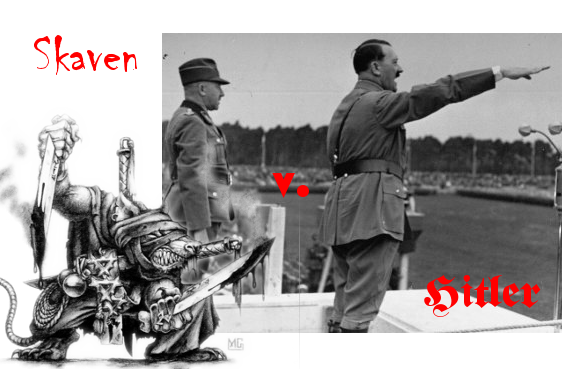
Skaven Versus Hitler

So I was doing really well at staying focused, revising, and not starting any new projects for, oh, at least two days, when a friend used the phrase "Skaven versus Hitler."

Dammit Joe.

Ratting Out

So in Skaven Versus Hitler, obviously, character represents both you and your pack of scrawny underlings. What is a skaven without a mob of worthless minions to sacrifice? Playing a skaven who isn't some kind of high-ranking schemer is no fun because you can be arbitrarily killed at any second and don't get to do anything.

Obviously, in this game, we will be playing the murderous Chaos-magic-wielding psychotic rat-monsters. Something strange has happened! The vast brazen Warpstone Sphere in which you planned to teleport into the heart of the Empire has emerged somewhere entirely different. Still, there are still miserable humans here, they seem pretty much the same, and if (as the Seers keep mumbling) this does turn out to be a completely different reality, think of how much glory you will reap by conquering the whole world in the name of the Horned Rat!

You begin with a stack of Skaven-appropriate skills. Pleasingly, most of these are equally appropriate to stereotypical occult Nazis. For simplicity’s sake, and because it felt flavourful, I have made these rather broader than the original skills list I based them on, which is broadly Dark Heresy. But first, Attributes.

  • Weapon Skill - for inflicting (or avoiding) stabby death.
  • Ballistic Skill - for killing things as far away from you as possible.
  • Strength - for heavy stuff
  • Toughness - for shrugging off injuries and resisting poisons
  • Agility - for getting a) out of the way or b) your stab in first
  • Intelligence - for working stuff out
  • Perception - for noticing stuff
  • Willpower - for restraining your craven impulses and primal nature
  • Fellowship Ego - because what kind of skaven has a rapport with their alleged fellows? It’s all about charisma and manipulation.

And some skills...

  • Beastmastery is used for identifying, controlling, riding and commanding animals.
  • Bioscience (Int) is everything vaguely biological or medical that isn’t unthinkable.
  • Browbeat (Ego) represents you ability to control the actions of others. This doesn't affect your own underlings (who are handled with Discipline) but can be used on both allies and enemies.
  • Connive (Int) is used to make deals with potential allies, such as persuading, bribing and bargaining.
  • Discipline (WP) is a crucial trait for panic-stricken rats, used for resisting fear or pulling off manoeuvres with your minions.
  • Disguise (Per) is self-evident.
  • Dodge (Ag) is self-evident.
  • Drive (Ag) is self-evident.
  • Forbidden Lore (Int) represents your knowledge of dark magics and mysteries. Whether it's identifying demons, using sinister artefacts or unleashing terrible magics, this covers it.
  • Hide and Seek (Per) covers concealment and detection of things other than yourself.
  • Human Lore (Int) is knowing stuff about humans.
  • Navigation (int) is self-evident.
  • Not Dying (T) is a highly useful skill, comprising not starving, not getting eaten, not drowning, not freezing to death and so on..
  • Paranoia (Per) represents your sensitivity to what is going on around you. This is a combination of what you see, hear and (being skaven) smell, plus the array of secondary senses, intuition about the actions of others and general sixth-sensing.
  • Physical Science (Int) is anything about physics, engineering and architecture.
  • Poisons (Int) deals with toxic substances, their use, and even their countermeasures. More broadly, it covers chemical stuff.
  • Rumour-Mongering (Ego) is finding out or creating rumours and gossip.
  • Skittering (Ag) represents leaping across, scrabbling up and ducking under things (Acrobatics, Climb and Contortionist).
  • Skullduggery (Ag) represents sneaking, lurking, spying, stealing and similar.
  • Stalking (Per) covers tracking or observing potential prey.
  • Tech-Use (Int) is used for any device that isn’t mad science.
  • Weird Science (Int) represents your understanding the truly bizarre theories and crackpot ideas that also turn out (in this game reality) to be broadly accurate. Operating warpstone weaponry falls under this skill.

There are also a few properties that don't fit well as skills.

  • Insanity represents your mental integrity, which is damaged by doing or enduring weird things, mostly occult.
  • Corruption represents your physical integrity, which degrades as a result of exposure to strange substances, use of Chaos magic, drugs and so on.
  • Warp represents your reserves of magical energy, and is used to cast spells or activate devices. It can be replenished with rest or, more hazardously, by consuming warpstone.
  • Minions is an abstract representation of how much cannon fodder you have protecting you. In another game, this would be Hit Points, but what kind of self-respecting skaven goes around risking physical injury? That's what slaves are for!
  • Fate can be invoked to change your luck, improving a die roll or surviving implausibly.

Minions!

A game about skaven and Nazis is clearly nothing without minions. Your minions should be important. Their most obvious feature is that they represent your hit points, because neither party here should be making heroic last stands on their own. When your minions are dead, you either surrender, die or flee.

Secondly, the type of minions you choose should affect your abilities. Cannon fodder are numerous (and so provide a lot of hit points) but are feeble. Shock troops are dangerous, but can't take many hits. Specialists can throw out special effects due to their weird weaponry, or provide skill boosts.

During the game, you'll give orders to your troops to achieve different effects, giving temporary boosts of various kinds. This doesn't mean you're left entirely alone (you're not stupid) but represents the main focus of the minions' attention. Of course, giving those orders will require the use of Discipline.

  • Kill Them All! The most common order, this has your troops joining your efforts in battle. This covers most kinds of combat, including stealthy killing, but also deals with things like breaking obstacles.
  • Aid Me! The minions rush to help their master, carrying them over obstacles or rearranging furniture at their instruction.
  • Get Me Out of Here! In a sticky situation, the logical solution is to sacrifice minions. You can reduce your minion magnitude in order to break from combat, escape a trap and so on.
  • Over There! You can use minions to create a distraction, interact with an object for you (in simple ways) and so on.
  • Hold The Line! Your minions fall close in to fend off danger, defending you.

Some types of minion you can expect to see (again, representing the chief strength of your minions rather than every single one):

  • Skavenslaves are feeble but numerous. Any skaven champion can easily purchase them in droves, gaining the maximum additional Wounds but no other benefits, and with poor discipline.
  • Stormvermin are tough, ferocious warriors and immensely loyal to their master. They provide an all-round boost.
  • Rat Ogres are hulking, hideous brutes, immensely tough and very stupid. They are also highly expensive.
  • Plague Monks are fanatical disciples of disease. They are tough, basically immune to chemical and biological weapons, and wreathed in a corrosive aura of disease that few mortals can withstand, making them lethal in melée.
  • Gutter Runners are stealthy assassins and expert scouts.
  • Warlock Engineers are crazed scientists, armed with motley experimental warpstone weapons.

Mechanics

Skaven Versus Hitler will use 2d6 rather than the usual d100 for Warhammer games, but retain the roll-under mechanic.

When you're using either Chaos Magic, Warpstone Weaponry or Weird Science, any roll of a double means something unexpected has happened. If the roll was otherwise a success, your efforts were Brilliantly Successful! If the roll was otherwise a failure, something has gone Horribly Wrong!

For our ratty "heroes", attributes begin at 4+1d3, and skills are based on your attributes. This isn't great! But you also have 30 points to distribute amongst your skills these as you wish. You will gain further bonuses from your Minions. A roll of 12 always fails, since dice should only be rolled when failure seems plausible.

Your aim is to roll equal to or under your skill. Bonuses and penalties apply as seems appropriate. For example, if you are attacking a bunch of unarmed civilians, you will have a large bonus. If you are trying to strike a pact with a group of sentries to open the gates in return for a sack of gold, you will have a penalty.

Your Warp and Minions begin at 10. Your Corruption and Insanity begin at 1, because nobody gets to be a ranking skaven warrior without going through some pretty weird stuff. You have 3 Fate Points.

  • Skavenslaves grant +20 Minions, +2 Paranoia and +2 Not Dying , but impose a -2 penalty to Discipline.
  • Stormvermin grant +10 Minions, +1 Weapon Skill, +1 Toughness, +2 Browbeat and +1 Discipline.
  • Rat Ogres grant +5 Minions, +1 Browbeat, +2 Strength and +3 Toughness. They suffer a -2 penalty to Discipline, except when ordered to Kill Them All!
  • Plague Monks grant +10 Minions, +1 Toughness and +1 Poisons. They halve damage from chemical or biological weapons, and are surrounded by a toxic fog that affects targets in melée.
  • Gutter Runners grant +10 Minions, +1 Paranoia, +1 Poisons, +2 Skullduggery, +1 Skittering and +1 Stalking.
  • Warlock Engineers grant +10 Minions, +1 Physical Science, +1 Bioscience, +2 Weird Science and +1 Forbidden Lore. Their weapons can pin, panic, ignite or poison enemy units.

Minions function like Wounds. You lose them by taking damage, but it's assumed that once the immediate battle is over, you may be able to recoup some of your losses by either slapping some shirkers around the chops, calling in reinforcements, performing horrific surgery on the wounded, or whatever.

Warp is burned like fuel to power spells and magical devices. You regain some when you rest, or by consuming warpstone, if you can get any. However, warpstone can increase your Corruption score due to its hideous mutating effects, and at the very least causes violent nosebleeds and mild hallucinations.

Tuesday, 30 September 2014

RPGaDay, day 30

Day 30: Rarest RPG Owned

I don't own any rare RPGs, only common ones and a load of PDFs (inherently not-rare). By that argument, the answer is either:

Hellcats and Hockeysticks, because the least common RPG must be the rarest; or

one of the ones I'm writing myself, because nobody else owns them. Technically this would be De Jure, the only one that I think is arguably complete, although it's more a hack than a game per se.

The Voyages of Dr Charvik: professional interest

Led astray and abandoned by my companions, I had found myself prisoner in a hateful frozen waste, awaiting an abrupt termination to my career at the hands of murderous authorities. Freed by the kindly intervention of a passing dragon, I had reluctantly fought my way free of the blazing ruins and followed a native guide to a nearby village in search of shelter, food, and more amenable company.

My guide Had Var led me into a dwelling and introduced me to the residents. These poor but generous folk welcomed me in with only a modicum of staring, and shared their meal with us. In truth, the cold had slowed my metabolism sufficiently that I had not yet digested my meal of, it emerged, two days earlier, when I was knocked unconscious and captured. More welcome was the roaring fire, where I warmed myself eagerly. Had Var was a little shy of the fire, presumably still shocked by the fiery destruction of his place of employment. I expressed due condolences, and offerd my hope that he would soon find fresh occupation with some more amenable employer. Looking around, I very much doubted that severance pay or unemployment benefits existed at all in this place.

Had Var assured me that he would cope, but was more preoccupied with a practical matter. The keep (a place called Hell End, I believe - how appropriate!) had been destroyed by a dragon, and someone ought to be informed. This had not, I confess, have been my first thought, but I realised as I considered the matter that there would undoubtedly be paperwork to complete, reports to write, and so on. Would I, perhaps, be willing to undertake a journey to the local jarl (some species of secretary) and pass on the news? He was naturally shy in asking me, considering how I had been treated. However, I was most willing. For one thing, though the house where we rested was warm and dry, I suspected that more salubrious quarters could be found elsewhere.

Moreover, the proposal showed once more the good sense he had always so far displayed. As the local man, he no doubt had all manner of responsibilities to perform, bodies to identify, salvage work to undertake, and so on and so forth. He was well-placed to take care of these matters. I, on the other hand, was a trustworthy, educated stranger with no immediate responsibilties in the area, and an obvious distaste for any further involvement with matters in Hell End. Nor could I possibly receive any censure for supposed dereliction of duty, always a risk for any underling delivering unwelcome news. Who bettter to carry a clear, reliable message to a town some distance away? It would, no doubt, also be an opportunity to receive apologies for my treatment, make appropriate arrangements for my return to civilisation, and perhaps even enjoy some more refined company.

Gathering a small bag of food in case of trouble, I strode outside. It was only an hour or so's walk to this town of White Run, and soon I would be on my way back to... actually, I could not quite recall the name of whatever benighted town had been our last port of call. Presumably, however, my baggage would still be there. Or at least, I could find a way to contact the traders I had been travelling with. That, at least, should not be difficult. One of them, I was almost certain, had been called Master Something. Another had a beard, and both of them wore dull-coloured limb-fitting garments much like those my recent host had sported. Was that not one of them across the street, perhaps looking for me? No, it would seem not. But that fellow over there had a beard! Ah, my mistake.

It appeared this might be a little more difficult than I had hoped. Still, first the brief stroll to White Run in the warm evening sun - the chill wind was less helpful, but I now had a warm cloak - and then all could be dealt with comfortably. I nodded politely to the guards as I wandered out of the town gate, turned a corner along the stream, and was immediately set upon by a pack of wolves.

With some difficulty, I extricated myself from the animals, with many benevolent thoughts towards my military tutors. It occurred to me that perhaps these animals were in some sense domesticated, living as they did so close to the town, and bent to check the bodies for brands or collars. Could it be simply that they had never before encountered one of our people? I found neither, but noted that the pelts were of a different subspecies to any encountered in our home shores. As such, I deemed it wise to remove them for later study. Comparative biology is not my primary field, but a scholar should always have an open mind and a wide range of interests. If they did not prove to be scientifically valuable, they might at least be of some use in keeping out the cold.

Finding the pelts a little inconvenient, I returned to the village and sought out a local trader. The family was apparently engaged in debate of some kind, and I politely waited for them to conclude. With some difficulty, I was able to converse in pidgin Human and persuade them to part with a few sacks in exchange for gold. I took the opportunity to also purchase some small jars and boxes to store the botanical specimens I had so far obtained. When the subject of the wolves was broached, with particular reference to their immediate proximity to this village, my interlocutor seemed rather offended than concerned. Perhaps wolves are a taboo of this proud people? Perhaps his civic pride was hurt at the implication that a traveller had been inconvenienced by their rather lax environmental management? I did not care to enquire further.

Observing me with interest - and one must assume that few of our people, and perhaps fewer educated folk, travel to this land - the male attempted some conversation that I struggled to follow. Luckily, his partner intervened. Apparently, something they described as a "golden claw" had gone missing, presumed stolen. I presumed this to be some species of local herb or fungus, prized for its medicinal properties, or perhaps a trinket; mildly interesting on a better occasion, but I could not immediately see why they wished to discuss it with me. However, at length I realised that they were discussing a relic that, if authentic, must undoubtedly be of genuine archaeological importance. A ten-inch golden object, with mobile joints, in the shape of a reptilian foot? You may be assured that this secured my attention.

The couple seemed to know where the purported thieves had taken their relic, and this made me wary. It is so easy for a visiting researcher to find themself involved in local matters and pressed to take sides. Was this truly a theft, or simply a case of disputed ownership? These cases are sadly common where historical artefacts are in question, and even in Blackmarsh it is not unknown for cases to proceed to the High Court itself. In this desolate place, where mere gold is prized so highly, there were undoubtedly other considerations in the case. My natural caution warred with my academic's inquisitiveness, and scholarship won the day.

The thieves, I was told, had travelled to a nearby ruin known as Bleak Fells, or Black Falls, or possibly Back Ferns, said to hold ancient crypts. This, I felt, disclosed the truth of the matter. Such a site would be an obvious draw for any scholar. It seemed to me that the most likely explanation was this: an archaeological expedition had travelled through the area and enquired in the village about relics, as is common practice, for many items are unearthed and kept for decades by laymen unaware of their true significance. The merchants had possessed this golden claw, and displayed it to their visitors. Perhaps they had agreed to a sale and later changed their mind, for often and often an owner will wilingly render up some item, only to later wonder whether they settled for too low a price, and have been cheated by the stranger with a greater knowledge of an item's value. However, let us be honest; it is by no means uncommon for underfunded researchers to resort to other means as necessary to secure a vital artefact.

In either case, my course was clear: I must immediately make contact with this expedition. As a scholar of architecture and associated matters, I had a natural interest in their work and was keen to learn more about it. Moreover, such a group was bound to have links to more civilised lands, and might be able to assist me in resuming my own journey. Perhaps I might even find one of my correspondents was present! In any case, I would take the opportunity to raise the question of this golden claw, and suggest that they carry out further negotiations with the previous owners. Such matters are, as readers will know all too well, of vital importance in maintaining the good reputation of scholars and their institutions. It is easy for one bad apple to impede future research by sabotaging relations with the local community, whose practical assistance and oral tradition is often so valuable to us.

Thus, I delayed my visit to the jarl a little, in order to pay a brief call to Black Fells. His, her or its paperwork would have to wait; I saw no particular urgency.

Black Fells turned out to be a large temple-like building high on a snowy mountain. Even at a distance, I was impressed that something of its age and primitive human craftsmanship had survived the centuries. While simple squares and walls may stand, it is unusual for complex and fragile arches to last in exposed positions, still less when subject to the gales and icy temperatures of this clime. All the more reason to study it.

I made a careful entrance, moving quietly and cautiously to minimise potential damage to the archaeological site or startling the workers. Inside, I found the pleasing glow of a warm fire crackling nearby, adjacent to a tunnel leading further into the complex. Two figures stood warming themselves at the fire, while I noticed the corpses of several large rodents scattered around the building.  Sadly, it seemed that the complex had not survived as well as I hoped; large sections of the roof had fallen in, weakening the structure and leaving it liable to sudden collapse. The urgency of the survey work was clear, and I could see that the team had wasted no time in delving deep into the subterranean section while it was still accessible.

I stepped forward and called a greeting to them, waving my axe to attract their attention in the flickering firelight. To my surprise, they shouted agressively and drew weapons. Presumably, they feared I was a bandit of some kind, come to try and raid their camp. To soothe their fears, I lowered my axe, gripping it near the blade with my spare hand to show I meant no harm, and bared my teeth. Now, to the lay reader this may seem a curious way to show friendship; but humans have a gesture called "smile", used extensively as a sign of humour or peace.* I had had plenty of recent opportunity to observe the phenomenon, and even discreetly practiced it in my private chambers. The lips are curled back, the jaws slightly parted, the cheek muscles tightened, and often a sharp exhalation follows.

* Ziltrach and Hbiss, in their Comprehensive Introduction to Human Gesture, write extensively on this gesture and its subtle cultural and social connocations. Hbiss argues convincingly that it derives from a gesture of mercy to a physically weaker person, indicating that although fully capable of doing so, the smiler has made a moral decision to refrain from eating them. Ziltrach offers several interesting counter-hypotheses, including the argument from social advantage; that is so say, displaying a full set of teeth as an indicator of fitness, marking the smiler as a capable and valuable individual whose friendship is likely to be beneficial.

Despite my efforts, the humans remained alarmed, and one loosed an arrow at me while the other circled round. Unable to retreat through the door, I was forced to defend myself. Searching the bodies, I came to the conclusion that these could not possibly be academics. Most likely, then, they were guards or porters hired by the expedition leaders. It was most unfortunate that I had been obliged to kill them, but seeing my own extensive injuries I could not wholly sympathise. Thankfully, a schooling in basic healing magic allowed me to repair the worst of the damage.

At this stage I should, perhaps, have left a polite explanatory note and withdrawn. However, I was enchanted by the historic site, and felt a strong urge to follow the footprints leading deeper within. Perhaps, too, I would be able to speak with the expedition leader and make my apologies in person - surely any guards found within would be more sensible. In fact, a rational person would likely conclude that, since I was present in the inner chambers, I must have been allowed passage by the guards, since it was statistically improbable that a single and (I might add) physically unimposing stranger could have overcome them by force. Thus, I saw no reason for concern, and began my descent.

The catacombs were not splendid, but of respectable artistry and containing many ceramics that had survived the years. Sadly, large roots had broken through the roofs and walls in many places, shattering stone and blocking passageways. I doubted that funding would ever be available to fully excavate the ruins. There were sporadic signs of habitation - a brazier here, a footprint there - but I saw no-one. The tunnels grew increasingly thick with cobwebs, some of them both large and recent, and at last I came to a heavily-webbed chamber from whence a faint noise issued. Presuming this to be my fellow-scholar, I pushed through the fresh webs, announcing slowly and clearly that I was a friend, for I had no wish to meet with further violence.

Such a scene met my eyes. The room was a high and once ornate chamber, but now every inch was covered in layer upon layer of spiderweb. The bound corpses of rodents, and of humans, littered the floor. Against the far wall, I saw a faint struggling motion, and I realised at once that the archaeologist must have been seized and imprisoned here. But where was the culprit?

As it happened, the culprit was at that moment directly overhead and descending with great speed. It was only the faint clattering of cuticle against carapace that alerted me, and I sprang aside in mounting horror as the thing dropped. Its mandibles chattered, its myriad eyes glared balefully, and it approached with obvious predatory intent. Naturally, I turned tail and sprinted from the room at full pelt.

Having rounded the corner, I soon recollected that the entrance had been very narrow, and surmised correctly that the spider could not possibly have pursued me. My course of action was clear. I must free the unfortunate who had been captured, before their organs were rendered into a soupy broth by digestive enzymes; and, incidentally, take samples from this remarkable arachnid. It proved a straightforward matter to bring the creature down with repeated bowshots, though its intriguing habit of expelling globules of some neurotoxin was something of an impediment. Having no sample phials, I was obliged to collect some of the subtance in a small pot and seal it with wax. Thankfully, there were many candles nearby. Having secured my specimens, I took brief sketches of the web architecture and certain anatomical features, since it seemed improbable that I could convey the creature's corpse to any really competent taxidermist. I also secured some unhatched eggs from amongst the webbing, taking care to close and label these jars.

Having dealt with the urgent matters, I began to saw through the webbing around the latest victim, who had been shouting in a rather distracting manner for some time. Once his mouth (for it was a male) was free, and taking care not to loose any limbs in case of violent reactions, I introduced myself and enquired as to whether he was the gentleman studying the golden claw. He eagerly confirmed this; I could not quite make out his words due to his extreme zeal, but he clearly stated that he understood its secrets and would show them to me. This I took to be a sign of coherence, for he had apparently grasped that I was a fellow-scholar with whom he could talk sensibly.

My analysis proved to be a little inaccurate, for no sooner had I finished unbinding him than he sprang deeper into the tunnel, calling out in his enthusiasm. I deduced that some chemical action of the spider's venom had affected his mind, for he was clearly heedless of danger. Concerned that further spiders might be present, I followed at pace but a little more cautiously, and we entered a long burial chamber lined with decomposed bodies. Passing by, my keen eyes noted the once-fine burial cloths, obviously human bone structures, and extensive grave goods.

To my astonishment, my companion's progress was suddenly interrupted by some of the dead lurching upright and striking at him with rusting weapons.

Before I could intervene, he was struck down. It was all I could do to fend off my own attackers. Even now, I have not yet forgiven myself for this carelessness. Now and again, the scene will rise again to my eyes, and I wonder whether there was not something I could have done differently. If I had only been a little faster - been more hesitant to release him - performed a simple phlebotomy and sanguinochemical distillation - this fearless scholar might have lived to finish his work.

Having destroyed the creatures, I went to my companion's aid. Satisfied by the gaping wounds in his chest, cranium and neck, and the total absence of heartbeat or breath, that he was beyond my help, I carefully emptied his pockets. My hope was that the man carried some form of identification, along the lines of a personal seal, that would enable me to identify him and report his death; perhaps also return any notes to his department. Alas, there was none. Moreover, I found no documentation whatsoever, despite a thorough search of both corpse and the upper chambers. I was forced to conclude that whatever observations he had made, they were purely cerebral, or hidden so well that I could not discover them. Only the claw remained. It was exactly as it had been described: remarkable workmanship for its age, if rather crude. Geometric spirals decorate the digits, while the palm is inscribed with three stylised animals.**

For further particulars, consult Antique Dragon Claws of the Skyrim Region, Charvik U., AQ342, Press of the Eight Winds. The items can be inspected at the Academy by special arrangement.

I quickly realised what my companion must have always known: the claw was intimately associated with this monument. Unable to resist the temptation to venture a little deeper, I was forced to dispatch a number of animated skeletons - truly an uncomfortable phenomenon of this region, and one of which future travellers would do well to beware.

The tunnels proved of considerable interest, and I spent more time than I initially realised in taking down my observations by the light of the many convenient braziers, presumably imbued with some illuminatory enchantment. I even discovered simple mechanisms built into this tomb by the ancient architects - a very impressive demonstration of early engineering. In several places I was obliged to rotate symbols to reflect the symbology of the chambers - hardly an effective security measure, but nevertheless a feat of engineering. Similarly, the claw proved to be a key to a very fine bronze-worked door; displaying the same short-sighted cunning, the door contained a symbol lock whose combination was inscribed upon the key itself, without which an intruder could not in any case proceed further.

Eventually, I realised the hour was becoming late and was forced to leave, since I did not wish to spend the night in an inhospitable place. Rather than make the long trek round, I crested the mountain and found myself descending into a valley where a huge fire was blazing. Naturally, I made it my destination.

I quickly discovered the reason for the size of the fire: it had been constructed by a pair of vast humanoids. These, clearly, were the giants of which I had read so many papers. Though the creatures did not seem overtly hostile, I was well aware of the peril these simple brutes can present to a traveller, and effaced myself quickly - very, very quickly, in fact. Seeing faint smoke on the darkening sky, I continued northward towards what I correctly identified as my destination of White Run.

But first, I simply must investigate the intriguing half-ruined buildings that littered the valley floor. The jarl's paperwork would have to wait.

Monday, 29 September 2014

RPGaDay, day 29

Day 29: Most memorable encounter

For all the wrong reasons, this would be the Deathwatch game where we didn't have any armour or equipment, so ran around bouncing daggers ineffectually off a Tyrannosaurus rex until our Librarian managed to microwave it to death.

Hell 4 Leather, part 5

A Role-Playing Game of Bloody Revenge on Devil's Night

Post-Game Discussion

In this episode, we discuss our playthrough of game of Hell 4 Leather, a Tarot-based game of vengeful murderous undead bikers. There are no spoilers here, so listen away as you please.

As always, be aware that the podcast is not really family-friendly, if that sort of thing bothers you.

Episode 5

The Episode

It's interesting listening back to this and hearing us all say basically we wouldn't bother playing it again, because right now it's kind of tempting. I know it sounded silly earlier, but I genuinely quite like the idea of doing a version based around a band of Speed Freeks whose dying outcast is saved by Mad Dok Snikbatz, to the point that I'd added it to my Games Wishlist sticky. Dan's suggestion of one themed around an adventuring party is also very appealing. This makes me wonder whether putting out a supplementary PDF of hacks for H4L might add a lot to the value; it's hard to say, though, because maybe with experiment I'd decide that the mechanics aren't satisfying enough to play multiple times anyway.

Despite what we say, I actually suspect you could mash together the Fiasco reality-building rules with the Hell 4 Leather scene-building rules to get something playable. I don't have either ruleset, so I can't try it. The point is that the Fiasco mechanics are basically roleplaying prompts, so all you'd be doing is helping players flesh out more usable characters for H4L.


Copyright and suchlike

Hell 4 Leather is copyright and/or trademark Price of Darkness Games. The podcast theme music is Vltava from Smetana's Má Vlast as taken from Wikimedia Commons under the CC0 licence. The episode intro is Hell Bent for Leather by Judas Priest. The outro is Bat out of Hell by Meat Loaf.

Sunday, 28 September 2014

RPGaDay, day 28

Day 28: Scariest Game you’ve played

I don't think I've played any scary games. A few have had individually tense moments, either because we knew an enemy was somewhere but hadn't found it, or because a combat was going badly. Arthur's AD&D games have had some quite tense, creepy sections involving strange ancient magics, usually coupled with the threat of enemies skulking somewhere nearby.

Apparently some of my games have featured very creepy sections, but then I tend to run either Call of Cthulhu or D&D games with lots of undead, both of which demand a lot of describing creepy things. I have a tic of describing completely harmless things in dire tones and being blandly innocent about dangerous things; I need to watch out for that.

Vessel: the Demon: the Fallen ripoff verbing

So, I said this:

It does strike me that Demon might serve as an interesting template for variations on the same theme, of spirits in mortal bodies. You could semi-easily do something more generic by assuming a kind of animist setting, and allowing characters to host animal, plant, rock, river, sky and so on spirits. This would immediately tackle the issue that most of the demonic powers aren't very demonic. Some of the others could be discarded, or turned into generic Lores accessible to anyone - although personally I'd want to drop or pare-and-merge some of them for being either incoherent or rubbish. Again, that seems like it would fit well with the idea of Generic Supernatural Power that spirits might be able to bestow on top of their specific spheres of power.

Money, meet mouth.